

J-3 Gauss surface normal coordinates: case study triaxial ellipsoid 655
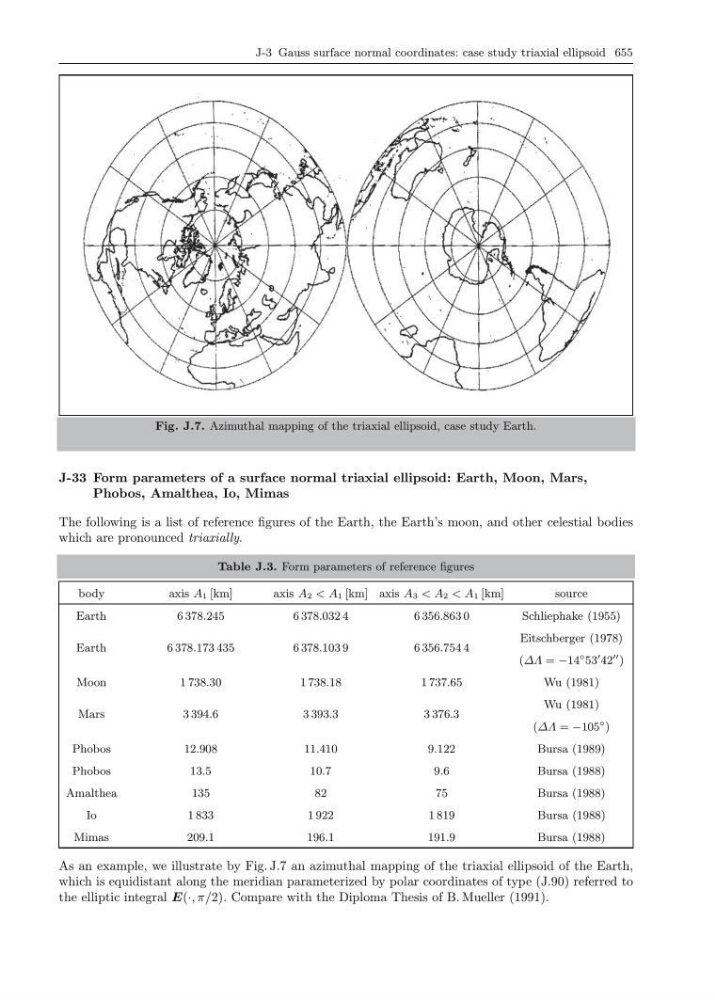
Fig. J.7. Azimuthal mapping of the triaxial ellipsoid, case study Earth.
J-33 Form parameters of a surface normal triaxial ellipsoid: Earth, Moon, Mars,
Phobos, Amalthea, Io, Mimas
The following is a list of reference figures of the Earth, the Earth’s moon, and other celestial bodies
which are pronounced triaxially.
Table J.3. Form parameters of reference figures
body
axis A 1 [km]
axis A 2 < A 1 [km] axis A 3 < A 2 < A 1 [km]
source
Earth
6 378.245
6 378.032 4
6 356.863 0
Schliephake (1955)
Earth
6 378.173 435
6 378.103 9
6 356.754 4
Eitschberger (1978)
(∆Λ = −14
◦ 53
42
)
Moon
1 738.30
1 738.18
1 737.65
Wu (1981)
Mars
3 394.6
3 393.3
3 376.3
Wu (1981)
(∆Λ = −105
◦ )
Phobos
12.908
11.410
9.122
Bursa (1989)
Phobos
13.5
1 0 .7
9 .6
Bursa (1988)
Amalthea
135
82
75
Bursa (1988)
Io
1 833
1 922
1 819
Bursa (1988)
Mimas
209.1
196.1
191.9
Bursa (1988)
As an example, we illustrate by Fig. J.7 an azimuthal mapping of the triaxial ellipsoid of the Earth,
which is equidistant along the meridian parameterized by polar coordinates of type (J.90) referred to
the elliptic integral E(·, π/2). Compare with the Diploma Thesis of B. Mueller (1991).