

J-3 Gauss surface normal coordinates: case study triaxial ellipsoid 653
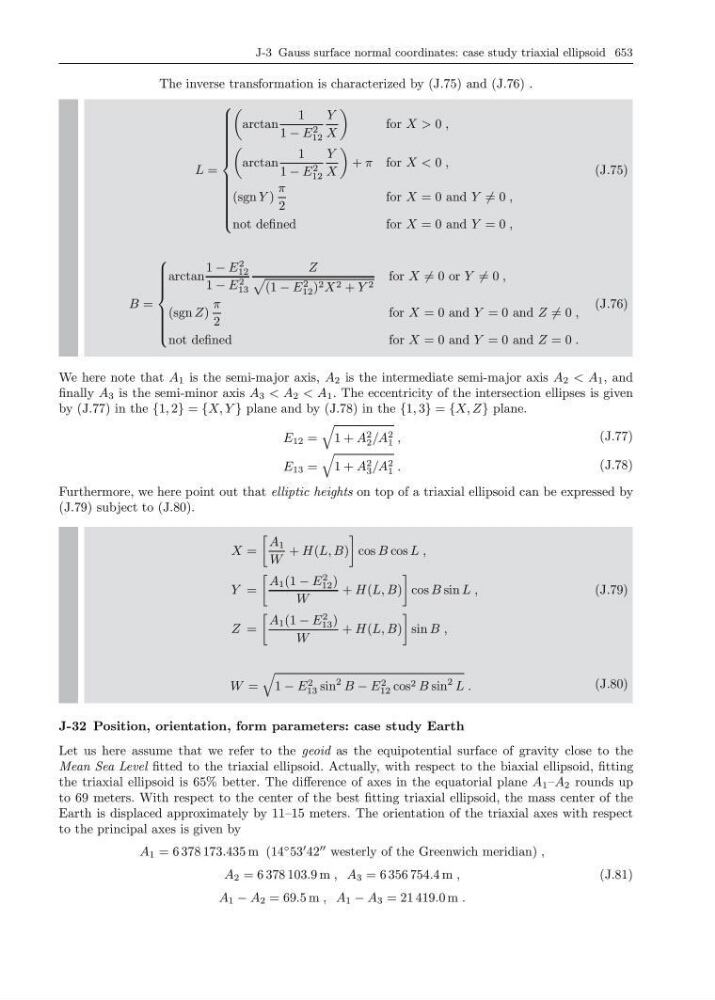
The inverse transformation is characterized by (J.75) and (J.76) .
L =
⎧
⎪ ⎪ ⎪ ⎪ ⎪ ⎪ ⎪ ⎪ ⎪ ⎪ ⎨
⎪ ⎪ ⎪ ⎪ ⎪ ⎪ ⎪ ⎪ ⎪ ⎪ ⎩
arctan
1
1 − E 2
12
Y
X
for X > 0 ,
arctan
1
1 − E 2
12
Y
X
+ π for X < 0 ,
(sgn Y )
π
2
for X = 0 and Y = 0 ,
not defined
for X = 0 and Y = 0 ,
(J.75)
B =
⎧
⎪ ⎪ ⎪ ⎪ ⎪ ⎨
⎪ ⎪ ⎪ ⎪ ⎪ ⎩
arctan
1 − E
2
12
1 − E 2
13
Z
(1 − E 2
12 ) 2 X 2 + Y 2
for X = 0 or Y = 0 ,
(sgn Z)
π
2
for X = 0 and Y = 0 and Z = 0 ,
not defined
for X = 0 and Y = 0 and Z = 0 .
(J.76)
We here note that A 1 is the semi-major axis, A 2 is the intermediate semi-major axis A 2 < A 1 , and
finally A 3 is the semi-minor axis A 3 < A 2 < A 1 . The eccentricity of the intersection ellipses is given
by (J.77) in the {1, 2} = {X, Y } plane and by (J.78) in the {1, 3} = {X, Z} plane.
E 12 =
1 + A 2
2 /A 2
1 ,
(J.77)
E 13 =
1 + A 2
3 /A 2
1 .
(J.78)
Furthermore, we here point out that elliptic heights on top of a triaxial ellipsoid can be expressed by
(J.79) subject to (J.80).
X =
A 1
W
+ H(L, B)
cos B cos L ,
Y =
A 1 (1 − E
2
12 )
W
+ H(L, B)
cos B sin L ,
Z =
A 1 (1 − E
2
13 )
W
+ H(L, B)
sin B ,
(J.79)
W =
1 − E 2
13 sin
2 B − E 2
12 cos 2 B sin
2 L .
(J.80)
J-32 Position, orientation, form parameters: case study Earth
Let us here assume that we refer to the geoid as the equipotential surface of gravity close to the
Mean Sea Level fitted to the triaxial ellipsoid. Actually, with respect to the biaxial ellipsoid, fitting
the triaxial ellipsoid is 65% better. The difference of axes in the equatorial plane A 1 –A 2 rounds up
to 69 meters. With respect to the center of the best fitting triaxial ellipsoid, the mass center of the
Earth is displaced approximately by 11–15 meters. The orientation of the triaxial axes with respect
to the principal axes is given by
A 1 = 6 378 173.435 m (14
◦ 53
42
westerly of the Greenwich meridian) ,
A 2 = 6 378 103.9 m , A 3 = 6 356 754.4 m ,
A 1 − A 2 = 69.5 m , A 1 − A 3 = 21 419.0 m .
(J.81)