

644 J Gauss surface normal coordinates in geometry and gravity space
J-21 Review of surface normal coordinates for the ellipsoid-of-revolution
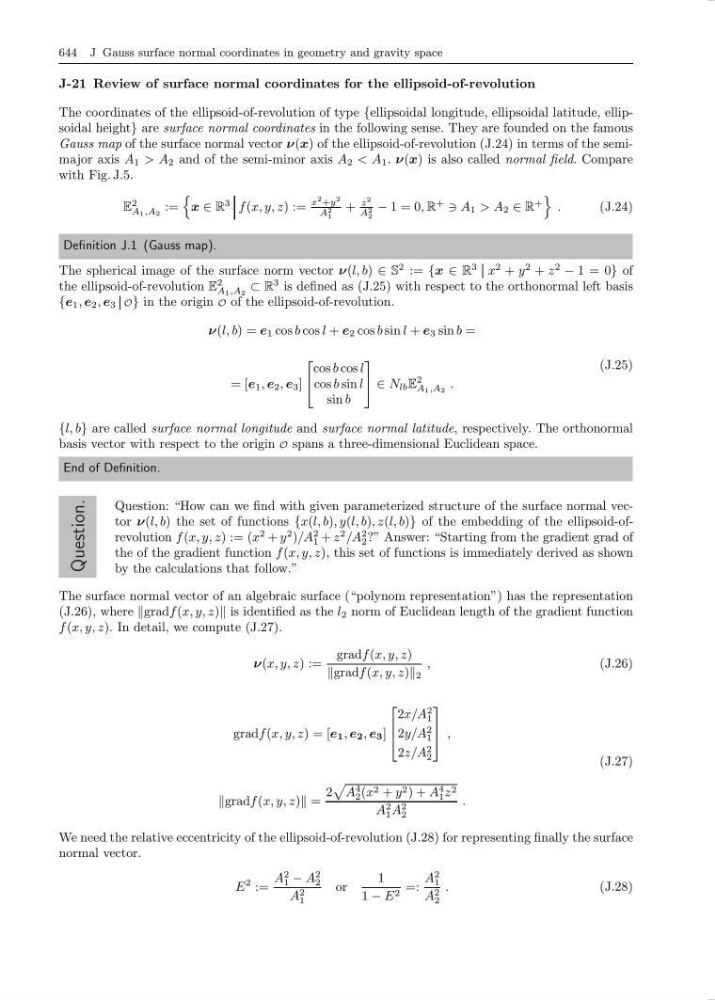
The coordinates of the ellipsoid-of-revolution of type {ellipsoidal longitude, ellipsoidal latitude, ellipsoidal height} are surface normal coordinates in the following sense. They are founded on the famous
Gauss map of the surface normal vector ν(x) of the ellipsoid-of-revolution (J.24) in terms of the semimajor axis A 1 > A 2 and of the semi-minor axis A 2 < A 1 . ν(x) is also called normal field. Compare
with Fig. J.5.
E
2
A 1 ,A 2
:=
x ∈ R
3 f (x, y, z) :=
x
2 +y
2
A 2
1
+
z
2
A 2
2
− 1 = 0, R
+
A 1 > A 2 ∈ R
+
.
(J.24)
Definition J.1 (Gauss map).
The spherical image of the surface norm vector ν(l, b) ∈ S
2 := {x ∈ R
3 x
2 + y
2 + z
2
− 1 = 0} of
the ellipsoid-of-revolution E
2
A 1 ,A 2
⊂ R
3 is defined as (J.25) with respect to the orthonormal left basis
{e 1 , e 2 , e 3 O} in the origin O of the ellipsoid-of-revolution.
ν(l, b) = e 1 cos b cos l + e 2 cos b sin l + e 3 sin b =
= [e 1 , e 2 , e 3 ]
⎡
⎣
cos b cos l
cos b sin l
sin b
⎤
⎦ ∈ N lb E
2
A 1 ,A 2 .
(J.25)
{l, b} are called surface normal longitude and surface normal latitude, respectively. The orthonormal
basis vector with respect to the origin O spans a three-dimensional Euclidean space.
End of Definition.
Question.
Question: “How can we find with given parameterized structure of the surface normal vector ν(l, b) the set of functions {x(l, b), y(l, b), z(l, b)} of the embedding of the ellipsoid-ofrevolution f (x, y, z) := (x
2 + y
2 )/A
2
1 + z
2 /A
2
2 ?” Answer: “Starting from the gradient grad of
the of the gradient function f (x, y, z), this set of functions is immediately derived as shown
by the calculations that follow.”
The surface normal vector of an algebraic surface (“polynom representation”) has the representation
(J.26), where gradf (x, y, z) is identified as the l 2 norm of Euclidean length of the gradient function
f (x, y, z). In detail, we compute (J.27).
ν(x, y, z) :=
gradf (x, y, z)
gradf (x, y, z) 2
,
(J.26)
gradf (x, y, z) = [e 1 , e 2 , e 3 ]
⎡
⎢
⎣
2x/A
2
1
2y/A
2
1
2z/A
2
2
⎤
⎥
⎦ ,
gradf (x, y, z) =
2
A 4
2 (x 2 + y 2 ) + A 4
1 z 2
A 2
1 A 2
2
.
(J.27)
We need the relative eccentricity of the ellipsoid-of-revolution (J.28) for representing finally the surface
normal vector.
E
2 :=
A
2
1 − A
2
2
A 2
1
or
1
1 − E 2 =:
A
2
1
A 2
2
.
(J.28)