

J-2 Gauss surface normal coordinates: case study ellipsoid-of-revolution 643
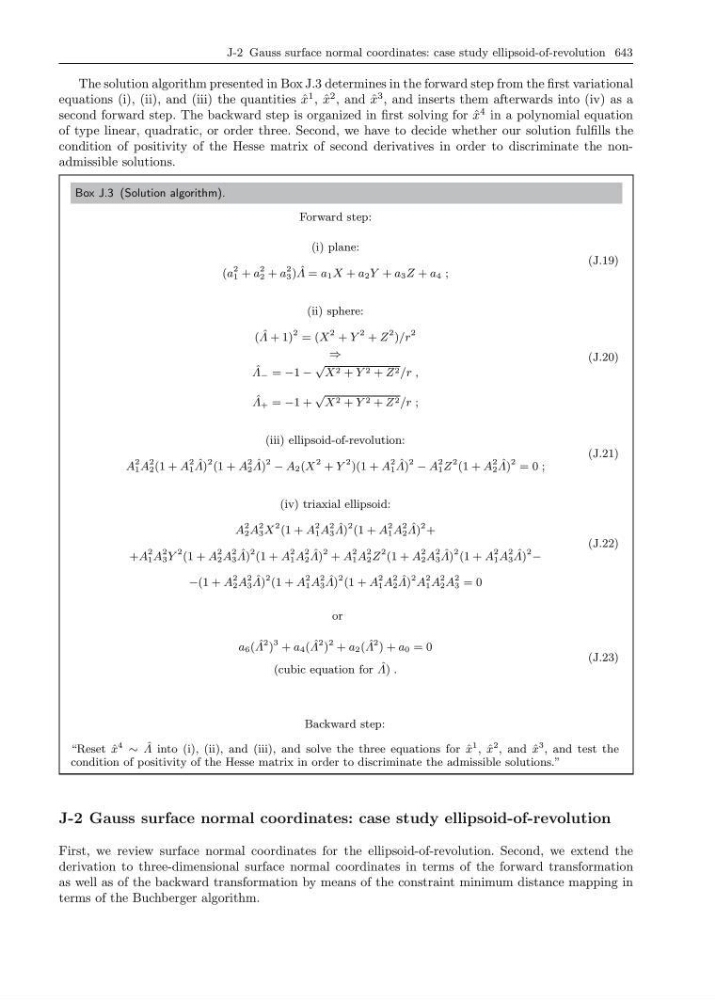
The solution algorithm presented in Box J.3 determines in the forward step from the first variational
equations (i), (ii), and (iii) the quantities ˆ
x
1 , ˆ
x
2 , and ˆ
x
3 , and inserts them afterwards into (iv) as a
second forward step. The backward step is organized in first solving for ˆ
x
4 in a polynomial equation
of type linear, quadratic, or order three. Second, we have to decide whether our solution fulfills the
condition of positivity of the Hesse matrix of second derivatives in order to discriminate the nonadmissible solutions.
Box J.3 (Solution algorithm).
Forward step:
(i) plane:
(a
2
1 + a
2
2 + a
2
3 ) ˆ
Λ = a 1 X + a 2 Y + a 3 Z + a 4 ;
(J.19)
(ii) sphere:
( ˆ
Λ + 1)
2 = (X
2 + Y
2 + Z
2 )/r
2
⇒
ˆ
Λ − = −1 −
√
X 2 + Y 2 + Z 2 /r ,
ˆ
Λ + = −1 +
√
X 2 + Y 2 + Z 2 /r ;
(J.20)
(iii) ellipsoid-of-revolution:
A
2
1 A
2
2 (1 + A
2
1
ˆ
Λ)
2 (1 + A
2
2
ˆ
Λ)
2 − A 2 (X
2 + Y
2 )(1 + A
2
1
ˆ
Λ)
2 − A
2
1 Z
2 (1 + A
2
2
ˆ
Λ)
2 = 0 ;
(J.21)
(iv) triaxial ellipsoid:
A
2
2 A
2
3 X
2 (1 + A
2
1 A
2
3
ˆ
Λ)
2 (1 + A
2
1 A
2
2
ˆ
Λ)
2 +
+A
2
1 A
2
3 Y
2 (1 + A
2
2 A
2
3
ˆ
Λ)
2 (1 + A
2
1 A
2
2
ˆ
Λ)
2 + A
2
1 A
2
2 Z
2 (1 + A
2
2 A
2
3
ˆ
Λ)
2 (1 + A
2
1 A
2
3
ˆ
Λ)
2 −
−(1 + A
2
2 A
2
3
ˆ
Λ)
2 (1 + A
2
1 A
2
3
ˆ
Λ)
2 (1 + A
2
1 A
2
2
ˆ
Λ)
2 A
2
1 A
2
2 A
2
3 = 0
(J.22)
or
a 6 ( ˆ
Λ
2 )
3 + a 4 ( ˆ
Λ
2 )
2 + a 2 ( ˆ
Λ
2 ) + a 0 = 0
(cubic equation for ˆ
Λ) .
(J.23)
Backward step:
“Reset ˆ
x
4 ∼ ˆ
Λ into (i), (ii), and (iii), and solve the three equations for ˆ
x
1 , ˆ
x
2 , and ˆ
x
3 , and test the
condition of positivity of the Hesse matrix in order to discriminate the admissible solutions.”
J-2 Gauss surface normal coordinates: case study ellipsoid-of-revolution
First, we review surface normal coordinates for the ellipsoid-of-revolution. Second, we extend the
derivation to three-dimensional surface normal coordinates in terms of the forward transformation
as well as of the backward transformation by means of the constraint minimum distance mapping in
terms of the Buchberger algorithm.