

H-1 The transverse equiareal projection of the biaxial ellipsoid 605
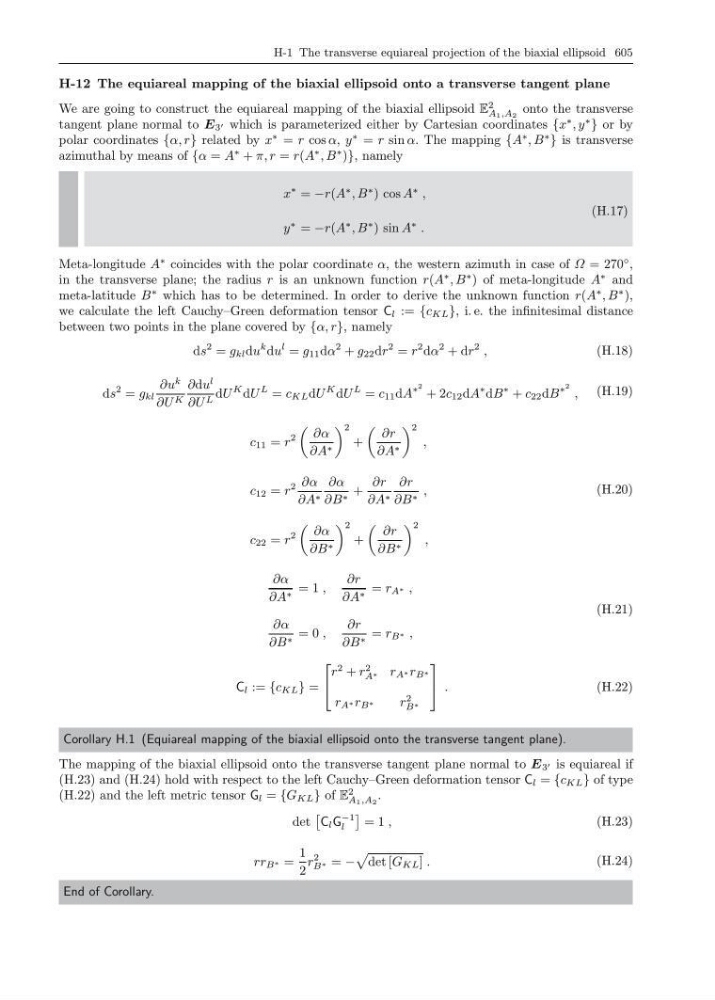
H-12 The equiareal mapping of the biaxial ellipsoid onto a transverse tangent plane
We are going to construct the equiareal mapping of the biaxial ellipsoid E
2
A 1 ,A 2
onto the transverse
tangent plane normal to E 3 which is parameterized either by Cartesian coordinates {x
∗ , y
∗
} or by
polar coordinates {α, r} related by x
∗ = r cos α, y
∗ = r sin α. The mapping {A
∗ , B
∗
} is transverse
azimuthal by means of {α = A
∗ + π, r = r(A
∗ , B
∗ )}, namely
x
∗ = −r(A
∗ , B
∗ ) cos A
∗ ,
y
∗ = −r(A
∗ , B
∗ ) sin A
∗ .
(H.17)
Meta-longitude A
∗ coincides with the polar coordinate α, the western azimuth in case of Ω = 270
◦ ,
in the transverse plane; the radius r is an unknown function r(A
∗ , B
∗ ) of meta-longitude A
∗ and
meta-latitude B
∗ which has to be determined. In order to derive the unknown function r(A
∗ , B
∗ ),
we calculate the left Cauchy–Green deformation tensor C l := {c KL }, i. e. the infinitesimal distance
between two points in the plane covered by {α, r}, namely
ds
2 = g kl du
k du
l = g 11 dα
2 + g 22 dr
2 = r
2 dα
2 + dr
2 ,
(H.18)
ds
2 = g kl
∂u
k
∂U K
∂du
l
∂U L dU
K dU
L = c KL dU
K dU
L = c 11 dA
∗
2 + 2c 12 dA
∗ dB
∗ + c 22 dB
∗
2 , (H.19)
c 11 = r
2
∂α
∂A ∗
2
+
∂r
∂A ∗
2
,
c 12 = r
2 ∂α
∂A ∗
∂α
∂B ∗ +
∂r
∂A ∗
∂r
∂B ∗ ,
c 22 = r
2
∂α
∂B ∗
2
+
∂r
∂B ∗
2
,
(H.20)
∂α
∂A ∗ = 1 ,
∂r
∂A ∗ = r A ∗ ,
∂α
∂B ∗ = 0 ,
∂r
∂B ∗ = r B ∗ ,
(H.21)
C l := {c KL } =
⎡
⎣
r
2 + r
2
A ∗ r A ∗ r B ∗
r A ∗ r B ∗
r
2
B ∗
⎤
⎦ .
(H.22)
Corollary H.1 (Equiareal mapping of the biaxial ellipsoid onto the transverse tangent plane).
The mapping of the biaxial ellipsoid onto the transverse tangent plane normal to E 3 is equiareal if
(H.23) and (H.24) hold with respect to the left Cauchy–Green deformation tensor C l = {c KL } of type
(H.22) and the left metric tensor G l = {G KL } of E
2
A 1 ,A 2
.
det
C l G
−1
l
= 1 ,
(H.23)
rr B ∗ =
1
2
r
2
B ∗ = −
det [G KL ] .
(H.24)
End of Corollary.