

604 H Generalized Hammer projection
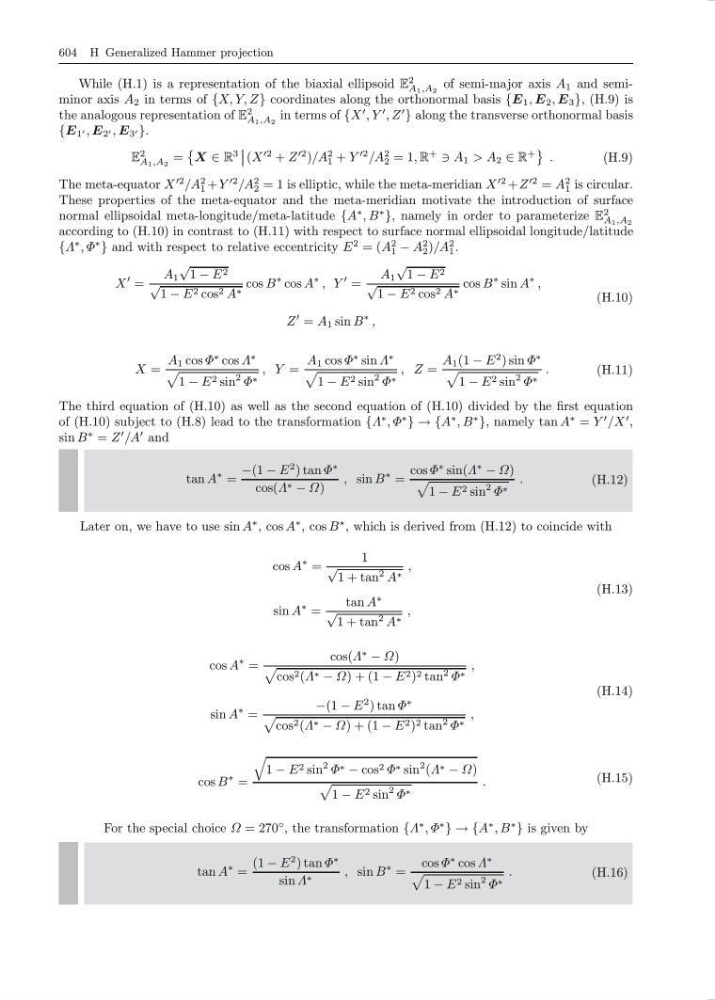
While (H.1) is a representation of the biaxial ellipsoid E
2
A 1 ,A 2
of semi-major axis A 1 and semiminor axis A 2 in terms of {X, Y, Z} coordinates along the orthonormal basis {E 1 , E 2 , E 3 }, (H.9) is
the analogous representation of E
2
A 1 ,A 2
in terms of {X
, Y
, Z
} along the transverse orthonormal basis
{E 1 , E 2 , E 3 }.
E
2
A 1 ,A 2
=
X ∈ R
3 (X
2 + Z
2 )/A
2
1 + Y
2 /A
2
2 = 1, R
+
A 1 > A 2 ∈ R
+
.
(H.9)
The meta-equator X
2 /A
2
1 + Y
2 /A
2
2 = 1 is elliptic, while the meta-meridian X
2 + Z
2 = A
2
1 is circular.
These properties of the meta-equator and the meta-meridian motivate the introduction of surface
normal ellipsoidal meta-longitude/meta-latitude {A
∗ , B
∗
}, namely in order to parameterize E
2
A 1 ,A 2
according to (H.10) in contrast to (H.11) with respect to surface normal ellipsoidal longitude/latitude
{Λ
∗ , Φ
∗
} and with respect to relative eccentricity E
2 = (A
2
1 − A
2
2 )/A
2
1 .
X
=
A 1
√
1 − E 2
√
1 − E 2 cos 2 A ∗
cos B
∗ cos A
∗ , Y
=
A 1
√
1 − E 2
√
1 − E 2 cos 2 A ∗
cos B
∗ sin A
∗ ,
Z
= A 1 sin B
∗ ,
(H.10)
X =
A 1 cos Φ
∗ cos Λ
∗
1 − E 2 sin
2 Φ ∗
, Y =
A 1 cos Φ
∗ sin Λ
∗
1 − E 2 sin
2 Φ ∗
, Z =
A 1 (1 − E
2 ) sin Φ
∗
1 − E 2 sin
2 Φ ∗
.
(H.11)
The third equation of (H.10) as well as the second equation of (H.10) divided by the first equation
of (H.10) subject to (H.8) lead to the transformation {Λ
∗ , Φ
∗
} → {A
∗ , B
∗
}, namely tan A
∗ = Y
/X
,
sin B
∗ = Z
/A
and
tan A
∗ =
−(1 − E
2 ) tan Φ
∗
cos(Λ ∗ − Ω)
, sin B
∗ =
cos Φ
∗ sin(Λ
∗
− Ω)
1 − E 2 sin
2 Φ ∗
.
(H.12)
Later on, we have to use sin A
∗ , cos A
∗ , cos B
∗ , which is derived from (H.12) to coincide with
cos A
∗ =
1
√
1 + tan
2 A ∗
,
sin A
∗ =
tan A
∗
√
1 + tan
2 A ∗
,
(H.13)
cos A
∗ =
cos(Λ
∗
− Ω)
cos 2 (Λ ∗ − Ω) + (1 − E 2 ) 2 tan
2 Φ ∗
,
sin A
∗ =
−(1 − E
2 ) tan Φ
∗
cos 2 (Λ ∗ − Ω) + (1 − E 2 ) 2 tan
2 Φ ∗
,
(H.14)
cos B
∗ =
1 − E 2 sin
2 Φ ∗ − cos 2 Φ ∗ sin
2 (Λ ∗ − Ω)
1 − E 2 sin
2 Φ ∗
.
(H.15)
For the special choice Ω = 270
◦ , the transformation {Λ
∗ , Φ
∗
} → {A
∗ , B
∗
} is given by
tan A
∗ =
(1 − E
2 ) tan Φ
∗
sin Λ ∗
, sin B
∗ =
cos Φ
∗ cos Λ
∗
1 − E 2 sin
2 Φ ∗
.
(H.16)