

H-1 The transverse equiareal projection of the biaxial ellipsoid 603
The rotation around the 3 axis, we have denoted by Ω, the right ascension of the ascending node,
while the rotation around the intermediate 1 axis by I, the inclination. R 1 and R 3 , respectively, are
orthonormal matrices such that (H.3) holds.
R 1 (I)R 3 (Ω) =
⎡
⎣
cos Ω
sin Ω
0
− sin Ω cos I + cos Ω cos I sin I
+ sin Ω sin I − cos Ω sin I cos I
⎤
⎦ ∈ R
3×3 .
(H.3)
A ccordingly, (H.4) is a representation of the placement vector X in the orthonormal bases {E 1 , E 2 , E 3 }
and {E 1 , E 2 , E 3 }, respectively. We aim at a transverse orientation of the oblique frame of reference
{E 1 , E 2 , E 3 ;0 }, which is characterized by a base vector E 3 in the equatorial plane P
2 (X, Y ) and the
base vectors {E 1 , E 2 } in the rotated plane P
2 (−Y, −Z). S
uch an orientation of the transverse frame
of reference {E 1 , E 2 , E 3 ;0 } is achieved choosing the inclination I = 270
◦ (cos I = 0, sin I = −1),
for instance, namely (H.5) or (H.6).
X =
3
i=1
E i X
i =
3
i =1
E i X
i
,
(H.4)
E 1 = E 1 cos Ω + E 2 sin Ω , E 2 = −E 3 , E 3 = −E 1 sin Ω + E 2 cos Ω ,
(H.5)
X
= X cos Ω + Y sin Ω , Y
= −Z , Z
= −X sin Ω + Y cos Ω .
(H.6)
Example H.1 (An example: Ω = 270
◦ (cos Ω = 0, sin Ω = −1)).
A s an example, let us choose Ω = 270
◦ (cos Ω = 0, sin Ω = −1) so that we obtain (H.7) or (H.8),
identified as western, southern, and G
reenwich.
E 1 = −E 2 , E 2 = −E 3 , E 3 = E 1 ,
(H.7)
X
= −Y , Y
= −Z , Z
= X .
(H.8)
I ndeed, the meta-equator is elliptic in the plane P
2 (X, Y ) directed towards G reenwich.
End of Example.
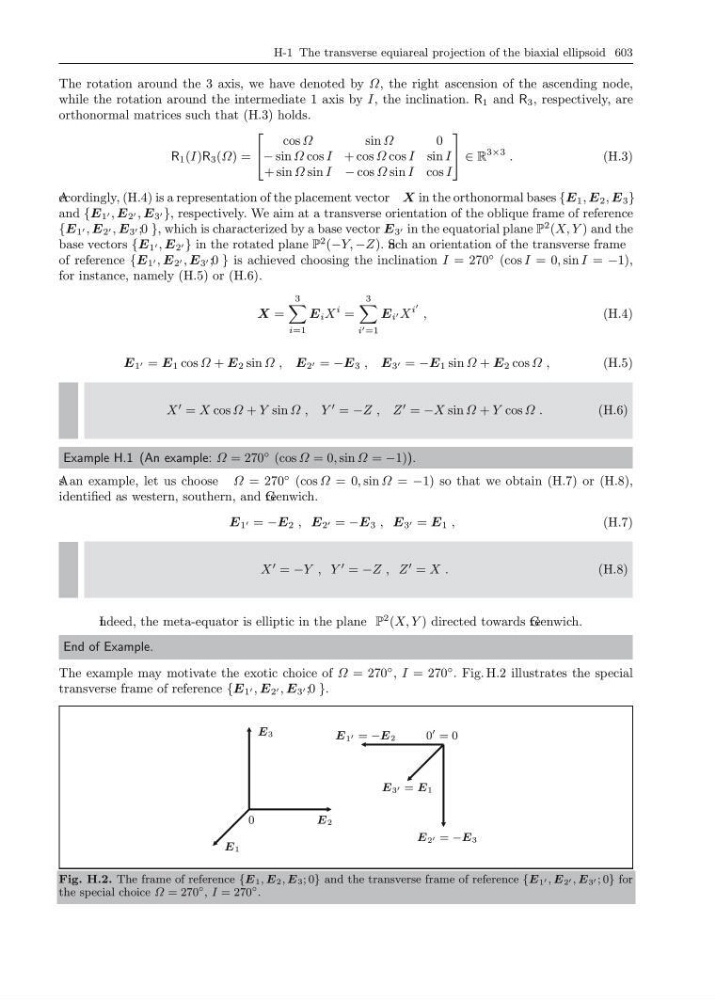
The example may motivate the exotic choice of Ω = 270
◦ , I = 270
◦ . Fig. H.2 illustrates the special
transverse frame of reference {E 1 , E 2 , E 3 ;0 }.
E1
E2
0
E3
E 1 = −E 2
E 2 = −E 3
0
= 0
E 3 = E 1
Fig. H.2. The frame of reference {E 1 , E 2 , E 3 ; 0} and the transverse frame of reference {E 1 , E 2 , E 3 ; 0} for
the special choice Ω = 270
◦ , I = 270
◦ .