

602 H Generalized Hammer projection
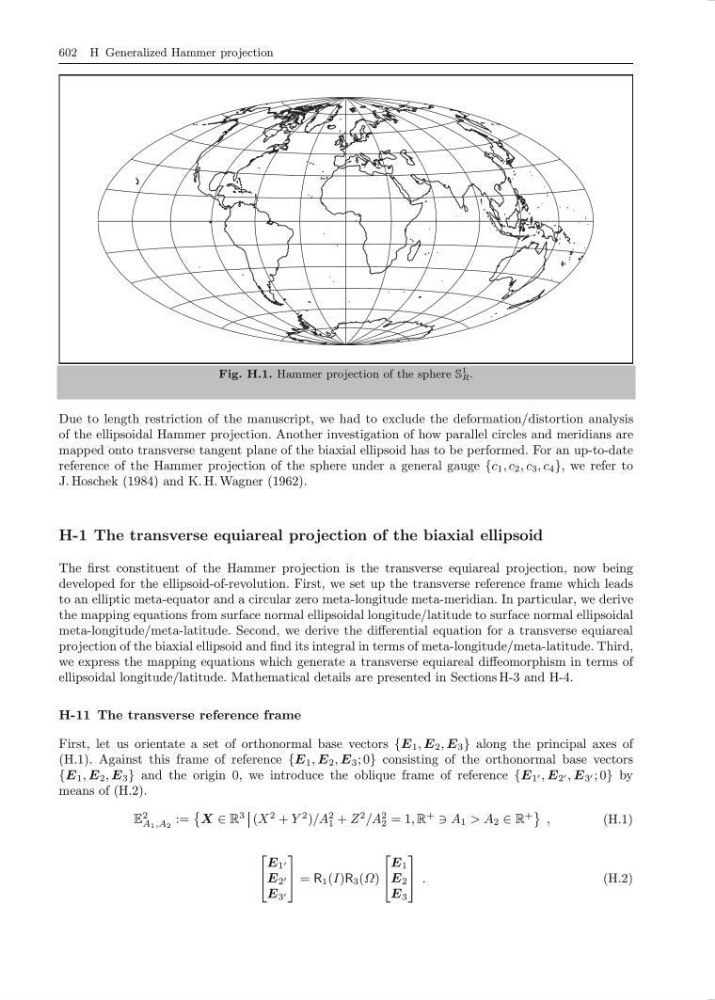
Fig. H.1. Hammer projection of the sphere S
1
R .
Due to length restriction of the manuscript, we had to exclude the deformation/distortion analysis
of the ellipsoidal Hammer projection. Another investigation of how parallel circles and meridians are
mapped onto transverse tangent plane of the biaxial ellipsoid has to be performed. For an up-to-date
reference of the Hammer projection of the sphere under a general gauge {c 1 , c 2 , c 3 , c 4 }, we refer to
J. Hoschek (1984) and K. H. Wagner (1962).
H-1 The transverse equiareal projection of the biaxial ellipsoid
The first constituent of the Hammer projection is the transverse equiareal projection, now being
developed for the ellipsoid-of-revolution. First, we set up the transverse reference frame which leads
to an elliptic meta-equator and a circular zero meta-longitude meta-meridian. In particular, we derive
the mapping equations from surface normal ellipsoidal longitude/latitude to surface normal ellipsoidal
meta-longitude/meta-latitude. Second, we derive the differential equation for a transverse equiareal
projection of the biaxial ellipsoid and find its integral in terms of meta-longitude/meta-latitude. Third,
we express the mapping equations which generate a transverse equiareal diffeomorphism in terms of
ellipsoidal longitude/latitude. Mathematical details are presented in Sections H-3 and H-4.
H-11 The transverse reference frame
First, let us orientate a set of orthonormal base vectors {E 1 , E 2 , E 3 } along the principal axes of
(H.1). Against this frame of reference {E 1 , E 2 , E 3 ; 0} consisting of the orthonormal base vectors
{E 1 , E 2 , E 3 } and the origin 0, we introduce the oblique frame of reference {E 1 , E 2 , E 3 ; 0} by
means of (H.2).
E
2
A 1 ,A 2
:=
X ∈ R
3 (X
2 + Y
2 )/A
2
1 + Z
2 /A
2
2 = 1, R
+
A 1 > A 2 ∈ R
+
,
(H.1)
⎡
⎣
E 1
E 2
E 3
⎤
⎦ = R 1 (I)R 3 (Ω)
⎡
⎣
E 1
E 2
E 3
⎤
⎦ .
(H.2)