

606 H Generalized Hammer projection
F
or the proof of (H.23), we refer to E
. G rafarend (1995 ).
Proof.
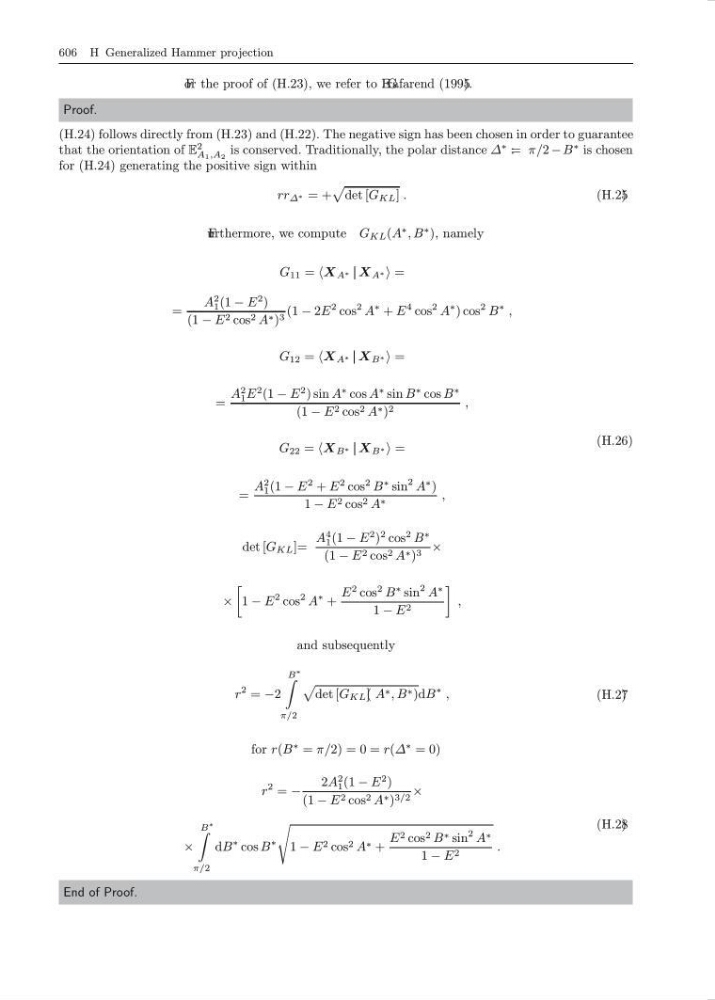
(H.24) follows directly from (H.23) and (H.22). The negative sign has been chosen in order to guarantee
that the orientation of E
2
A 1 ,A 2
is conserved. Traditionally, the polar distance ∆
∗ : = π/2 − B
∗ is chosen
for (H.24) generating the positive sign within
rr ∆ ∗ = +
det [G KL ] .
(H.25 )
F
urthermore, we compute G KL (A
∗ , B
∗ ), namely
G 11 = X A ∗ X A ∗ =
=
A
2
1 (1 − E
2 )
(1 − E 2 cos 2 A ∗ ) 3 (1 − 2E
2 cos
2 A
∗ + E
4 cos
2 A
∗ ) cos
2 B
∗ ,
G 12 = X A ∗ X B ∗ =
=
A
2
1 E
2 (1 − E
2 ) sin A
∗ cos A
∗ sin B
∗ cos B
∗
(1 − E 2 cos 2 A ∗ ) 2
,
G 22 = X B ∗ X B ∗ =
=
A
2
1 (1 − E
2 + E
2 cos
2 B
∗ sin
2 A
∗ )
1 − E 2 cos 2 A ∗
,
det [G KL ]=
A
4
1 (1 − E
2 )
2 cos
2 B
∗
(1 − E 2 cos 2 A ∗ ) 3 ×
×
1 − E
2 cos
2 A
∗ +
E
2 cos
2 B
∗ sin
2 A
∗
1 − E 2
,
(H.26)
and subsequently
r
2 = −2
B
∗
π/2
det [G KL ] ( A ∗ , B ∗ )dB
∗ ,
(H.27 )
for r(B
∗ = π/2) = 0 = r(∆
∗ = 0)
r
2 = −
2A
2
1 (1 − E
2 )
(1 − E 2 cos 2 A ∗ ) 3/2 ×
×
B
∗
π/2
dB
∗ cos B
∗
1 − E 2 cos 2 A ∗ +
E 2 cos 2 B ∗ sin
2 A ∗
1 − E 2
.
(H.28 )
End of Proof.
F
or the proof of (H.23), we refer to E
. G rafarend (1995 ).
Proof.
(H.24) follows directly from (H.23) and (H.22). The negative sign has been chosen in order to guarantee
that the orientation of E
2
A 1 ,A 2
is conserved. Traditionally, the polar distance ∆
∗ : = π/2 − B
∗ is chosen
for (H.24) generating the positive sign within
rr ∆ ∗ = +
det [G KL ] .
(H.25 )
F
urthermore, we compute G KL (A
∗ , B
∗ ), namely
G 11 = X A ∗ X A ∗ =
=
A
2
1 (1 − E
2 )
(1 − E 2 cos 2 A ∗ ) 3 (1 − 2E
2 cos
2 A
∗ + E
4 cos
2 A
∗ ) cos
2 B
∗ ,
G 12 = X A ∗ X B ∗ =
=
A
2
1 E
2 (1 − E
2 ) sin A
∗ cos A
∗ sin B
∗ cos B
∗
(1 − E 2 cos 2 A ∗ ) 2
,
G 22 = X B ∗ X B ∗ =
=
A
2
1 (1 − E
2 + E
2 cos
2 B
∗ sin
2 A
∗ )
1 − E 2 cos 2 A ∗
,
det [G KL ]=
A
4
1 (1 − E
2 )
2 cos
2 B
∗
(1 − E 2 cos 2 A ∗ ) 3 ×
×
1 − E
2 cos
2 A
∗ +
E
2 cos
2 B
∗ sin
2 A
∗
1 − E 2
,
(H.26)
and subsequently
r
2 = −2
B
∗
π/2
det [G KL ] ( A ∗ , B ∗ )dB
∗ ,
(H.27 )
for r(B
∗ = π/2) = 0 = r(∆
∗ = 0)
r
2 = −
2A
2
1 (1 − E
2 )
(1 − E 2 cos 2 A ∗ ) 3/2 ×
×
B
∗
π/2
dB
∗ cos B
∗
1 − E 2 cos 2 A ∗ +
E 2 cos 2 B ∗ sin
2 A ∗
1 − E 2
.
(H.28 )
End of Proof.