

574 F Mixed cylindric map projections
Proof.
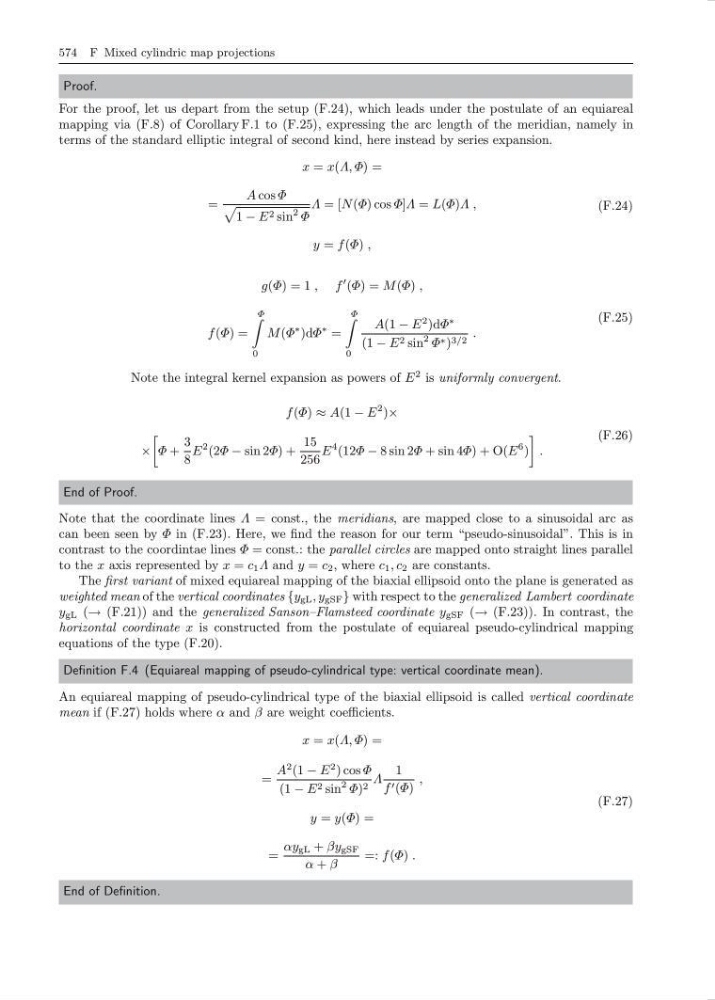
For the proof, let us depart from the setup (F.24), which leads under the postulate of an equiareal
mapping via (F.8) of Corollary F.1 to (F.25), expressing the arc length of the meridian, namely in
terms of the standard elliptic integral of second kind, here instead by series expansion.
x = x(Λ, Φ) =
=
A cos Φ
1 − E 2 sin
2 Φ
Λ = [N (Φ) cos Φ]Λ = L(Φ)Λ ,
y = f (Φ) ,
(F.24)
g(Φ) = 1 , f
(Φ) = M (Φ) ,
f (Φ) =
Φ
0
M (Φ
∗ )dΦ
∗ =
Φ
0
A(1 − E
2 )dΦ
∗
(1 − E 2 sin
2 Φ ∗ ) 3/2 .
(F.25)
Note the integral kernel expansion as powers of E
2 is uniformly convergent.
f (Φ) ≈ A(1 − E
2 )×
×
Φ +
3
8
E
2 (2Φ − sin 2Φ) +
15
256
E
4 (12Φ − 8 sin 2Φ + sin 4Φ) + O(E
6 )
.
(F.26)
End of Proof.
Note that the coordinate lines Λ = const., the meridians, are mapped close to a sinusoidal arc as
can been seen by Φ in (F.23). Here, we find the reason for our term “pseudo-sinusoidal”. This is in
contrast to the coordintae lines Φ = const.: the parallel circles are mapped onto straight lines parallel
to the x axis represented by x = c 1 Λ and y = c 2 , where c 1 , c 2 are constants.
The first variant of mixed equiareal mapping of the biaxial ellipsoid onto the plane is generated as
weighted mean of the vertical coordinates {y gL , y gSF } with respect to the generalized Lambert coordinate
y gL (→ (F.21)) and the generalized Sanson–Flamsteed coordinate y gSF (→ (F.23)). In contrast, the
horizontal coordinate x is constructed from the postulate of equiareal pseudo-cylindrical mapping
equations of the type (F.20).
Definition F.4 (Equiareal mapping of pseudo-cylindrical type: vertical coordinate mean).
An equiareal mapping of pseudo-cylindrical type of the biaxial ellipsoid is called vertical coordinate
mean if (F.27) holds where α and β are weight coefficients.
x = x(Λ, Φ) =
=
A
2 (1 − E
2 ) cos Φ
(1 − E 2 sin
2 Φ) 2 Λ
1
f (Φ)
,
y = y(Φ) =
=
αy gL + βy gSF
α + β
=: f (Φ) .
(F.27)
End of Definition.
Proof.
For the proof, let us depart from the setup (F.24), which leads under the postulate of an equiareal
mapping via (F.8) of Corollary F.1 to (F.25), expressing the arc length of the meridian, namely in
terms of the standard elliptic integral of second kind, here instead by series expansion.
x = x(Λ, Φ) =
=
A cos Φ
1 − E 2 sin
2 Φ
Λ = [N (Φ) cos Φ]Λ = L(Φ)Λ ,
y = f (Φ) ,
(F.24)
g(Φ) = 1 , f
(Φ) = M (Φ) ,
f (Φ) =
Φ
0
M (Φ
∗ )dΦ
∗ =
Φ
0
A(1 − E
2 )dΦ
∗
(1 − E 2 sin
2 Φ ∗ ) 3/2 .
(F.25)
Note the integral kernel expansion as powers of E
2 is uniformly convergent.
f (Φ) ≈ A(1 − E
2 )×
×
Φ +
3
8
E
2 (2Φ − sin 2Φ) +
15
256
E
4 (12Φ − 8 sin 2Φ + sin 4Φ) + O(E
6 )
.
(F.26)
End of Proof.
Note that the coordinate lines Λ = const., the meridians, are mapped close to a sinusoidal arc as
can been seen by Φ in (F.23). Here, we find the reason for our term “pseudo-sinusoidal”. This is in
contrast to the coordintae lines Φ = const.: the parallel circles are mapped onto straight lines parallel
to the x axis represented by x = c 1 Λ and y = c 2 , where c 1 , c 2 are constants.
The first variant of mixed equiareal mapping of the biaxial ellipsoid onto the plane is generated as
weighted mean of the vertical coordinates {y gL , y gSF } with respect to the generalized Lambert coordinate
y gL (→ (F.21)) and the generalized Sanson–Flamsteed coordinate y gSF (→ (F.23)). In contrast, the
horizontal coordinate x is constructed from the postulate of equiareal pseudo-cylindrical mapping
equations of the type (F.20).
Definition F.4 (Equiareal mapping of pseudo-cylindrical type: vertical coordinate mean).
An equiareal mapping of pseudo-cylindrical type of the biaxial ellipsoid is called vertical coordinate
mean if (F.27) holds where α and β are weight coefficients.
x = x(Λ, Φ) =
=
A
2 (1 − E
2 ) cos Φ
(1 − E 2 sin
2 Φ) 2 Λ
1
f (Φ)
,
y = y(Φ) =
=
αy gL + βy gSF
α + β
=: f (Φ) .
(F.27)
End of Definition.