

F-2 Mixed equiareal cylindric mapping: biaxial ellipsoid onto plane 575
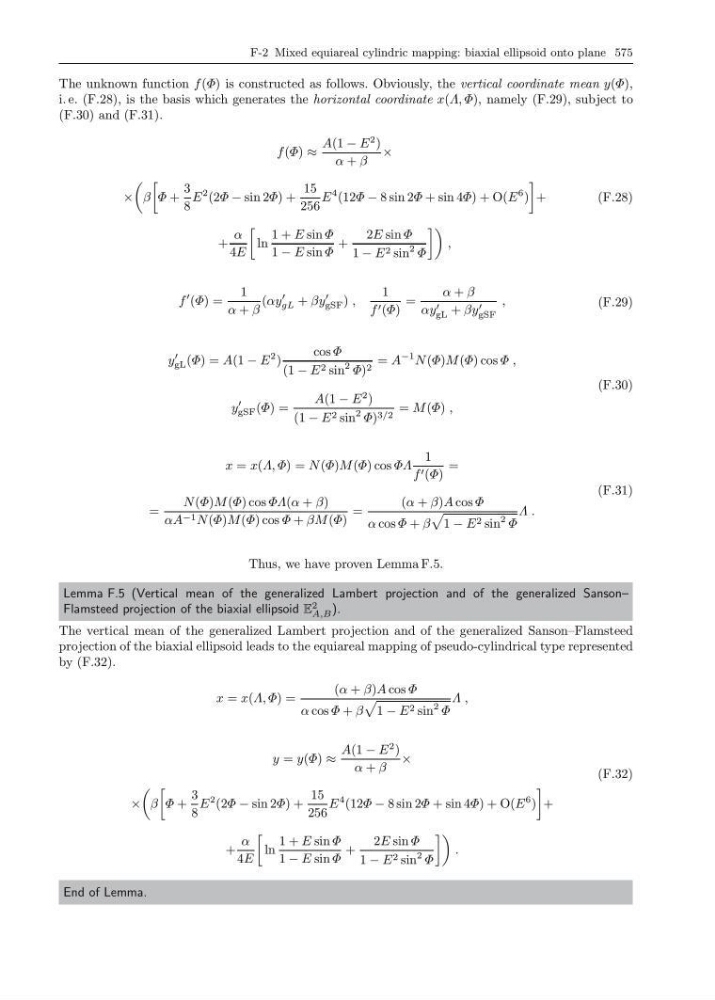
The unknown function f (Φ) is constructed as follows. Obviously, the vertical coordinate mean y(Φ),
i. e. (F.28), is the basis which generates the horizontal coordinate x(Λ, Φ), namely (F.29), subject to
(F.30) and (F.31).
f (Φ) ≈
A(1 − E
2 )
α + β
×
×
β
Φ +
3
8
E
2 (2Φ − sin 2Φ) +
15
256
E
4 (12Φ − 8 sin 2Φ + sin 4Φ) + O(E
6 )
+
+
α
4E
ln
1 + E sin Φ
1 − E sin Φ
+
2E sin Φ
1 − E 2 sin
2 Φ
,
(F.28)
f
(Φ) =
1
α + β
(αy
gL + βy
gSF ) ,
1
f (Φ)
=
α + β
αy
gL + βy
gSF
,
(F.29)
y
gL (Φ) = A(1 − E
2 )
cos Φ
(1 − E 2 sin
2 Φ) 2 = A
−1 N (Φ)M (Φ) cos Φ ,
y
gSF (Φ) =
A(1 − E
2 )
(1 − E 2 sin
2 Φ) 3/2 = M (Φ) ,
(F.30)
x = x(Λ, Φ) = N (Φ)M (Φ) cos ΦΛ
1
f (Φ)
=
=
N (Φ)M (Φ) cos ΦΛ(α + β)
αA −1 N (Φ)M (Φ) cos Φ + βM(Φ)
=
(α + β)A cos Φ
α cos Φ + β
1 − E 2 sin
2 Φ
Λ .
(F.31)
Thus, we have proven Lemma F.5.
Lemma F.5 (Vertical mean of the generalized Lambert projection and of the generalized Sanson–
Flamsteed projection of the biaxial ellipsoid E
2
A,B ).
The vertical mean of the generalized Lambert projection and of the generalized Sanson–Flamsteed
projection of the biaxial ellipsoid leads to the equiareal mapping of pseudo-cylindrical type represented
by (F.32).
x = x(Λ, Φ) =
(α + β)A cos Φ
α cos Φ + β
1 − E 2 sin
2 Φ
Λ ,
y = y(Φ) ≈
A(1 − E
2 )
α + β
×
×
β
Φ +
3
8
E
2 (2Φ − sin 2Φ) +
15
256
E
4 (12Φ − 8 sin 2Φ + sin 4Φ) + O(E
6 )
+
+
α
4E
ln
1 + E sin Φ
1 − E sin Φ
+
2E sin Φ
1 − E 2 sin
2 Φ
.
(F.32)
End of Lemma.
The unknown function f (Φ) is constructed as follows. Obviously, the vertical coordinate mean y(Φ),
i. e. (F.28), is the basis which generates the horizontal coordinate x(Λ, Φ), namely (F.29), subject to
(F.30) and (F.31).
f (Φ) ≈
A(1 − E
2 )
α + β
×
×
β
Φ +
3
8
E
2 (2Φ − sin 2Φ) +
15
256
E
4 (12Φ − 8 sin 2Φ + sin 4Φ) + O(E
6 )
+
+
α
4E
ln
1 + E sin Φ
1 − E sin Φ
+
2E sin Φ
1 − E 2 sin
2 Φ
,
(F.28)
f
(Φ) =
1
α + β
(αy
gL + βy
gSF ) ,
1
f (Φ)
=
α + β
αy
gL + βy
gSF
,
(F.29)
y
gL (Φ) = A(1 − E
2 )
cos Φ
(1 − E 2 sin
2 Φ) 2 = A
−1 N (Φ)M (Φ) cos Φ ,
y
gSF (Φ) =
A(1 − E
2 )
(1 − E 2 sin
2 Φ) 3/2 = M (Φ) ,
(F.30)
x = x(Λ, Φ) = N (Φ)M (Φ) cos ΦΛ
1
f (Φ)
=
=
N (Φ)M (Φ) cos ΦΛ(α + β)
αA −1 N (Φ)M (Φ) cos Φ + βM(Φ)
=
(α + β)A cos Φ
α cos Φ + β
1 − E 2 sin
2 Φ
Λ .
(F.31)
Thus, we have proven Lemma F.5.
Lemma F.5 (Vertical mean of the generalized Lambert projection and of the generalized Sanson–
Flamsteed projection of the biaxial ellipsoid E
2
A,B ).
The vertical mean of the generalized Lambert projection and of the generalized Sanson–Flamsteed
projection of the biaxial ellipsoid leads to the equiareal mapping of pseudo-cylindrical type represented
by (F.32).
x = x(Λ, Φ) =
(α + β)A cos Φ
α cos Φ + β
1 − E 2 sin
2 Φ
Λ ,
y = y(Φ) ≈
A(1 − E
2 )
α + β
×
×
β
Φ +
3
8
E
2 (2Φ − sin 2Φ) +
15
256
E
4 (12Φ − 8 sin 2Φ + sin 4Φ) + O(E
6 )
+
+
α
4E
ln
1 + E sin Φ
1 − E sin Φ
+
2E sin Φ
1 − E 2 sin
2 Φ
.
(F.32)
End of Lemma.