

F-2 Mixed equiareal cylindric mapping: biaxial ellipsoid onto plane 573
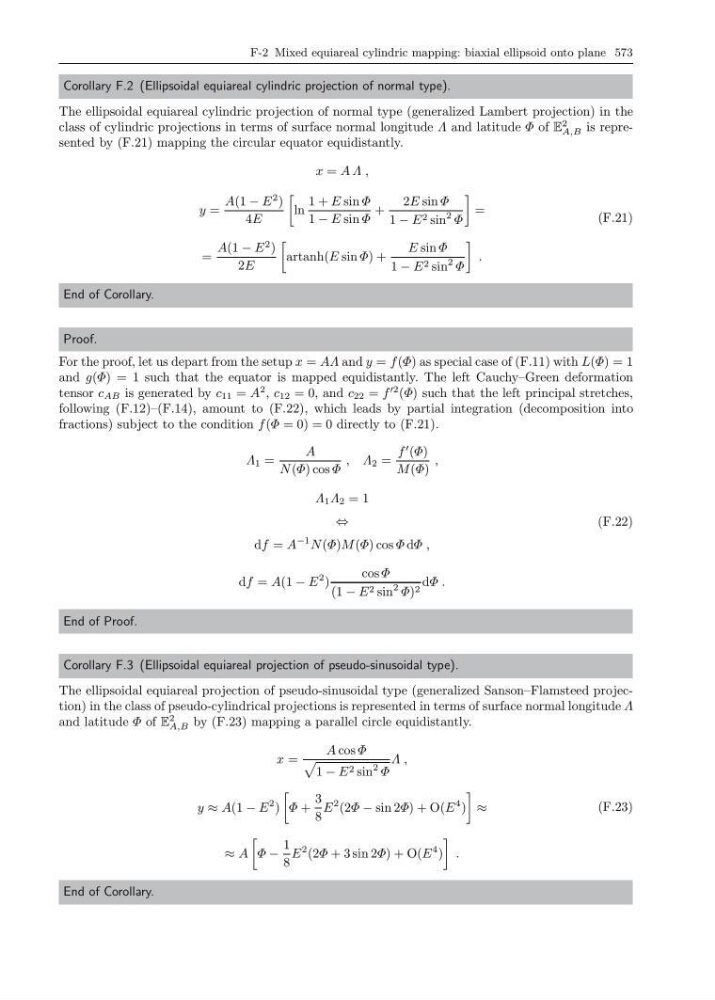
Corollary F.2 (Ellipsoidal equiareal cylindric projection of normal type).
The ellipsoidal equiareal cylindric projection of normal type (generalized Lambert projection) in the
class of cylindric projections in terms of surface normal longitude Λ and latitude Φ of E
2
A,B is represented by (F.21) mapping the circular equator equidistantly.
x = A Λ ,
y =
A(1 − E
2 )
4E
ln
1 + E sin Φ
1 − E sin Φ
+
2E sin Φ
1 − E 2 sin
2 Φ
=
=
A(1 − E
2 )
2E
artanh(E sin Φ) +
E sin Φ
1 − E 2 sin
2 Φ
.
(F.21)
End of Corollary.
Proof.
For the proof, let us depart from the setup x = AΛ and y = f (Φ) as special case of (F.11) with L(Φ) = 1
and g(Φ) = 1 such that the equator is mapped equidistantly. The left Cauchy–Green deformation
tensor c AB is generated by c 11 = A
2 , c 12 = 0, and c 22 = f
2 (Φ) such that the left principal stretches,
following (F.12)–(F.14), amount to (F.22), which leads by partial integration (decomposition into
fractions) subject to the condition f (Φ = 0) = 0 directly to (F.21).
Λ 1 =
A
N (Φ) cos Φ
, Λ 2 =
f
(Φ)
M (Φ)
,
Λ 1 Λ 2 = 1
⇔
df = A
−1 N (Φ)M (Φ) cos Φ dΦ ,
df = A(1 − E
2 )
cos Φ
(1 − E 2 sin
2 Φ) 2 dΦ .
(F.22)
End of Proof.
Corollary F.3 (Ellipsoidal equiareal projection of pseudo-sinusoidal type).
The ellipsoidal equiareal projection of pseudo-sinusoidal type (generalized Sanson–Flamsteed projection) in the class of pseudo-cylindrical projections is represented in terms of surface normal longitude Λ
and latitude Φ of E
2
A,B by (F.23) mapping a parallel circle equidistantly.
x =
A cos Φ
1 − E 2 sin
2 Φ
Λ ,
y ≈ A(1 − E
2 )
Φ +
3
8
E
2 (2Φ − sin 2Φ) + O(E
4 )
≈
≈ A
Φ −
1
8
E
2 (2Φ + 3 sin 2Φ) + O(E
4 )
.
(F.23)
End of Corollary.
Corollary F.2 (Ellipsoidal equiareal cylindric projection of normal type).
The ellipsoidal equiareal cylindric projection of normal type (generalized Lambert projection) in the
class of cylindric projections in terms of surface normal longitude Λ and latitude Φ of E
2
A,B is represented by (F.21) mapping the circular equator equidistantly.
x = A Λ ,
y =
A(1 − E
2 )
4E
ln
1 + E sin Φ
1 − E sin Φ
+
2E sin Φ
1 − E 2 sin
2 Φ
=
=
A(1 − E
2 )
2E
artanh(E sin Φ) +
E sin Φ
1 − E 2 sin
2 Φ
.
(F.21)
End of Corollary.
Proof.
For the proof, let us depart from the setup x = AΛ and y = f (Φ) as special case of (F.11) with L(Φ) = 1
and g(Φ) = 1 such that the equator is mapped equidistantly. The left Cauchy–Green deformation
tensor c AB is generated by c 11 = A
2 , c 12 = 0, and c 22 = f
2 (Φ) such that the left principal stretches,
following (F.12)–(F.14), amount to (F.22), which leads by partial integration (decomposition into
fractions) subject to the condition f (Φ = 0) = 0 directly to (F.21).
Λ 1 =
A
N (Φ) cos Φ
, Λ 2 =
f
(Φ)
M (Φ)
,
Λ 1 Λ 2 = 1
⇔
df = A
−1 N (Φ)M (Φ) cos Φ dΦ ,
df = A(1 − E
2 )
cos Φ
(1 − E 2 sin
2 Φ) 2 dΦ .
(F.22)
End of Proof.
Corollary F.3 (Ellipsoidal equiareal projection of pseudo-sinusoidal type).
The ellipsoidal equiareal projection of pseudo-sinusoidal type (generalized Sanson–Flamsteed projection) in the class of pseudo-cylindrical projections is represented in terms of surface normal longitude Λ
and latitude Φ of E
2
A,B by (F.23) mapping a parallel circle equidistantly.
x =
A cos Φ
1 − E 2 sin
2 Φ
Λ ,
y ≈ A(1 − E
2 )
Φ +
3
8
E
2 (2Φ − sin 2Φ) + O(E
4 )
≈
≈ A
Φ −
1
8
E
2 (2Φ + 3 sin 2Φ) + O(E
4 )
.
(F.23)
End of Corollary.