

D-2 D’Alembert–Euler (Cauchy–Riemann) equations 537
Example D.3 (Optimal universal transverse Mercator projection, biaxial ellipsoid E
2
a,b ).
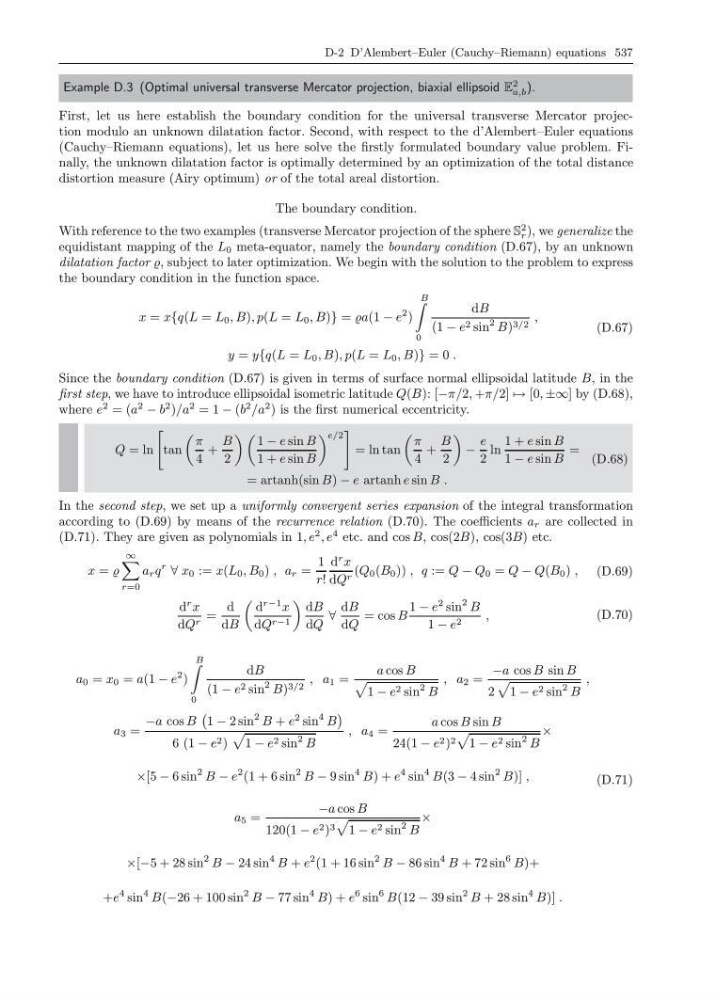
First, let us here establish the boundary condition for the universal transverse Mercator projection modulo an unknown dilatation factor. Second, with respect to the d’Alembert–Euler equations
(Cauchy–Riemann equations), let us here solve the firstly formulated boundary value problem. Finally, the unknown dilatation factor is optimally determined by an optimization of the total distance
distortion measure (Airy optimum) or of the total areal distortion.
The boundary condition.
With reference to the two examples (transverse Mercator projection of the sphere S
2
r ), we generalize the
equidistant mapping of the L 0 meta-equator, namely the boundary condition (D.67), by an unknown
dilatation factor , subject to later optimization. We begin with the solution to the problem to express
the boundary condition in the function space.
x = x{q(L = L 0 , B), p(L = L 0 , B)} = a(1 − e
2 )
B
0
dB
(1 − e 2 sin
2 B) 3/2 ,
y = y{q(L = L 0 , B), p(L = L 0 , B)} = 0 .
(D.67)
Since the boundary condition (D.67) is given in terms of surface normal ellipsoidal latitude B, in the
first step, we have to introduce ellipsoidal isometric latitude Q(B): [−π/2, +π/2] → [0, ±∞] by (D.68),
where e
2 = (a
2
− b
2 )/a
2 = 1 − (b
2 /a
2 ) is the first numerical eccentricity.
Q = ln
tan
π
4
+
B
2
1 − e sin B
1 + e sin B
e/2
= ln tan
π
4
+
B
2
−
e
2
ln
1 + e sin B
1 − e sin B
=
= artanh(sin B) − e artanh e sin B .
(D.68)
In the second step, we set up a uniformly convergent series expansion of the integral transformation
according to (D.69) by means of the recurrence relation (D.70). The coefficients a r are collected in
(D.71). They are given as polynomials in 1, e
2 , e
4 etc. and cos B, cos(2B), cos(3B) etc.
x =
∞
r=0
a r q
r
∀ x 0 := x(L 0 , B 0 ) , a r =
1
r!
d
r x
dQ r (Q 0 (B 0 )) , q := Q − Q 0 = Q − Q(B 0 ) , (D.69)
d
r x
dQ r =
d
dB
d
r−1 x
dQ r−1
dB
dQ
∀
dB
dQ
= cos B
1 − e
2 sin
2 B
1 − e 2
,
(D.70)
a 0 = x 0 = a(1 − e
2 )
B
0
dB
(1 − e 2 sin
2 B) 3/2 , a 1 =
a cos B
1 − e 2 sin
2 B
, a 2 =
−a cos B sin B
2
1 − e 2 sin
2 B
,
a 3 =
−a cos B
1 − 2 sin
2 B + e
2 sin
4 B
6 (1 − e 2 )
1 − e 2 sin
2 B
, a 4 =
a cos B sin B
24(1 − e 2 ) 2
1 − e 2 sin
2 B
×
×[5 − 6 sin
2 B − e
2 (1 + 6 sin
2 B − 9 sin
4 B) + e
4 sin
4 B(3 − 4 sin
2 B)] ,
a 5 =
−a cos B
120(1 − e 2 ) 3
1 − e 2 sin
2 B
×
×[−5 + 28 sin
2 B − 24 sin
4 B + e
2 (1 + 16 sin
2 B − 86 sin
4 B + 72 sin
6 B)+
+e
4 sin
4 B(−26 + 100 sin
2 B − 77 sin
4 B) + e
6 sin
6 B(12 − 39 sin
2 B + 28 sin
4 B)] .
(D.71)
Example D.3 (Optimal universal transverse Mercator projection, biaxial ellipsoid E
2
a,b ).
First, let us here establish the boundary condition for the universal transverse Mercator projection modulo an unknown dilatation factor. Second, with respect to the d’Alembert–Euler equations
(Cauchy–Riemann equations), let us here solve the firstly formulated boundary value problem. Finally, the unknown dilatation factor is optimally determined by an optimization of the total distance
distortion measure (Airy optimum) or of the total areal distortion.
The boundary condition.
With reference to the two examples (transverse Mercator projection of the sphere S
2
r ), we generalize the
equidistant mapping of the L 0 meta-equator, namely the boundary condition (D.67), by an unknown
dilatation factor , subject to later optimization. We begin with the solution to the problem to express
the boundary condition in the function space.
x = x{q(L = L 0 , B), p(L = L 0 , B)} = a(1 − e
2 )
B
0
dB
(1 − e 2 sin
2 B) 3/2 ,
y = y{q(L = L 0 , B), p(L = L 0 , B)} = 0 .
(D.67)
Since the boundary condition (D.67) is given in terms of surface normal ellipsoidal latitude B, in the
first step, we have to introduce ellipsoidal isometric latitude Q(B): [−π/2, +π/2] → [0, ±∞] by (D.68),
where e
2 = (a
2
− b
2 )/a
2 = 1 − (b
2 /a
2 ) is the first numerical eccentricity.
Q = ln
tan
π
4
+
B
2
1 − e sin B
1 + e sin B
e/2
= ln tan
π
4
+
B
2
−
e
2
ln
1 + e sin B
1 − e sin B
=
= artanh(sin B) − e artanh e sin B .
(D.68)
In the second step, we set up a uniformly convergent series expansion of the integral transformation
according to (D.69) by means of the recurrence relation (D.70). The coefficients a r are collected in
(D.71). They are given as polynomials in 1, e
2 , e
4 etc. and cos B, cos(2B), cos(3B) etc.
x =
∞
r=0
a r q
r
∀ x 0 := x(L 0 , B 0 ) , a r =
1
r!
d
r x
dQ r (Q 0 (B 0 )) , q := Q − Q 0 = Q − Q(B 0 ) , (D.69)
d
r x
dQ r =
d
dB
d
r−1 x
dQ r−1
dB
dQ
∀
dB
dQ
= cos B
1 − e
2 sin
2 B
1 − e 2
,
(D.70)
a 0 = x 0 = a(1 − e
2 )
B
0
dB
(1 − e 2 sin
2 B) 3/2 , a 1 =
a cos B
1 − e 2 sin
2 B
, a 2 =
−a cos B sin B
2
1 − e 2 sin
2 B
,
a 3 =
−a cos B
1 − 2 sin
2 B + e
2 sin
4 B
6 (1 − e 2 )
1 − e 2 sin
2 B
, a 4 =
a cos B sin B
24(1 − e 2 ) 2
1 − e 2 sin
2 B
×
×[5 − 6 sin
2 B − e
2 (1 + 6 sin
2 B − 9 sin
4 B) + e
4 sin
4 B(3 − 4 sin
2 B)] ,
a 5 =
−a cos B
120(1 − e 2 ) 3
1 − e 2 sin
2 B
×
×[−5 + 28 sin
2 B − 24 sin
4 B + e
2 (1 + 16 sin
2 B − 86 sin
4 B + 72 sin
6 B)+
+e
4 sin
4 B(−26 + 100 sin
2 B − 77 sin
4 B) + e
6 sin
6 B(12 − 39 sin
2 B + 28 sin
4 B)] .
(D.71)