

D-2 D’Alembert–Euler (Cauchy–Riemann) equations 531
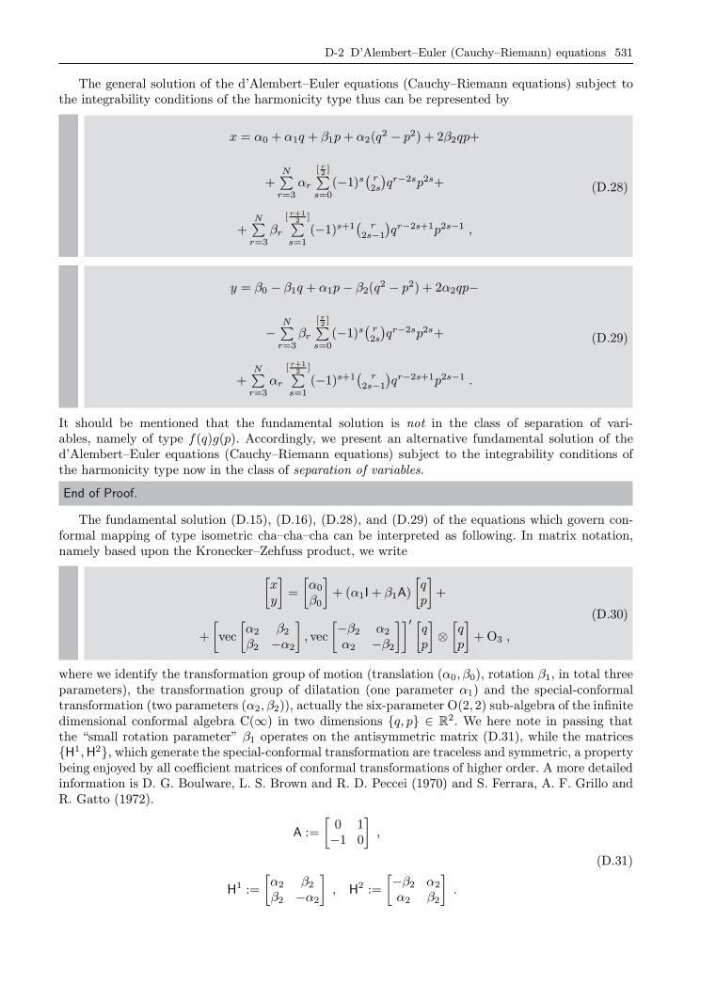
The general solution of the d’Alembert–Euler equations (Cauchy–Riemann equations) subject to
the integrability conditions of the harmonicity type thus can be represented by
x = α 0 + α 1 q + β 1 p + α 2 (q
2
− p
2 ) + 2β 2 qp+
+
N
r=3
α r
[
r
2 ]
s=0
(−1)
s
r
2s
q
r−2s p
2s +
+
N
r=3
β r
[
r+1
2 ]
s=1
(−1)
s+1
r
2s−1
q
r−2s+1 p
2s−1 ,
(D.28)
y = β 0 − β 1 q + α 1 p − β 2 (q
2
− p
2 ) + 2α 2 qp−
−
N
r=3
β r
[
r
2 ]
s=0
(−1)
s
r
2s
q
r−2s p
2s +
+
N
r=3
α r
[
r+1
2 ]
s=1
(−1)
s+1
r
2s−1
q
r−2s+1 p
2s−1 .
(D.29)
It should be mentioned that the fundamental solution is not in the class of separation of variables, namely of type f (q)g(p). Accordingly, we present an alternative fundamental solution of the
d’Alembert–Euler equations (Cauchy–Riemann equations) subject to the integrability conditions of
the harmonicity type now in the class of separation of variables.
End of Proof.
The fundamental solution (D.15), (D.16), (D.28), and (D.29) of the equations which govern conformal mapping of type isometric cha–cha–cha can be interpreted as following. In matrix notation,
namely based upon the Kronecker–Zehfuss product, we write
x
y
=
α 0
β 0
+ (α 1 I + β 1 A)
q
p
+
+
vec
α 2 β 2
β 2 −α 2
, vec
−β 2 α 2
α 2 −β 2
q
p
⊗
q
p
+ O 3 ,
(D.30)
where we identify the transformation group of motion (translation (α 0 , β 0 ), rotation β 1 , in total three
parameters), the transformation group of dilatation (one parameter α 1 ) and the special-conformal
transformation (two parameters (α 2 , β 2 )), actually the six-parameter O(2, 2) sub-algebra of the infinite
dimensional conformal algebra C(∞) in two dimensions {q, p} ∈ R
2 . We here note in passing that
the “small rotation parameter” β 1 operates on the antisymmetric matrix (D.31), while the matrices
{H
1 , H
2
}, which generate the special-conformal transformation are traceless and symmetric, a property
being enjoyed by all coefficient matrices of conformal transformations of higher order. A more detailed
information is D. G. Boulware, L. S. Brown and R. D. Peccei (1970) and S. Ferrara, A. F. Grillo and
R. Gatto (1972).
A :=
0 1
−1 0
,
H
1 :=
α 2 β 2
β 2 −α 2
, H
2 :=
−β 2 α 2
α 2 β 2
.
(D.31)
The general solution of the d’Alembert–Euler equations (Cauchy–Riemann equations) subject to
the integrability conditions of the harmonicity type thus can be represented by
x = α 0 + α 1 q + β 1 p + α 2 (q
2
− p
2 ) + 2β 2 qp+
+
N
r=3
α r
[
r
2 ]
s=0
(−1)
s
r
2s
q
r−2s p
2s +
+
N
r=3
β r
[
r+1
2 ]
s=1
(−1)
s+1
r
2s−1
q
r−2s+1 p
2s−1 ,
(D.28)
y = β 0 − β 1 q + α 1 p − β 2 (q
2
− p
2 ) + 2α 2 qp−
−
N
r=3
β r
[
r
2 ]
s=0
(−1)
s
r
2s
q
r−2s p
2s +
+
N
r=3
α r
[
r+1
2 ]
s=1
(−1)
s+1
r
2s−1
q
r−2s+1 p
2s−1 .
(D.29)
It should be mentioned that the fundamental solution is not in the class of separation of variables, namely of type f (q)g(p). Accordingly, we present an alternative fundamental solution of the
d’Alembert–Euler equations (Cauchy–Riemann equations) subject to the integrability conditions of
the harmonicity type now in the class of separation of variables.
End of Proof.
The fundamental solution (D.15), (D.16), (D.28), and (D.29) of the equations which govern conformal mapping of type isometric cha–cha–cha can be interpreted as following. In matrix notation,
namely based upon the Kronecker–Zehfuss product, we write
x
y
=
α 0
β 0
+ (α 1 I + β 1 A)
q
p
+
+
vec
α 2 β 2
β 2 −α 2
, vec
−β 2 α 2
α 2 −β 2
q
p
⊗
q
p
+ O 3 ,
(D.30)
where we identify the transformation group of motion (translation (α 0 , β 0 ), rotation β 1 , in total three
parameters), the transformation group of dilatation (one parameter α 1 ) and the special-conformal
transformation (two parameters (α 2 , β 2 )), actually the six-parameter O(2, 2) sub-algebra of the infinite
dimensional conformal algebra C(∞) in two dimensions {q, p} ∈ R
2 . We here note in passing that
the “small rotation parameter” β 1 operates on the antisymmetric matrix (D.31), while the matrices
{H
1 , H
2
}, which generate the special-conformal transformation are traceless and symmetric, a property
being enjoyed by all coefficient matrices of conformal transformations of higher order. A more detailed
information is D. G. Boulware, L. S. Brown and R. D. Peccei (1970) and S. Ferrara, A. F. Grillo and
R. Gatto (1972).
A :=
0 1
−1 0
,
H
1 :=
α 2 β 2
β 2 −α 2
, H
2 :=
−β 2 α 2
α 2 β 2
.
(D.31)