

530 D Korn–Lichtenstein and d’Alembert–Euler equations
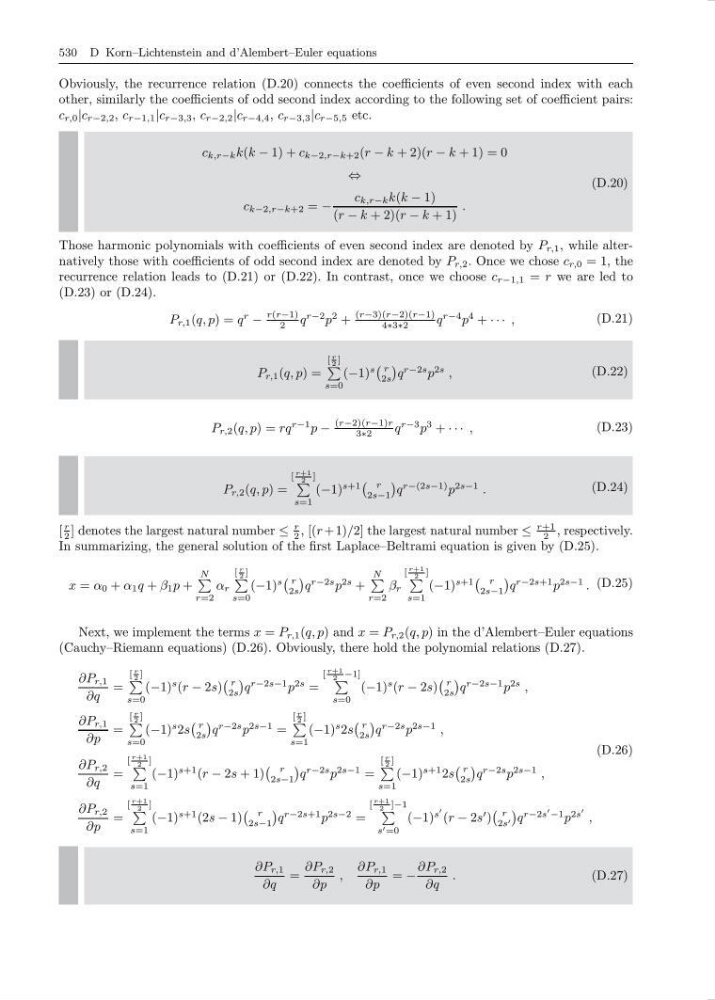
Obviously, the recurrence relation (D.20) connects the coefficients of even second index with each
other, similarly the coefficients of odd second index according to the following set of coefficient pairs:
c r,0 |c r−2,2 , c r−1,1 |c r−3,3 , c r−2,2 |c r−4,4 , c r−3,3 |c r−5,5 etc.
c k,r−k k(k − 1) + c k−2,r−k+2 (r − k + 2)(r − k + 1) = 0
⇔
c k−2,r−k+2 = −
c k,r−k k(k − 1)
(r − k + 2)(r − k + 1)
.
(D.20)
Those harmonic polynomials with coefficients of even second index are denoted by P r,1 , while alternatively those with coefficients of odd second index are denoted by P r,2 . Once we chose c r,0 = 1, the
recurrence relation leads to (D.21) or (D.22). In contrast, once we choose c r−1,1 = r we are led to
(D.23) or (D.24).
P r,1 (q, p) = q
r
−
r(r−1)
2
q
r−2 p
2 +
(r−3)(r−2)(r−1)
4∗3∗2
q
r−4 p
4 + · · · ,
(D.21)
P r,1 (q, p) =
[
r
2 ]
s=0
(−1)
s
r
2s
q
r−2s p
2s ,
(D.22)
P r,2 (q, p) = rq
r−1 p −
(r−2)(r−1)r
3∗2
q
r−3 p
3 + · · · ,
(D.23)
P r,2 (q, p) =
[
r+1
2 ]
s=1
(−1)
s+1
r
2s−1
q
r−(2s−1) p
2s−1 .
(D.24)
[
r
2 ] denotes the largest natural number ≤
r
2 , [(r +1)/2] the largest natural number ≤
r+1
2 , respectively.
In summarizing, the general solution of the first Laplace–Beltrami equation is given by (D.25).
x = α 0 + α 1 q + β 1 p +
N
r=2
α r
[
r
2 ]
s=0
(−1)
s
r
2s
q
r−2s p
2s +
N
r=2
β r
[
r+1
2 ]
s=1
(−1)
s+1
r
2s−1
q
r−2s+1 p
2s−1 . (D.25)
Next, we implement the terms x = P r,1 (q, p) and x = P r,2 (q, p) in the d’Alembert–Euler equations
(Cauchy–Riemann equations) (D.26). Obviously, there hold the polynomial relations (D.27).
∂P r,1
∂q
=
[
r
2 ]
s=0
(−1)
s (r − 2s)
r
2s
q
r−2s−1 p
2s =
[
r+1
2 −1]
s=0
(−1)
s (r − 2s)
r
2s
q
r−2s−1 p
2s ,
∂P r,1
∂p
=
[
r
2 ]
s=0
(−1)
s 2s
r
2s
q
r−2s p
2s−1 =
[
r
2 ]
s=1
(−1)
s 2s
r
2s
q
r−2s p
2s−1 ,
∂P r,2
∂q
=
[
r+1
2 ]
s=1
(−1)
s+1 (r − 2s + 1)
r
2s−1
q
r−2s p
2s−1 =
[
r
2 ]
s=1
(−1)
s+1 2s
r
2s
q
r−2s p
2s−1 ,
∂P r,2
∂p
=
[
r+1
2 ]
s=1
(−1)
s+1 (2s − 1)
r
2s−1
q
r−2s+1 p
2s−2 =
[
r+1
2 ]−1
s =0
(−1)
s
(r − 2s
)
r
2s
q
r−2s
−1 p
2s
,
(D.26)
∂P r,1
∂q
=
∂P r,2
∂p
,
∂P r,1
∂p
= −
∂P r,2
∂q
.
(D.27)
Obviously, the recurrence relation (D.20) connects the coefficients of even second index with each
other, similarly the coefficients of odd second index according to the following set of coefficient pairs:
c r,0 |c r−2,2 , c r−1,1 |c r−3,3 , c r−2,2 |c r−4,4 , c r−3,3 |c r−5,5 etc.
c k,r−k k(k − 1) + c k−2,r−k+2 (r − k + 2)(r − k + 1) = 0
⇔
c k−2,r−k+2 = −
c k,r−k k(k − 1)
(r − k + 2)(r − k + 1)
.
(D.20)
Those harmonic polynomials with coefficients of even second index are denoted by P r,1 , while alternatively those with coefficients of odd second index are denoted by P r,2 . Once we chose c r,0 = 1, the
recurrence relation leads to (D.21) or (D.22). In contrast, once we choose c r−1,1 = r we are led to
(D.23) or (D.24).
P r,1 (q, p) = q
r
−
r(r−1)
2
q
r−2 p
2 +
(r−3)(r−2)(r−1)
4∗3∗2
q
r−4 p
4 + · · · ,
(D.21)
P r,1 (q, p) =
[
r
2 ]
s=0
(−1)
s
r
2s
q
r−2s p
2s ,
(D.22)
P r,2 (q, p) = rq
r−1 p −
(r−2)(r−1)r
3∗2
q
r−3 p
3 + · · · ,
(D.23)
P r,2 (q, p) =
[
r+1
2 ]
s=1
(−1)
s+1
r
2s−1
q
r−(2s−1) p
2s−1 .
(D.24)
[
r
2 ] denotes the largest natural number ≤
r
2 , [(r +1)/2] the largest natural number ≤
r+1
2 , respectively.
In summarizing, the general solution of the first Laplace–Beltrami equation is given by (D.25).
x = α 0 + α 1 q + β 1 p +
N
r=2
α r
[
r
2 ]
s=0
(−1)
s
r
2s
q
r−2s p
2s +
N
r=2
β r
[
r+1
2 ]
s=1
(−1)
s+1
r
2s−1
q
r−2s+1 p
2s−1 . (D.25)
Next, we implement the terms x = P r,1 (q, p) and x = P r,2 (q, p) in the d’Alembert–Euler equations
(Cauchy–Riemann equations) (D.26). Obviously, there hold the polynomial relations (D.27).
∂P r,1
∂q
=
[
r
2 ]
s=0
(−1)
s (r − 2s)
r
2s
q
r−2s−1 p
2s =
[
r+1
2 −1]
s=0
(−1)
s (r − 2s)
r
2s
q
r−2s−1 p
2s ,
∂P r,1
∂p
=
[
r
2 ]
s=0
(−1)
s 2s
r
2s
q
r−2s p
2s−1 =
[
r
2 ]
s=1
(−1)
s 2s
r
2s
q
r−2s p
2s−1 ,
∂P r,2
∂q
=
[
r+1
2 ]
s=1
(−1)
s+1 (r − 2s + 1)
r
2s−1
q
r−2s p
2s−1 =
[
r
2 ]
s=1
(−1)
s+1 2s
r
2s
q
r−2s p
2s−1 ,
∂P r,2
∂p
=
[
r+1
2 ]
s=1
(−1)
s+1 (2s − 1)
r
2s−1
q
r−2s+1 p
2s−2 =
[
r+1
2 ]−1
s =0
(−1)
s
(r − 2s
)
r
2s
q
r−2s
−1 p
2s
,
(D.26)
∂P r,1
∂q
=
∂P r,2
∂p
,
∂P r,1
∂p
= −
∂P r,2
∂q
.
(D.27)