

532 D Korn–Lichtenstein and d’Alembert–Euler equations
Lemma D.3 (Fundamental solution of the d’Alembert-Euler equations subject to integrability conditions
of harmonicity, separation of variables).
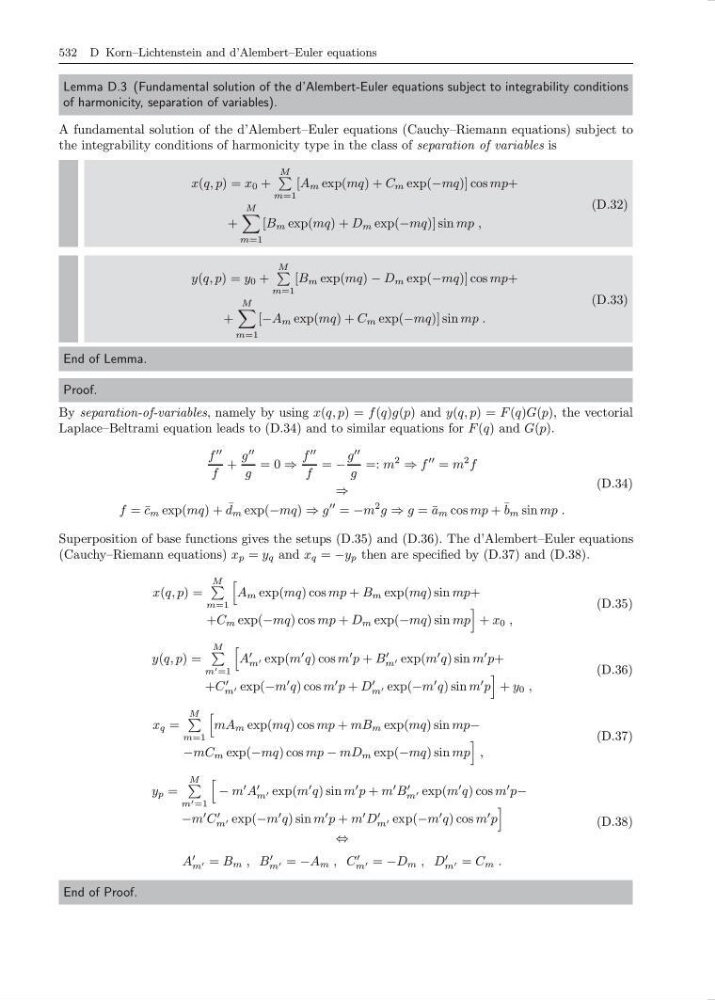
A fundamental solution of the d’Alembert–Euler equations (Cauchy–Riemann equations) subject to
the integrability conditions of harmonicity type in the class of separation of variables is
x(q, p) = x 0 +
M
m=1
[A m exp(mq) + C m exp(−mq)] cos mp+
+
M
m=1
[B m exp(mq) + D m exp(−mq)] sin mp ,
(D.32)
y(q, p) = y 0 +
M
m=1
[B m exp(mq) − D m exp(−mq)] cos mp+
+
M
m=1
[−A m exp(mq) + C m exp(−mq)] sin mp .
(D.33)
End of Lemma.
Proof.
By separation-of-variables, namely by using x(q, p) = f (q)g(p) and y(q, p) = F (q)G(p), the vectorial
Laplace–Beltrami equation leads to (D.34) and to similar equations for F (q) and G(p).
f
f
+
g
g
= 0 ⇒
f
f
= −
g
g
=: m
2
⇒ f
= m
2 f
⇒
f = ¯
c m exp(mq) + ¯
d m exp(−mq) ⇒ g
= −m
2 g ⇒ g = ¯
a m cos mp + ¯ b m sin mp .
(D.34)
Superposition of base functions gives the setups (D.35) and (D.36). The d’Alembert–Euler equations
(Cauchy–Riemann equations) x p = y q and x q = −y p then are specified by (D.37) and (D.38).
x(q, p) =
M
m=1
A m exp(mq) cos mp + B m exp(mq) sin mp+
+C m exp(−mq) cos mp + D m exp(−mq) sin mp
+ x 0 ,
(D.35)
y(q, p) =
M
m =1
A
m exp(m
q) cos m
p + B
m exp(m
q) sin m
p+
+C
m exp(−m
q) cos m
p + D
m exp(−m
q) sin m
p
+ y 0 ,
(D.36)
x q =
M
m=1
mA m exp(mq) cos mp + mB m exp(mq) sin mp−
−mC m exp(−mq) cos mp − mD m exp(−mq) sin mp
,
(D.37)
y p =
M
m =1
− m
A
m exp(m
q) sin m
p + m
B
m exp(m
q) cos m
p−
−m
C
m exp(−m
q) sin m
p + m
D
m exp(−m
q) cos m
p
⇔
A
m = B m , B
m = −A m , C
m = −D m , D
m = C m .
(D.38)
End of Proof.
Lemma D.3 (Fundamental solution of the d’Alembert-Euler equations subject to integrability conditions
of harmonicity, separation of variables).
A fundamental solution of the d’Alembert–Euler equations (Cauchy–Riemann equations) subject to
the integrability conditions of harmonicity type in the class of separation of variables is
x(q, p) = x 0 +
M
m=1
[A m exp(mq) + C m exp(−mq)] cos mp+
+
M
m=1
[B m exp(mq) + D m exp(−mq)] sin mp ,
(D.32)
y(q, p) = y 0 +
M
m=1
[B m exp(mq) − D m exp(−mq)] cos mp+
+
M
m=1
[−A m exp(mq) + C m exp(−mq)] sin mp .
(D.33)
End of Lemma.
Proof.
By separation-of-variables, namely by using x(q, p) = f (q)g(p) and y(q, p) = F (q)G(p), the vectorial
Laplace–Beltrami equation leads to (D.34) and to similar equations for F (q) and G(p).
f
f
+
g
g
= 0 ⇒
f
f
= −
g
g
=: m
2
⇒ f
= m
2 f
⇒
f = ¯
c m exp(mq) + ¯
d m exp(−mq) ⇒ g
= −m
2 g ⇒ g = ¯
a m cos mp + ¯ b m sin mp .
(D.34)
Superposition of base functions gives the setups (D.35) and (D.36). The d’Alembert–Euler equations
(Cauchy–Riemann equations) x p = y q and x q = −y p then are specified by (D.37) and (D.38).
x(q, p) =
M
m=1
A m exp(mq) cos mp + B m exp(mq) sin mp+
+C m exp(−mq) cos mp + D m exp(−mq) sin mp
+ x 0 ,
(D.35)
y(q, p) =
M
m =1
A
m exp(m
q) cos m
p + B
m exp(m
q) sin m
p+
+C
m exp(−m
q) cos m
p + D
m exp(−m
q) sin m
p
+ y 0 ,
(D.36)
x q =
M
m=1
mA m exp(mq) cos mp + mB m exp(mq) sin mp−
−mC m exp(−mq) cos mp − mD m exp(−mq) sin mp
,
(D.37)
y p =
M
m =1
− m
A
m exp(m
q) sin m
p + m
B
m exp(m
q) cos m
p−
−m
C
m exp(−m
q) sin m
p + m
D
m exp(−m
q) cos m
p
⇔
A
m = B m , B
m = −A m , C
m = −D m , D
m = C m .
(D.38)
End of Proof.