

528 D Korn–Lichtenstein and d’Alembert–Euler equations
dx = dy ,
(D.7)
dx = x U dU + x V dV = x I dU
I ,
x 1 :=
∂x
∂U
, x 2 :=
∂x
∂V
,
dy := e IJ
det [G l ]G
JK y K dU
I
∀ {I, J, K} ∈ {1, 2} ,
y 1 :=
∂y
∂U
, y 2 :=
∂y
∂V
,
(D.8)
e IJ =
⎧
⎪ ⎪ ⎨
⎪ ⎪ ⎩
+1 even permutation of the indices
−1 odd permutation of the indices
0 otherwise
,
(D.9)
dx := x I dU
I =
= e IJ
det [G l ]G
JK y K dU
I = dy ⇔
∂x
∂U I = e IJ
det [G l ]G
JK ∂y
∂U K .
(D.10)
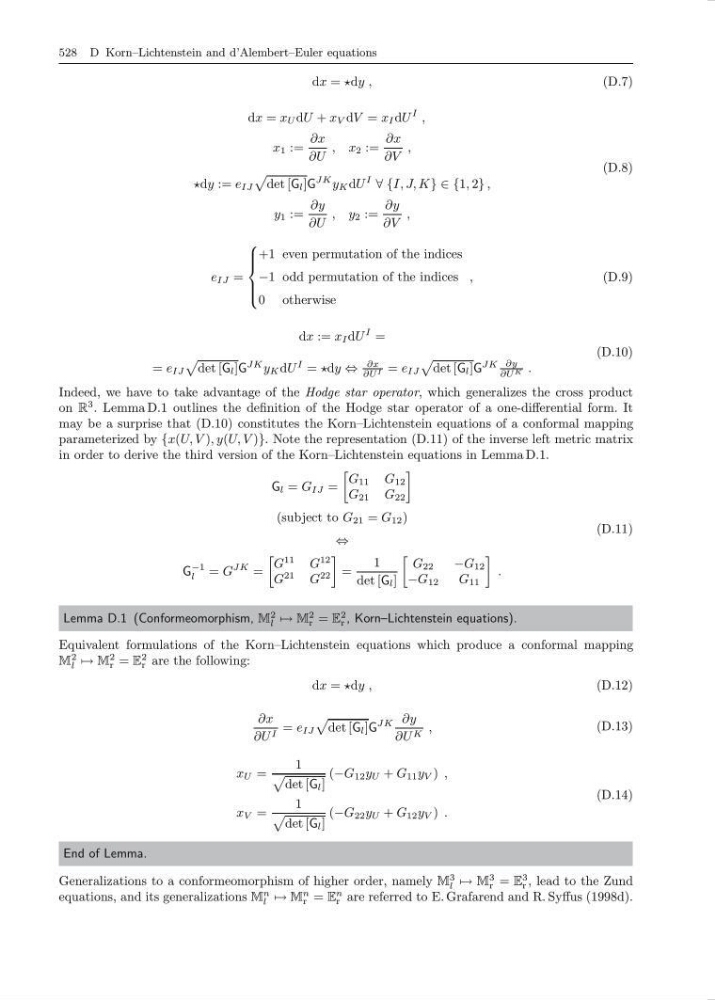
Indeed, we have to take advantage of the Hodge star operator, which generalizes the cross product
on R
3 . Lemma D.1 outlines the definition of the Hodge star operator of a one-differential form. It
may be a surprise that (D.10) constitutes the Korn–Lichtenstein equations of a conformal mapping
parameterized by {x(U, V ), y(U, V )}. Note the representation (D.11) of the inverse left metric matrix
in order to derive the third version of the Korn–Lichtenstein equations in Lemma D.1.
G l = G IJ =
G 11 G 12
G 21 G 22
(subject to G 21 = G 12 )
⇔
G
−1
l
= G
JK =
G
11
G
12
G
21
G
22
=
1
det [G l ]
G 22
−G 12
−G 12
G 11
.
(D.11)
Lemma D.1 (Conformeomorphism, M
2
l → M
2
r = E
2
r , Korn–Lichtenstein equations).
Equivalent formulations of the Korn–Lichtenstein equations which produce a conformal mapping
M
2
l → M
2
r = E
2
r are the following:
dx = dy ,
(D.12)
∂x
∂U I = e IJ
det [G l ]G
JK ∂y
∂U K ,
(D.13)
x U =
1
det [G l ]
(−G 12 y U + G 11 y V ) ,
x V =
1
det [G l ]
(−G 22 y U + G 12 y V ) .
(D.14)
End of Lemma.
Generalizations to a conformeomorphism of higher order, namely M
3
l → M
3
r = E
3
r , lead to the Zund
equations, and its generalizations M
n
l → M
n
r = E
n
r are referred to E. Grafarend and R. Syffus (1998d).
dx = dy ,
(D.7)
dx = x U dU + x V dV = x I dU
I ,
x 1 :=
∂x
∂U
, x 2 :=
∂x
∂V
,
dy := e IJ
det [G l ]G
JK y K dU
I
∀ {I, J, K} ∈ {1, 2} ,
y 1 :=
∂y
∂U
, y 2 :=
∂y
∂V
,
(D.8)
e IJ =
⎧
⎪ ⎪ ⎨
⎪ ⎪ ⎩
+1 even permutation of the indices
−1 odd permutation of the indices
0 otherwise
,
(D.9)
dx := x I dU
I =
= e IJ
det [G l ]G
JK y K dU
I = dy ⇔
∂x
∂U I = e IJ
det [G l ]G
JK ∂y
∂U K .
(D.10)
Indeed, we have to take advantage of the Hodge star operator, which generalizes the cross product
on R
3 . Lemma D.1 outlines the definition of the Hodge star operator of a one-differential form. It
may be a surprise that (D.10) constitutes the Korn–Lichtenstein equations of a conformal mapping
parameterized by {x(U, V ), y(U, V )}. Note the representation (D.11) of the inverse left metric matrix
in order to derive the third version of the Korn–Lichtenstein equations in Lemma D.1.
G l = G IJ =
G 11 G 12
G 21 G 22
(subject to G 21 = G 12 )
⇔
G
−1
l
= G
JK =
G
11
G
12
G
21
G
22
=
1
det [G l ]
G 22
−G 12
−G 12
G 11
.
(D.11)
Lemma D.1 (Conformeomorphism, M
2
l → M
2
r = E
2
r , Korn–Lichtenstein equations).
Equivalent formulations of the Korn–Lichtenstein equations which produce a conformal mapping
M
2
l → M
2
r = E
2
r are the following:
dx = dy ,
(D.12)
∂x
∂U I = e IJ
det [G l ]G
JK ∂y
∂U K ,
(D.13)
x U =
1
det [G l ]
(−G 12 y U + G 11 y V ) ,
x V =
1
det [G l ]
(−G 22 y U + G 12 y V ) .
(D.14)
End of Lemma.
Generalizations to a conformeomorphism of higher order, namely M
3
l → M
3
r = E
3
r , lead to the Zund
equations, and its generalizations M
n
l → M
n
r = E
n
r are referred to E. Grafarend and R. Syffus (1998d).