

D Korn–Lichtenstein and d’Alembert–Euler equations
Conformal mapping, Korn–Lichtenstein equations and d’Alembert–Euler (Cauchy–Riemann) equations.
Polynomial solutions. Conformeomorphism, condition of conformality.
D-1 Korn–Lichtenstein equations
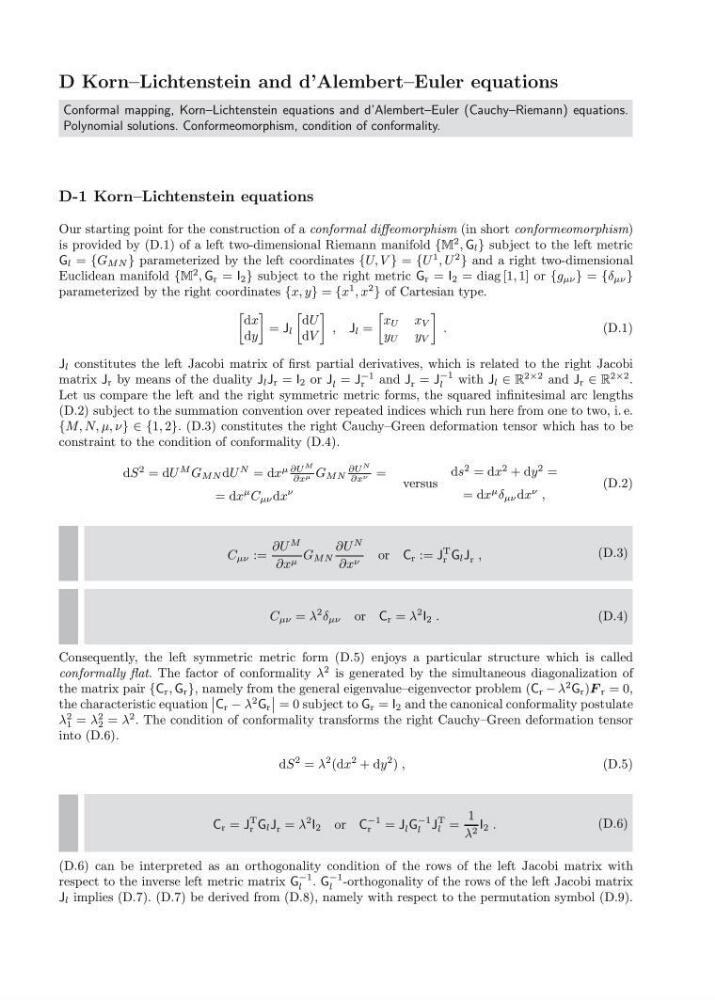
Our starting point for the construction of a conformal diffeomorphism (in short conformeomorphism)
is provided by (D.1) of a left two-dimensional Riemann manifold {M
2 , G l } subject to the left metric
G l = {G MN } parameterized by the left coordinates {U, V } = {U
1 , U
2
} and a right two-dimensional
Euclidean manifold {M
2 , G r = I 2 } subject to the right metric G r = I 2 = diag [1, 1] or {g µν } = {δ µν }
parameterized by the right coordinates {x, y} = {x
1 , x
2
} of Cartesian type.
dx
dy
= J l
dU
dV
, J l =
x U x V
y U y V
.
(D.1)
J l constitutes the left Jacobi matrix of first partial derivatives, which is related to the right Jacobi
matrix J r by means of the duality J l J r = I 2 or J l = J
−1
r
and J r = J
−1
l
with J l ∈ R
2×2 and J r ∈ R
2×2 .
Let us compare the left and the right symmetric metric forms, the squared infinitesimal arc lengths
(D.2) subject to the summation convention over repeated indices which run here from one to two, i. e.
{M, N, µ, ν} ∈ {1, 2}. (D.3) constitutes the right Cauchy–Green deformation tensor which has to be
constraint to the condition of conformality (D.4).
dS
2 = dU
M G MN dU
N = dx
µ ∂U
M
∂x µ G MN
∂U
N
∂x ν =
= dx
µ C µν dx
ν
versus
ds
2 = dx
2 + dy
2 =
= dx
µ δ µν dx
ν ,
(D.2)
C µν :=
∂U
M
∂x µ G MN
∂U
N
∂x ν or C r := J
T
r G l J r ,
(D.3)
C µν = λ
2 δ µν or C r = λ
2 I 2 .
(D.4)
Consequently, the left symmetric metric form (D.5) enjoys a particular structure which is called
conformally flat. The factor of conformality λ
2 is generated by the simultaneous diagonalization of
the matrix pair {C r , G r }, namely from the general eigenvalue–eigenvector problem (C r − λ
2 G r )F r = 0,
the characteristic equation
C r − λ
2 G r
= 0 subject to G r = I 2 and the canonical conformality postulate
λ
2
1 = λ
2
2 = λ
2 . The condition of conformality transforms the right Cauchy–Green deformation tensor
into (D.6).
dS
2 = λ
2 (dx
2 + dy
2 ) ,
(D.5)
C r = J
T
r G l J r = λ
2 I 2 or C
−1
r = J l G
−1
l J
T
l =
1
λ 2 I 2 .
(D.6)
(D.6) can be interpreted as an orthogonality condition of the rows of the left Jacobi matrix with
respect to the inverse left metric matrix G
−1
l . G
−1
l -orthogonality of the rows of the left Jacobi matrix
J l implies (D.7). (D.7) be derived from (D.8), namely with respect to the permutation symbol (D.9).
Conformal mapping, Korn–Lichtenstein equations and d’Alembert–Euler (Cauchy–Riemann) equations.
Polynomial solutions. Conformeomorphism, condition of conformality.
D-1 Korn–Lichtenstein equations
Our starting point for the construction of a conformal diffeomorphism (in short conformeomorphism)
is provided by (D.1) of a left two-dimensional Riemann manifold {M
2 , G l } subject to the left metric
G l = {G MN } parameterized by the left coordinates {U, V } = {U
1 , U
2
} and a right two-dimensional
Euclidean manifold {M
2 , G r = I 2 } subject to the right metric G r = I 2 = diag [1, 1] or {g µν } = {δ µν }
parameterized by the right coordinates {x, y} = {x
1 , x
2
} of Cartesian type.
dx
dy
= J l
dU
dV
, J l =
x U x V
y U y V
.
(D.1)
J l constitutes the left Jacobi matrix of first partial derivatives, which is related to the right Jacobi
matrix J r by means of the duality J l J r = I 2 or J l = J
−1
r
and J r = J
−1
l
with J l ∈ R
2×2 and J r ∈ R
2×2 .
Let us compare the left and the right symmetric metric forms, the squared infinitesimal arc lengths
(D.2) subject to the summation convention over repeated indices which run here from one to two, i. e.
{M, N, µ, ν} ∈ {1, 2}. (D.3) constitutes the right Cauchy–Green deformation tensor which has to be
constraint to the condition of conformality (D.4).
dS
2 = dU
M G MN dU
N = dx
µ ∂U
M
∂x µ G MN
∂U
N
∂x ν =
= dx
µ C µν dx
ν
versus
ds
2 = dx
2 + dy
2 =
= dx
µ δ µν dx
ν ,
(D.2)
C µν :=
∂U
M
∂x µ G MN
∂U
N
∂x ν or C r := J
T
r G l J r ,
(D.3)
C µν = λ
2 δ µν or C r = λ
2 I 2 .
(D.4)
Consequently, the left symmetric metric form (D.5) enjoys a particular structure which is called
conformally flat. The factor of conformality λ
2 is generated by the simultaneous diagonalization of
the matrix pair {C r , G r }, namely from the general eigenvalue–eigenvector problem (C r − λ
2 G r )F r = 0,
the characteristic equation
C r − λ
2 G r
= 0 subject to G r = I 2 and the canonical conformality postulate
λ
2
1 = λ
2
2 = λ
2 . The condition of conformality transforms the right Cauchy–Green deformation tensor
into (D.6).
dS
2 = λ
2 (dx
2 + dy
2 ) ,
(D.5)
C r = J
T
r G l J r = λ
2 I 2 or C
−1
r = J l G
−1
l J
T
l =
1
λ 2 I 2 .
(D.6)
(D.6) can be interpreted as an orthogonality condition of the rows of the left Jacobi matrix with
respect to the inverse left metric matrix G
−1
l . G
−1
l -orthogonality of the rows of the left Jacobi matrix
J l implies (D.7). (D.7) be derived from (D.8), namely with respect to the permutation symbol (D.9).