

1-5 One example: orthogonal map projection 33
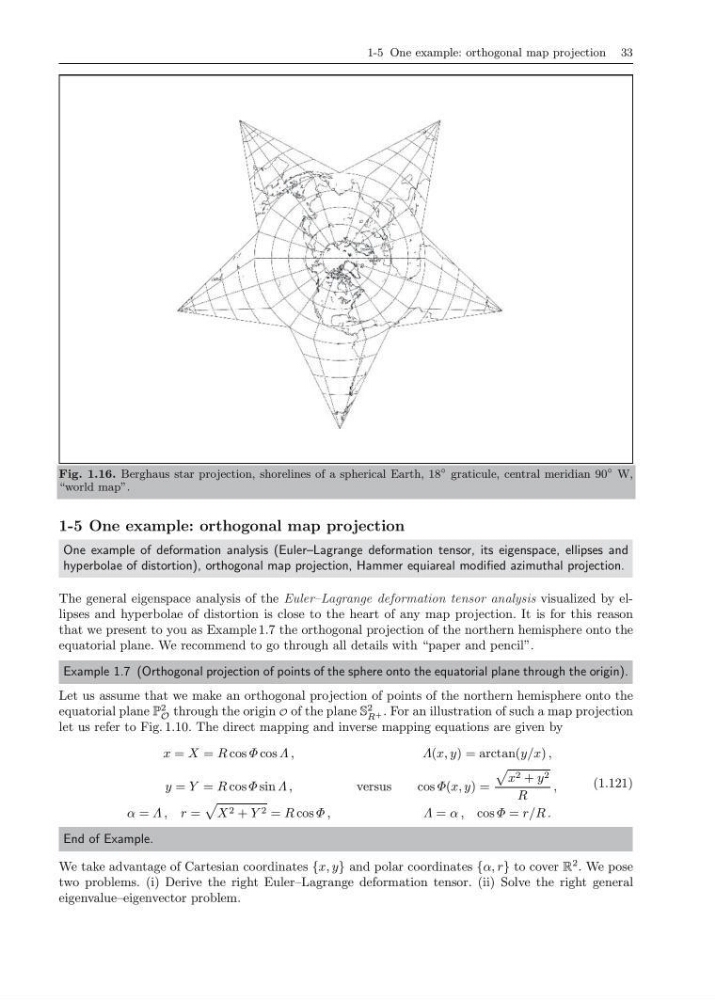
Fig. 1.16. Berghaus star projection, shorelines of a spherical Earth, 18
◦ graticule, central meridian 90
◦ W,
“world map”.
1-5 One example: orthogonal map projection
One example of deformation analysis (Euler–Lagrange deformation tensor, its eigenspace, ellipses and
hyperbolae of distortion), orthogonal map projection, Hammer equiareal modified azimuthal projection.
The general eigenspace analysis of the Euler–Lagrange deformation tensor analysis visualized by ellipses and hyperbolae of distortion is close to the heart of any map projection. It is for this reason
that we present to you as Example 1.7 the orthogonal projection of the northern hemisphere onto the
equatorial plane. We recommend to go through all details with “paper and pencil”.
Example 1.7 (Orthogonal projection of points of the sphere onto the equatorial plane through the origin).
Let us assume that we make an orthogonal projection of points of the northern hemisphere onto the
equatorial plane P
2
O through the origin O of the plane S
2
R + . For an illustration of such a map projection
let us refer to Fig. 1.10. The direct mapping and inverse mapping equations are given by
x = X = R cos Φ cos Λ ,
Λ(x, y) = arctan(y/x) ,
y = Y = R cos Φ sin Λ ,
versus
cos Φ(x, y) =
x 2 + y 2
R
,
α = Λ , r =
X 2 + Y 2 = R cos Φ ,
Λ = α , cos Φ = r/R .
(1.121)
End of Example.
We take advantage of Cartesian coordinates {x, y} and polar coordinates {α, r} to cover R
2 . We pose
two problems. (i) Derive the right Euler–Lagrange deformation tensor. (ii) Solve the right general
eigenvalue–eigenvector problem.
Fig. 1.16. Berghaus star projection, shorelines of a spherical Earth, 18
◦ graticule, central meridian 90
◦ W,
“world map”.
1-5 One example: orthogonal map projection
One example of deformation analysis (Euler–Lagrange deformation tensor, its eigenspace, ellipses and
hyperbolae of distortion), orthogonal map projection, Hammer equiareal modified azimuthal projection.
The general eigenspace analysis of the Euler–Lagrange deformation tensor analysis visualized by ellipses and hyperbolae of distortion is close to the heart of any map projection. It is for this reason
that we present to you as Example 1.7 the orthogonal projection of the northern hemisphere onto the
equatorial plane. We recommend to go through all details with “paper and pencil”.
Example 1.7 (Orthogonal projection of points of the sphere onto the equatorial plane through the origin).
Let us assume that we make an orthogonal projection of points of the northern hemisphere onto the
equatorial plane P
2
O through the origin O of the plane S
2
R + . For an illustration of such a map projection
let us refer to Fig. 1.10. The direct mapping and inverse mapping equations are given by
x = X = R cos Φ cos Λ ,
Λ(x, y) = arctan(y/x) ,
y = Y = R cos Φ sin Λ ,
versus
cos Φ(x, y) =
x 2 + y 2
R
,
α = Λ , r =
X 2 + Y 2 = R cos Φ ,
Λ = α , cos Φ = r/R .
(1.121)
End of Example.
We take advantage of Cartesian coordinates {x, y} and polar coordinates {α, r} to cover R
2 . We pose
two problems. (i) Derive the right Euler–Lagrange deformation tensor. (ii) Solve the right general
eigenvalue–eigenvector problem.