

21-4 Gauss–Krueger/UTM coordinates: from a local to a global datum 479
Box 21.22 (Series inversion of a local system of conformal coordinates of type Gauss–Krueger or UTM into
ellipsoidal coordinates).
l − l 0 =
= l 10
x
ρ
+ l 11
x
ρ
„
y
ρ
− y 00
«
+ l 30
„
x
ρ
« 3
+ l 12
x
ρ
„
y
ρ
− y 00
« 2
+ O(4) ,
b − b 0 =
= b 01
„
y
ρ
− y 00
«
+ b 20
„
x
ρ
« 2
+ b 02
„
y
ρ
− y 00
« 2
+ b 21
„
x
ρ
« 2 „
y
ρ
− y 00
«
+ b 03
„
y
ρ
− y 00
« 3
+ O(4) .
(21.79)
Box 21.23 (Coefficients of a bivariate series inversion of conformal type, the ellipsoidal longitude increments
l − l 0 ).
l 10 =
(1 − e
2 sin
2 b 0 )
1/2
a 1 cos b 0
,
l 11 =
tan b 0 (1 − e
2 sin
2 b 0 )
a
2
1 cos b 0
,
l 30 =
−(1 − e
2 sin
2 b 0 )
3/2 (1 + sin
2 b 0 − 3e
2 sin
2 b 0 + e
2 sin
4 b 0 )
6a
3
1 (1 − e 2 ) cos 3 b 0
,
l 12 =
+(1 − e
2 sin
2 b 0 )
3/2 (1 + sin
2 b 0 − 3e
2 sin
2 b 0 + e
2 sin
4 b 0 )
2a
3
1 (1 − e 2 ) cos 3 b 0
.
(21.80)
Box 21.24 (Coefficients of a bivariate series inversion of conformal type, the ellipsoidal latitude increments
b − b 0 ).
b 01 =
(1 − e
2 sin
2 b 0 )
3/2
a 1 (1 − e 2 )
,
b 20 =
− tan b 0 (1 − e
2 sin
2 b 0 )
2
2a
2
1 (1 − e 2 )
,
b 02 =
−3e
2 cos b 0 sin b 0 (1 − e
2 sin
2 b 0 )
2
2a
2
1 (1 − e 2 ) 2
,
b 21 =
−(1 − e
2 sin
2 b 0 )
5/2 (1 − 5e
2 sin
2 b 0 + 4e
2 sin
4 b 0 )
2a
3
1 (1 − e 2 ) 2 cos 2 b 0
,
b 03 =
−e
2 (1 − e
2 sin
2 b 0 )
5/2 (1 − 2 sin
2 b 0 − 5e
2 sin
2 b 0 + 6e
2 sin
4 b 0 )
2a
3
1 (1 − e 2 ) 3
.
(21.81)
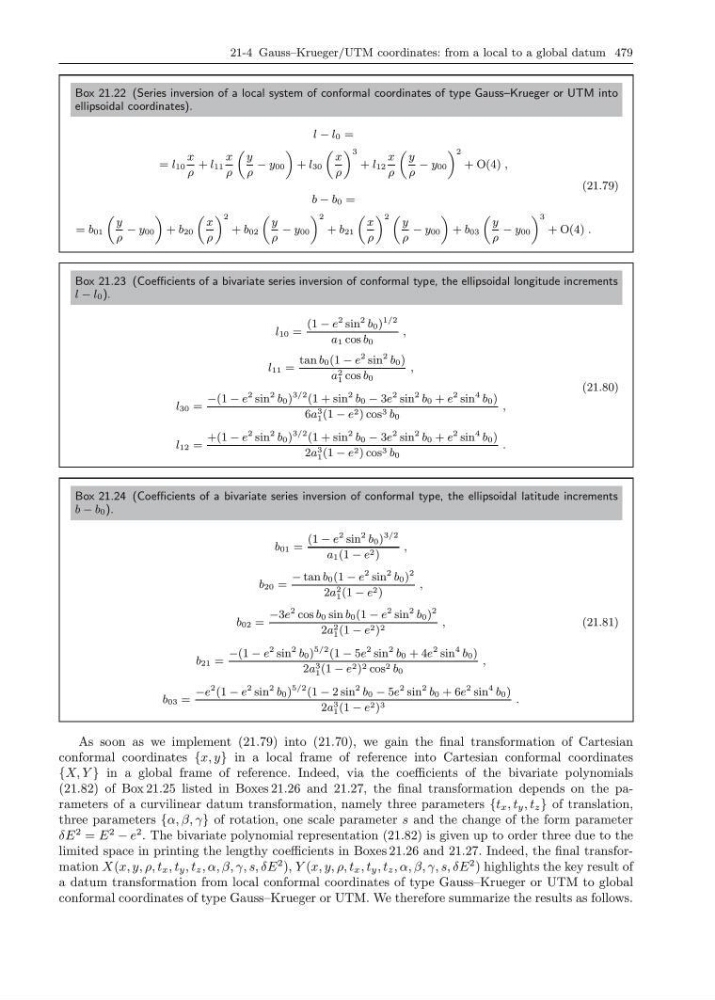
As soon as we implement (21.79) into (21.70), we gain the final transformation of Cartesian
conformal coordinates {x, y} in a local frame of reference into Cartesian conformal coordinates
{X, Y } in a global frame of reference. Indeed, via the coefficients of the bivariate polynomials
(21.82) of Box 21.25 listed in Boxes 21.26 and 21.27, the final transformation depends on the parameters of a curvilinear datum transformation, namely three parameters {t x , t y , t z } of translation,
three parameters {α, β, γ} of rotation, one scale parameter s and the change of the form parameter
δE
2 = E
2
− e
2 . The bivariate polynomial representation (21.82) is given up to order three due to the
limited space in printing the lengthy coefficients in Boxes 21.26 and 21.27. Indeed, the final transformation X(x, y, ρ, t x , t y , t z , α, β, γ, s, δE
2 ), Y (x, y, ρ, t x , t y , t z , α, β, γ, s, δE
2 ) highlights the key result of
a datum transformation from local conformal coordinates of type Gauss–Krueger or UTM to global
conformal coordinates of type Gauss–Krueger or UTM. We therefore summarize the results as follows.
Box 21.22 (Series inversion of a local system of conformal coordinates of type Gauss–Krueger or UTM into
ellipsoidal coordinates).
l − l 0 =
= l 10
x
ρ
+ l 11
x
ρ
„
y
ρ
− y 00
«
+ l 30
„
x
ρ
« 3
+ l 12
x
ρ
„
y
ρ
− y 00
« 2
+ O(4) ,
b − b 0 =
= b 01
„
y
ρ
− y 00
«
+ b 20
„
x
ρ
« 2
+ b 02
„
y
ρ
− y 00
« 2
+ b 21
„
x
ρ
« 2 „
y
ρ
− y 00
«
+ b 03
„
y
ρ
− y 00
« 3
+ O(4) .
(21.79)
Box 21.23 (Coefficients of a bivariate series inversion of conformal type, the ellipsoidal longitude increments
l − l 0 ).
l 10 =
(1 − e
2 sin
2 b 0 )
1/2
a 1 cos b 0
,
l 11 =
tan b 0 (1 − e
2 sin
2 b 0 )
a
2
1 cos b 0
,
l 30 =
−(1 − e
2 sin
2 b 0 )
3/2 (1 + sin
2 b 0 − 3e
2 sin
2 b 0 + e
2 sin
4 b 0 )
6a
3
1 (1 − e 2 ) cos 3 b 0
,
l 12 =
+(1 − e
2 sin
2 b 0 )
3/2 (1 + sin
2 b 0 − 3e
2 sin
2 b 0 + e
2 sin
4 b 0 )
2a
3
1 (1 − e 2 ) cos 3 b 0
.
(21.80)
Box 21.24 (Coefficients of a bivariate series inversion of conformal type, the ellipsoidal latitude increments
b − b 0 ).
b 01 =
(1 − e
2 sin
2 b 0 )
3/2
a 1 (1 − e 2 )
,
b 20 =
− tan b 0 (1 − e
2 sin
2 b 0 )
2
2a
2
1 (1 − e 2 )
,
b 02 =
−3e
2 cos b 0 sin b 0 (1 − e
2 sin
2 b 0 )
2
2a
2
1 (1 − e 2 ) 2
,
b 21 =
−(1 − e
2 sin
2 b 0 )
5/2 (1 − 5e
2 sin
2 b 0 + 4e
2 sin
4 b 0 )
2a
3
1 (1 − e 2 ) 2 cos 2 b 0
,
b 03 =
−e
2 (1 − e
2 sin
2 b 0 )
5/2 (1 − 2 sin
2 b 0 − 5e
2 sin
2 b 0 + 6e
2 sin
4 b 0 )
2a
3
1 (1 − e 2 ) 3
.
(21.81)
As soon as we implement (21.79) into (21.70), we gain the final transformation of Cartesian
conformal coordinates {x, y} in a local frame of reference into Cartesian conformal coordinates
{X, Y } in a global frame of reference. Indeed, via the coefficients of the bivariate polynomials
(21.82) of Box 21.25 listed in Boxes 21.26 and 21.27, the final transformation depends on the parameters of a curvilinear datum transformation, namely three parameters {t x , t y , t z } of translation,
three parameters {α, β, γ} of rotation, one scale parameter s and the change of the form parameter
δE
2 = E
2
− e
2 . The bivariate polynomial representation (21.82) is given up to order three due to the
limited space in printing the lengthy coefficients in Boxes 21.26 and 21.27. Indeed, the final transformation X(x, y, ρ, t x , t y , t z , α, β, γ, s, δE
2 ), Y (x, y, ρ, t x , t y , t z , α, β, γ, s, δE
2 ) highlights the key result of
a datum transformation from local conformal coordinates of type Gauss–Krueger or UTM to global
conformal coordinates of type Gauss–Krueger or UTM. We therefore summarize the results as follows.