

472 21 Datum problems
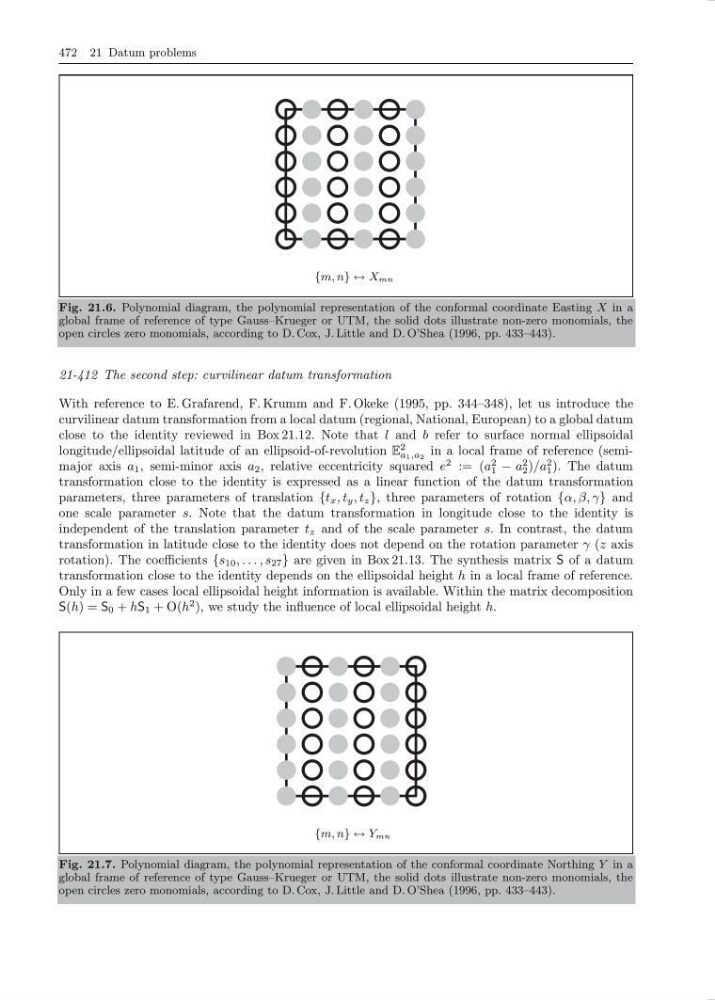
{m, n} ↔ X mn
Fig. 21.6. Polynomial diagram, the polynomial representation of the conformal coordinate Easting X in a
global frame of reference of type Gauss–Krueger or UTM, the solid dots illustrate non-zero monomials, the
open circles zero monomials, according to D. Cox, J. Little and D. O’Shea (1996, pp. 433–443).
21-412 The second step: curvilinear datum transformation
With reference to E. Grafarend, F. Krumm and F. Okeke (1995, pp. 344–348), let us introduce the
curvilinear datum transformation from a local datum (regional, National, European) to a global datum
close to the identity reviewed in Box 21.12. Note that l and b refer to surface normal ellipsoidal
longitude/ellipsoidal latitude of an ellipsoid-of-revolution E
2
a 1 ,a 2 in a local frame of reference (semimajor axis a 1 , semi-minor axis a 2 , relative eccentricity squared e
2 := (a
2
1 − a
2
2 )/a
2
1 ). The datum
transformation close to the identity is expressed as a linear function of the datum transformation
parameters, three parameters of translation {t x , t y , t z }, three parameters of rotation {α, β, γ} and
one scale parameter s. Note that the datum transformation in longitude close to the identity is
independent of the translation parameter t z and of the scale parameter s. In contrast, the datum
transformation in latitude close to the identity does not depend on the rotation parameter γ (z axis
rotation). The coefficients {s 10 , . . . , s 27 } are given in Box 21.13. The synthesis matrix S of a datum
transformation close to the identity depends on the ellipsoidal height h in a local frame of reference.
Only in a few cases local ellipsoidal height information is available. Within the matrix decomposition
S(h) = S 0 + hS 1 + O(h
2 ), we study the influence of local ellipsoidal height h.
{m, n} ↔ Y mn
Fig. 21.7. Polynomial diagram, the polynomial representation of the conformal coordinate Northing Y in a
global frame of reference of type Gauss–Krueger or UTM, the solid dots illustrate non-zero monomials, the
open circles zero monomials, according to D. Cox, J. Little and D. O’Shea (1996, pp. 433–443).
{m, n} ↔ X mn
Fig. 21.6. Polynomial diagram, the polynomial representation of the conformal coordinate Easting X in a
global frame of reference of type Gauss–Krueger or UTM, the solid dots illustrate non-zero monomials, the
open circles zero monomials, according to D. Cox, J. Little and D. O’Shea (1996, pp. 433–443).
21-412 The second step: curvilinear datum transformation
With reference to E. Grafarend, F. Krumm and F. Okeke (1995, pp. 344–348), let us introduce the
curvilinear datum transformation from a local datum (regional, National, European) to a global datum
close to the identity reviewed in Box 21.12. Note that l and b refer to surface normal ellipsoidal
longitude/ellipsoidal latitude of an ellipsoid-of-revolution E
2
a 1 ,a 2 in a local frame of reference (semimajor axis a 1 , semi-minor axis a 2 , relative eccentricity squared e
2 := (a
2
1 − a
2
2 )/a
2
1 ). The datum
transformation close to the identity is expressed as a linear function of the datum transformation
parameters, three parameters of translation {t x , t y , t z }, three parameters of rotation {α, β, γ} and
one scale parameter s. Note that the datum transformation in longitude close to the identity is
independent of the translation parameter t z and of the scale parameter s. In contrast, the datum
transformation in latitude close to the identity does not depend on the rotation parameter γ (z axis
rotation). The coefficients {s 10 , . . . , s 27 } are given in Box 21.13. The synthesis matrix S of a datum
transformation close to the identity depends on the ellipsoidal height h in a local frame of reference.
Only in a few cases local ellipsoidal height information is available. Within the matrix decomposition
S(h) = S 0 + hS 1 + O(h
2 ), we study the influence of local ellipsoidal height h.
{m, n} ↔ Y mn
Fig. 21.7. Polynomial diagram, the polynomial representation of the conformal coordinate Northing Y in a
global frame of reference of type Gauss–Krueger or UTM, the solid dots illustrate non-zero monomials, the
open circles zero monomials, according to D. Cox, J. Little and D. O’Shea (1996, pp. 433–443).