

21-4 Gauss–Krueger/UTM coordinates: from a local to a global datum 473
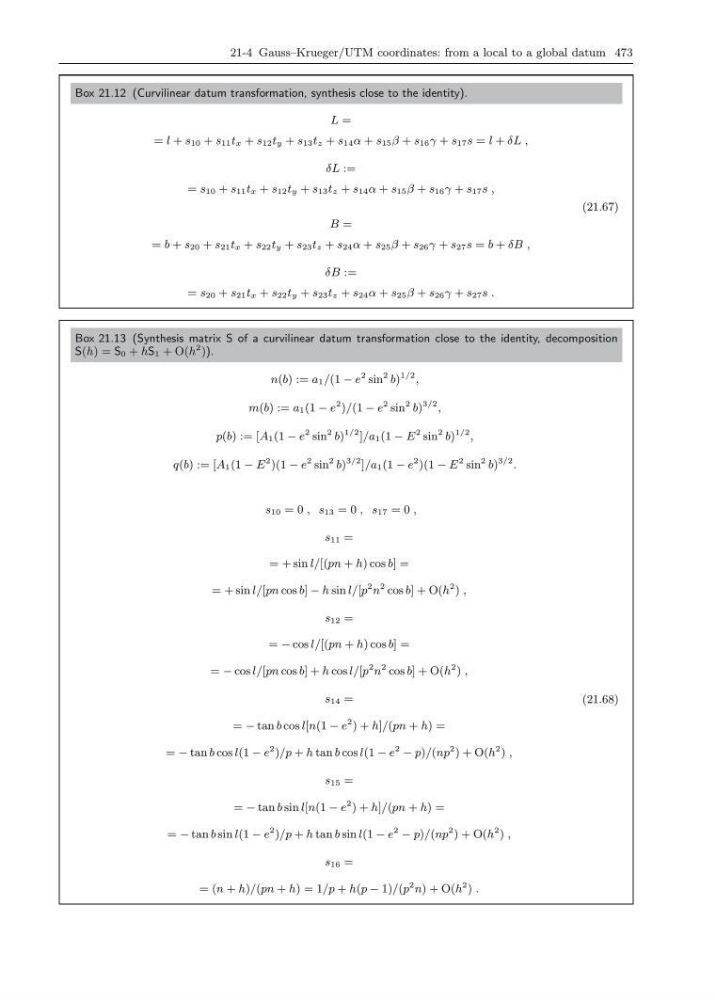
Box 21.12 (Curvilinear datum transformation, synthesis close to the identity).
L =
= l + s 10 + s 11 t x + s 12 t y + s 13 t z + s 14 α + s 15 β + s 16 γ + s 17 s = l + δL ,
δL :=
= s 10 + s 11 t x + s 12 t y + s 13 t z + s 14 α + s 15 β + s 16 γ + s 17 s ,
B =
= b + s 20 + s 21 t x + s 22 t y + s 23 t z + s 24 α + s 25 β + s 26 γ + s 27 s = b + δB ,
δB :=
= s 20 + s 21 t x + s 22 t y + s 23 t z + s 24 α + s 25 β + s 26 γ + s 27 s .
(21.67)
Box 21.13 (Synthesis matrix S of a curvilinear datum transformation close to the identity, decomposition
S(h) = S 0 + hS 1 + O(h
2 )).
n(b) := a 1 /(1 − e
2 sin
2 b)
1/2 ,
m(b) := a 1 (1 − e
2 )/(1 − e
2 sin
2 b)
3/2 ,
p(b) := [A 1 (1 − e
2 sin
2 b)
1/2 ]/a 1 (1 − E
2 sin
2 b)
1/2 ,
q(b) := [A 1 (1 − E
2 )(1 − e
2 sin
2 b)
3/2 ]/a 1 (1 − e
2 )(1 − E
2 sin
2 b)
3/2 .
s 10 = 0 , s 13 = 0 , s 17 = 0 ,
s 11 =
= + sin l/[(pn + h) cos b] =
= + sin l/[pn cos b] − h sin l/[p
2 n
2 cos b] + O(h
2 ) ,
s 12 =
= − cos l/[(pn + h) cos b] =
= − cos l/[pn cos b] + h cos l/[p
2 n
2 cos b] + O(h
2 ) ,
s 14 =
= − tan b cos l[n(1 − e
2 ) + h]/(pn + h) =
= − tan b cos l(1 − e
2 )/p + h tan b cos l(1 − e
2 − p)/(np
2 ) + O(h
2 ) ,
s 15 =
= − tan b sin l[n(1 − e
2 ) + h]/(pn + h) =
= − tan b sin l(1 − e
2 )/p + h tan b sin l(1 − e
2 − p)/(np
2 ) + O(h
2 ) ,
s 16 =
= (n + h)/(pn + h) = 1/p + h(p − 1)/(p
2 n) + O(h
2 ) .
(21.68)
Box 21.12 (Curvilinear datum transformation, synthesis close to the identity).
L =
= l + s 10 + s 11 t x + s 12 t y + s 13 t z + s 14 α + s 15 β + s 16 γ + s 17 s = l + δL ,
δL :=
= s 10 + s 11 t x + s 12 t y + s 13 t z + s 14 α + s 15 β + s 16 γ + s 17 s ,
B =
= b + s 20 + s 21 t x + s 22 t y + s 23 t z + s 24 α + s 25 β + s 26 γ + s 27 s = b + δB ,
δB :=
= s 20 + s 21 t x + s 22 t y + s 23 t z + s 24 α + s 25 β + s 26 γ + s 27 s .
(21.67)
Box 21.13 (Synthesis matrix S of a curvilinear datum transformation close to the identity, decomposition
S(h) = S 0 + hS 1 + O(h
2 )).
n(b) := a 1 /(1 − e
2 sin
2 b)
1/2 ,
m(b) := a 1 (1 − e
2 )/(1 − e
2 sin
2 b)
3/2 ,
p(b) := [A 1 (1 − e
2 sin
2 b)
1/2 ]/a 1 (1 − E
2 sin
2 b)
1/2 ,
q(b) := [A 1 (1 − E
2 )(1 − e
2 sin
2 b)
3/2 ]/a 1 (1 − e
2 )(1 − E
2 sin
2 b)
3/2 .
s 10 = 0 , s 13 = 0 , s 17 = 0 ,
s 11 =
= + sin l/[(pn + h) cos b] =
= + sin l/[pn cos b] − h sin l/[p
2 n
2 cos b] + O(h
2 ) ,
s 12 =
= − cos l/[(pn + h) cos b] =
= − cos l/[pn cos b] + h cos l/[p
2 n
2 cos b] + O(h
2 ) ,
s 14 =
= − tan b cos l[n(1 − e
2 ) + h]/(pn + h) =
= − tan b cos l(1 − e
2 )/p + h tan b cos l(1 − e
2 − p)/(np
2 ) + O(h
2 ) ,
s 15 =
= − tan b sin l[n(1 − e
2 ) + h]/(pn + h) =
= − tan b sin l(1 − e
2 )/p + h tan b sin l(1 − e
2 − p)/(np
2 ) + O(h
2 ) ,
s 16 =
= (n + h)/(pn + h) = 1/p + h(p − 1)/(p
2 n) + O(h
2 ) .
(21.68)