

20-2 Lagrange portrait, Hamilton portrait, Lie series, Clairaut constant 429
Second, we specify the metric tensor G KL by Box 20.1, 1st chart, in terms of orthogonal coordinates
{L, B} covering partially E
2
A 1 ,A 2
. Obviously, P
L = 0 (which holds for arbitrary surfaces-of-revolution)
generates the conservation of angular momentum P 1 = N (B) cos B cos α = A, where the constant A
is the A. C. Clairaut constant.
L
=
cos α
N (B) cos B
, B
=
sin α
M (B)
,
(20.69)
P
1 = P
L = [N (B) cos B cos α]
= 0 ,
P
2 = P
B =
1
2
cos
2 α
d
dB
ln(N
2 (B) cos
2 B) + sin
2 α
d
dB
ln(M
2 (B)
,
(20.70)
α
= −
tan B
N (B)
cos α .
(20.71)
The ellipsoid-of-revolution E
2
A 1 ,A 2
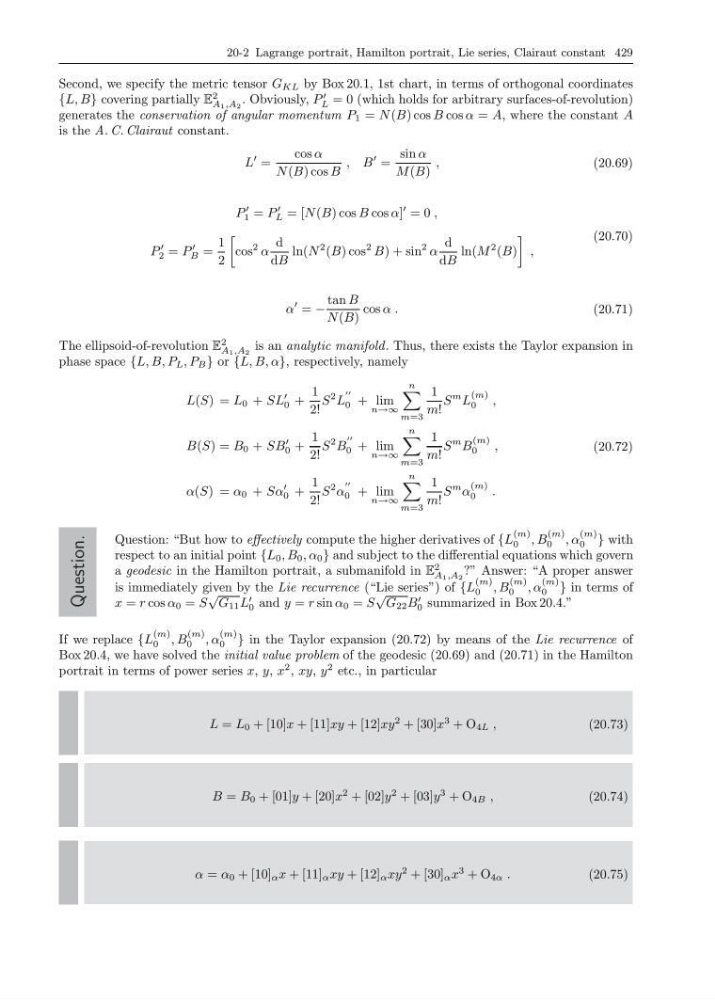
is an analytic manifold . Thus, there exists the Taylor expansion in
phase space {L, B, P L , P B } or {L, B, α}, respectively, namely
L(S) = L 0 + SL
0 +
1
2!
S
2 L
0 + lim
n→∞
n
m=3
1
m!
S
m L
(m)
0
,
B(S) = B 0 + SB
0 +
1
2!
S
2 B
0 + lim
n→∞
n
m=3
1
m!
S
m B
(m)
0
,
α(S) = α 0 + Sα
0 +
1
2!
S
2 α
0 + lim
n→∞
n
m=3
1
m!
S
m α
(m)
0
.
(20.72)
Question.
Question: “But how to effectively compute the higher derivatives of {L
(m)
0 , B
(m)
0 , α
(m)
0 } with
respect to an initial point {L 0 , B 0 , α 0 } and subject to the differential equations which govern
a geodesic in the Hamilton portrait, a submanifold in E
2
A 1 ,A 2
?” Answer: “A proper answer
is immediately given by the Lie recurrence (“Lie series”) of {L
(m)
0 , B
(m)
0 , α
(m)
0 } in terms of
x = r cos α 0 = S
√
G 11 L
0 and y = r sin α 0 = S
√
G 22 B
0 summarized in Box 20.4.”
If we replace {L
(m)
0 , B
(m)
0 , α
(m)
0 } in the Taylor expansion (20.72) by means of the Lie recurrence of
Box 20.4, we have solved the initial value problem of the geodesic (20.69) and (20.71) in the Hamilton
portrait in terms of power series x, y, x
2 , xy, y
2 etc., in particular
L = L 0 + [10]x + [11]xy + [12]xy
2 + [30]x
3 + O 4L ,
(20.73)
B = B 0 + [01]y + [20]x
2 + [02]y
2 + [03]y
3 + O 4B ,
(20.74)
α = α 0 + [10] α x + [11] α xy + [12] α xy
2 + [30] α x
3 + O 4α .
(20.75)
Second, we specify the metric tensor G KL by Box 20.1, 1st chart, in terms of orthogonal coordinates
{L, B} covering partially E
2
A 1 ,A 2
. Obviously, P
L = 0 (which holds for arbitrary surfaces-of-revolution)
generates the conservation of angular momentum P 1 = N (B) cos B cos α = A, where the constant A
is the A. C. Clairaut constant.
L
=
cos α
N (B) cos B
, B
=
sin α
M (B)
,
(20.69)
P
1 = P
L = [N (B) cos B cos α]
= 0 ,
P
2 = P
B =
1
2
cos
2 α
d
dB
ln(N
2 (B) cos
2 B) + sin
2 α
d
dB
ln(M
2 (B)
,
(20.70)
α
= −
tan B
N (B)
cos α .
(20.71)
The ellipsoid-of-revolution E
2
A 1 ,A 2
is an analytic manifold . Thus, there exists the Taylor expansion in
phase space {L, B, P L , P B } or {L, B, α}, respectively, namely
L(S) = L 0 + SL
0 +
1
2!
S
2 L
0 + lim
n→∞
n
m=3
1
m!
S
m L
(m)
0
,
B(S) = B 0 + SB
0 +
1
2!
S
2 B
0 + lim
n→∞
n
m=3
1
m!
S
m B
(m)
0
,
α(S) = α 0 + Sα
0 +
1
2!
S
2 α
0 + lim
n→∞
n
m=3
1
m!
S
m α
(m)
0
.
(20.72)
Question.
Question: “But how to effectively compute the higher derivatives of {L
(m)
0 , B
(m)
0 , α
(m)
0 } with
respect to an initial point {L 0 , B 0 , α 0 } and subject to the differential equations which govern
a geodesic in the Hamilton portrait, a submanifold in E
2
A 1 ,A 2
?” Answer: “A proper answer
is immediately given by the Lie recurrence (“Lie series”) of {L
(m)
0 , B
(m)
0 , α
(m)
0 } in terms of
x = r cos α 0 = S
√
G 11 L
0 and y = r sin α 0 = S
√
G 22 B
0 summarized in Box 20.4.”
If we replace {L
(m)
0 , B
(m)
0 , α
(m)
0 } in the Taylor expansion (20.72) by means of the Lie recurrence of
Box 20.4, we have solved the initial value problem of the geodesic (20.69) and (20.71) in the Hamilton
portrait in terms of power series x, y, x
2 , xy, y
2 etc., in particular
L = L 0 + [10]x + [11]xy + [12]xy
2 + [30]x
3 + O 4L ,
(20.73)
B = B 0 + [01]y + [20]x
2 + [02]y
2 + [03]y
3 + O 4B ,
(20.74)
α = α 0 + [10] α x + [11] α xy + [12] α xy
2 + [30] α x
3 + O 4α .
(20.75)