

428 20 Geodetic mapping
Important!
The Lagrange portrait of a geodesic is based upon Legendre series up to order five in terms
of series {U
1 , U
2
} = {L, B}, power series {S
0 , S
1 , . . . , S
n
} in terms of distance functions.
The initial values {L 0 , B 0 , L
0 , B
0 } constitute the initial value problem. In contrast, in the
boundary value problem, the homogeneous polynomial in terms of {L A − L B , B A − B B }
as power series is given, while the Riemann Cartesian coordinates {x, y} = {x
1 , x
2
} are
completely unknown.
20-22 Hamilton portrait of a geodesic: Hamilton equations, initial/boundary values
The Hamilton portrait of a geodesic, here a submanifold in E
2
A 1 ,A 2
, is based upon the generalized
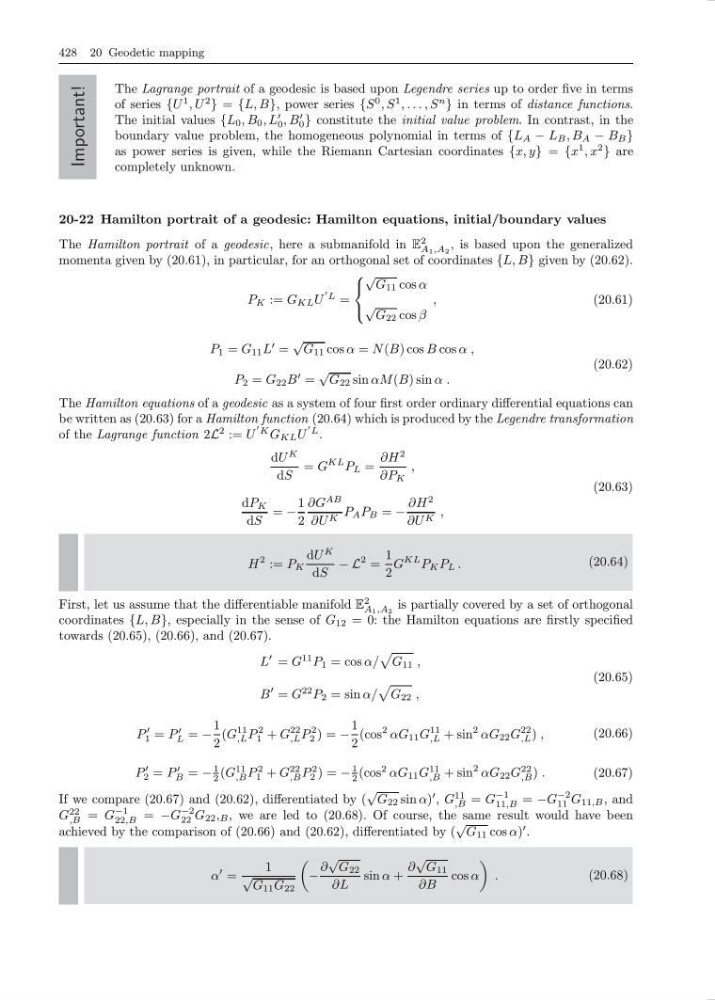
momenta given by (20.61), in particular, for an orthogonal set of coordinates {L, B} given by (20.62).
P K := G KL U
L =
⎧
⎨
⎩
√
G 11 cos α
√
G 22 cos β
,
(20.61)
P 1 = G 11 L
=
√
G 11 cos α = N (B) cos B cos α ,
P 2 = G 22 B
=
√
G 22 sin αM (B) sin α .
(20.62)
The Hamilton equations of a geodesic as a system of four first order ordinary differential equations can
be written as (20.63) for a Hamilton function (20.64) which is produced by the Legendre transformation
of the Lagrange function 2L
2 := U
K G KL U
L .
dU
K
dS
= G
KL P L =
∂H
2
∂P K
,
dP K
dS
= −
1
2
∂G
AB
∂U K P A P B = −
∂H
2
∂U K ,
(20.63)
H
2 := P K
dU
K
dS
− L
2 =
1
2
G
KL P K P L .
(20.64)
First, let us assume that the differentiable manifold E
2
A 1 ,A 2
is partially covered by a set of orthogonal
coordinates {L, B}, especially in the sense of G 12 = 0: the Hamilton equations are firstly specified
towards (20.65), (20.66), and (20.67).
L
= G
11 P 1 = cos α/
G 11 ,
B
= G
22 P 2 = sin α/
G 22 ,
(20.65)
P
1 = P
L = −
1
2
(G
11
,L P
2
1 + G
22
,L P
2
2 ) = −
1
2
(cos
2 αG 11 G
11
,L + sin
2 αG 22 G
22
,L ) ,
(20.66)
P
2 = P
B = −
1
2 (G
11
,B P
2
1 + G
22
,B P
2
2 ) = −
1
2 (cos
2 αG 11 G
11
,B + sin
2 αG 22 G
22
,B ) .
(20.67)
If we compare (20.67) and (20.62), differentiated by (
√
G 22 sin α)
, G
11
,B = G
−1
11,B = −G
−2
11 G 11,B , and
G
22
,B = G
−1
22,B = −G
−2
22 G 22 , B , we are led to (20.68). Of course, the same result would have been
achieved by the comparison of (20.66) and (20.62), differentiated by (
√
G 11 cos α)
.
α
=
1
√
G 11 G 22
−
∂
√
G 22
∂L
sin α +
∂
√
G 11
∂B
cos α
.
(20.68)
Important!
The Lagrange portrait of a geodesic is based upon Legendre series up to order five in terms
of series {U
1 , U
2
} = {L, B}, power series {S
0 , S
1 , . . . , S
n
} in terms of distance functions.
The initial values {L 0 , B 0 , L
0 , B
0 } constitute the initial value problem. In contrast, in the
boundary value problem, the homogeneous polynomial in terms of {L A − L B , B A − B B }
as power series is given, while the Riemann Cartesian coordinates {x, y} = {x
1 , x
2
} are
completely unknown.
20-22 Hamilton portrait of a geodesic: Hamilton equations, initial/boundary values
The Hamilton portrait of a geodesic, here a submanifold in E
2
A 1 ,A 2
, is based upon the generalized
momenta given by (20.61), in particular, for an orthogonal set of coordinates {L, B} given by (20.62).
P K := G KL U
L =
⎧
⎨
⎩
√
G 11 cos α
√
G 22 cos β
,
(20.61)
P 1 = G 11 L
=
√
G 11 cos α = N (B) cos B cos α ,
P 2 = G 22 B
=
√
G 22 sin αM (B) sin α .
(20.62)
The Hamilton equations of a geodesic as a system of four first order ordinary differential equations can
be written as (20.63) for a Hamilton function (20.64) which is produced by the Legendre transformation
of the Lagrange function 2L
2 := U
K G KL U
L .
dU
K
dS
= G
KL P L =
∂H
2
∂P K
,
dP K
dS
= −
1
2
∂G
AB
∂U K P A P B = −
∂H
2
∂U K ,
(20.63)
H
2 := P K
dU
K
dS
− L
2 =
1
2
G
KL P K P L .
(20.64)
First, let us assume that the differentiable manifold E
2
A 1 ,A 2
is partially covered by a set of orthogonal
coordinates {L, B}, especially in the sense of G 12 = 0: the Hamilton equations are firstly specified
towards (20.65), (20.66), and (20.67).
L
= G
11 P 1 = cos α/
G 11 ,
B
= G
22 P 2 = sin α/
G 22 ,
(20.65)
P
1 = P
L = −
1
2
(G
11
,L P
2
1 + G
22
,L P
2
2 ) = −
1
2
(cos
2 αG 11 G
11
,L + sin
2 αG 22 G
22
,L ) ,
(20.66)
P
2 = P
B = −
1
2 (G
11
,B P
2
1 + G
22
,B P
2
2 ) = −
1
2 (cos
2 αG 11 G
11
,B + sin
2 αG 22 G
22
,B ) .
(20.67)
If we compare (20.67) and (20.62), differentiated by (
√
G 22 sin α)
, G
11
,B = G
−1
11,B = −G
−2
11 G 11,B , and
G
22
,B = G
−1
22,B = −G
−2
22 G 22 , B , we are led to (20.68). Of course, the same result would have been
achieved by the comparison of (20.66) and (20.62), differentiated by (
√
G 11 cos α)
.
α
=
1
√
G 11 G 22
−
∂
√
G 22
∂L
sin α +
∂
√
G 11
∂B
cos α
.
(20.68)