

20 Geodetic mapping
Geodesics, geodetic mapping. Riemann, Soldner, and Fermi coordinates on the ellipsoid-of-revolution,
initial values, boundary values. Initial value problems versus boundary value problems.
A global length preserving mapping of a geodetic reference surface such as the sphere or such as
the ellipsoid-of-revolution (spheroid) onto the plane (the chart) does not exist. Thus, as a compromise, equidistant mappings of certain coordinate lines like the equator or the central meridian of a
UTM/Gauss–Krueger strip system have been proposed. Of focal interest are geodetic mappings: a
mapping of a surface (two-dimensional Riemann manifold) is called geodetic if geodesics on the given
surface (in particular, shortest geodesics like the “great circles” on the sphere) are mapped onto
straight lines in the plane (the chart). In the plane (the chart), straight lines are geodesics, of course.
According to a fundamental lemma of E. Beltrami (1866), a geodetic mapping of a surface exists if
and only if the surface is characterized by constant Gaussian curvature. Thus, a geodetic mapping of
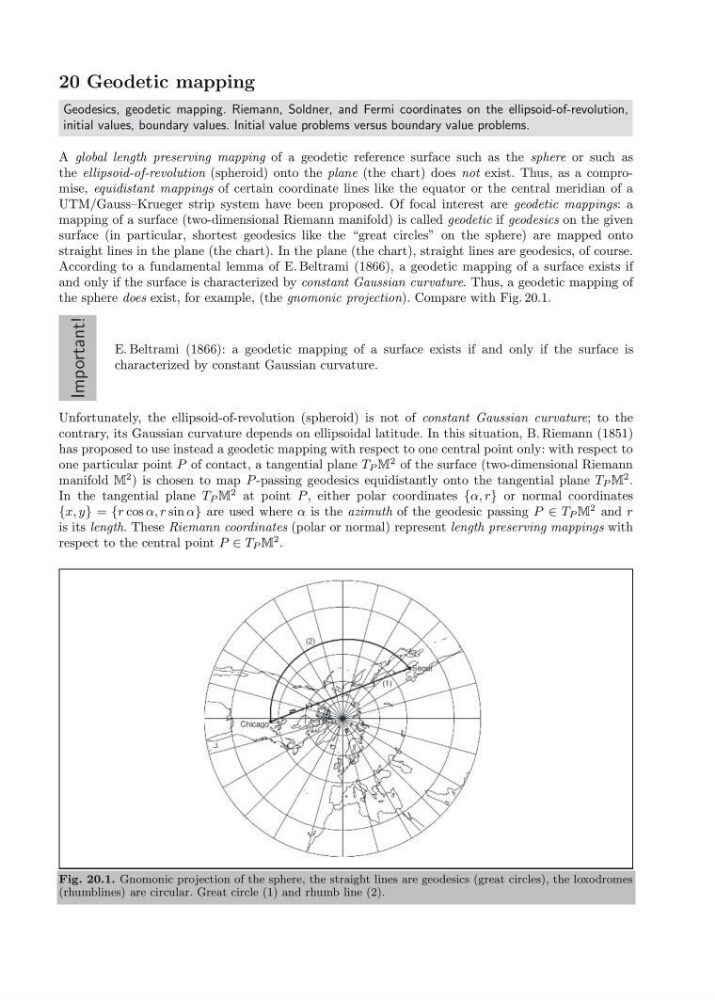
the sphere does exist, for example, (the gnomonic projection). Compare with Fig. 20.1.
Important!
E. Beltrami (1866): a geodetic mapping of a surface exists if and only if the surface is
characterized by constant Gaussian curvature.
Unfortunately, the ellipsoid-of-revolution (spheroid) is not of constant Gaussian curvature; to the
contrary, its Gaussian curvature depends on ellipsoidal latitude. In this situation, B. Riemann (1851)
has proposed to use instead a geodetic mapping with respect to one central point only: with respect to
one particular point P of contact, a tangential plane T P M
2 of the surface (two-dimensional Riemann
manifold M
2 ) is chosen to map P -passing geodesics equidistantly onto the tangential plane T P M
2 .
In the tangential plane T P M
2 at point P , either polar coordinates {α, r} or normal coordinates
{x, y} = {r cos α, r sin α} are used where α is the azimuth of the geodesic passing P ∈ T P M
2 and r
is its length. These Riemann coordinates (polar or normal) represent length preserving mappings with
respect to the central point P ∈ T P M
2 .
Fig. 20.1. Gnomonic projection of the sphere, the straight lines are geodesics (great circles), the loxodromes
(rhumblines) are circular. Great circle (1) and rhumb line (2).
Geodesics, geodetic mapping. Riemann, Soldner, and Fermi coordinates on the ellipsoid-of-revolution,
initial values, boundary values. Initial value problems versus boundary value problems.
A global length preserving mapping of a geodetic reference surface such as the sphere or such as
the ellipsoid-of-revolution (spheroid) onto the plane (the chart) does not exist. Thus, as a compromise, equidistant mappings of certain coordinate lines like the equator or the central meridian of a
UTM/Gauss–Krueger strip system have been proposed. Of focal interest are geodetic mappings: a
mapping of a surface (two-dimensional Riemann manifold) is called geodetic if geodesics on the given
surface (in particular, shortest geodesics like the “great circles” on the sphere) are mapped onto
straight lines in the plane (the chart). In the plane (the chart), straight lines are geodesics, of course.
According to a fundamental lemma of E. Beltrami (1866), a geodetic mapping of a surface exists if
and only if the surface is characterized by constant Gaussian curvature. Thus, a geodetic mapping of
the sphere does exist, for example, (the gnomonic projection). Compare with Fig. 20.1.
Important!
E. Beltrami (1866): a geodetic mapping of a surface exists if and only if the surface is
characterized by constant Gaussian curvature.
Unfortunately, the ellipsoid-of-revolution (spheroid) is not of constant Gaussian curvature; to the
contrary, its Gaussian curvature depends on ellipsoidal latitude. In this situation, B. Riemann (1851)
has proposed to use instead a geodetic mapping with respect to one central point only: with respect to
one particular point P of contact, a tangential plane T P M
2 of the surface (two-dimensional Riemann
manifold M
2 ) is chosen to map P -passing geodesics equidistantly onto the tangential plane T P M
2 .
In the tangential plane T P M
2 at point P , either polar coordinates {α, r} or normal coordinates
{x, y} = {r cos α, r sin α} are used where α is the azimuth of the geodesic passing P ∈ T P M
2 and r
is its length. These Riemann coordinates (polar or normal) represent length preserving mappings with
respect to the central point P ∈ T P M
2 .
Fig. 20.1. Gnomonic projection of the sphere, the straight lines are geodesics (great circles), the loxodromes
(rhumblines) are circular. Great circle (1) and rhumb line (2).