

414 19 “Ellipsoid-of-revolution to cone”: polar aspect
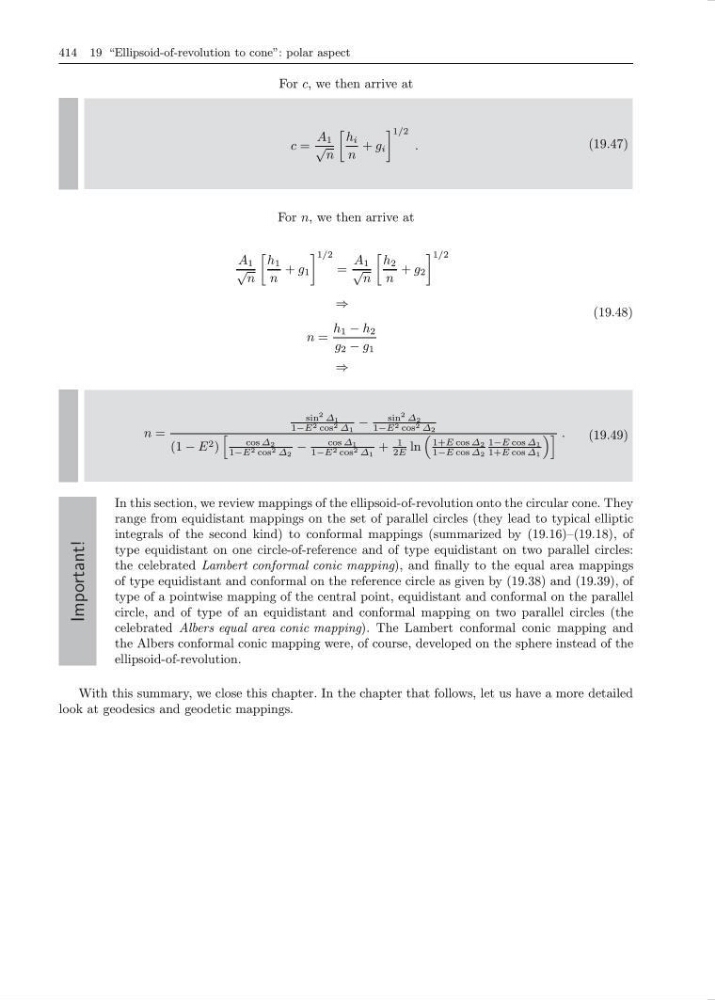
For c, we then arrive at
c =
A 1
√ n
h i
n
+ g i
1/2
.
(19.47)
For n, we then arrive at
A 1
√
n
h 1
n
+ g 1
1/2
=
A 1
√
n
h 2
n
+ g 2
1/2
⇒
n =
h 1 − h 2
g 2 − g 1
⇒
(19.48)
n =
sin
2 ∆ 1
1−E 2 cos 2 ∆ 1
−
sin
2 ∆ 2
1−E 2 cos 2 ∆ 2
(1 − E 2 )
cos ∆ 2
1−E 2 cos 2 ∆ 2
−
cos ∆ 1
1−E 2 cos 2 ∆ 1
+
1
2E ln
1+E cos ∆ 2
1−E cos ∆ 2
1−E cos ∆ 1
1+E cos ∆ 1
.
(19.49)
Important!
In this section, we review mappings of the ellipsoid-of-revolution onto the circular cone. They
range from equidistant mappings on the set of parallel circles (they lead to typical elliptic
integrals of the second kind) to conformal mappings (summarized by (19.16)–(19.18), of
type equidistant on one circle-of-reference and of type equidistant on two parallel circles:
the celebrated Lambert conformal conic mapping), and finally to the equal area mappings
of type equidistant and conformal on the reference circle as given by (19.38) and (19.39), of
type of a pointwise mapping of the central point, equidistant and conformal on the parallel
circle, and of type of an equidistant and conformal mapping on two parallel circles (the
celebrated Albers equal area conic mapping). The Lambert conformal conic mapping and
the Albers conformal conic mapping were, of course, developed on the sphere instead of the
ellipsoid-of-revolution.
With this summary, we close this chapter. In the chapter that follows, let us have a more detailed
look at geodesics and geodetic mappings.
For c, we then arrive at
c =
A 1
√ n
h i
n
+ g i
1/2
.
(19.47)
For n, we then arrive at
A 1
√
n
h 1
n
+ g 1
1/2
=
A 1
√
n
h 2
n
+ g 2
1/2
⇒
n =
h 1 − h 2
g 2 − g 1
⇒
(19.48)
n =
sin
2 ∆ 1
1−E 2 cos 2 ∆ 1
−
sin
2 ∆ 2
1−E 2 cos 2 ∆ 2
(1 − E 2 )
cos ∆ 2
1−E 2 cos 2 ∆ 2
−
cos ∆ 1
1−E 2 cos 2 ∆ 1
+
1
2E ln
1+E cos ∆ 2
1−E cos ∆ 2
1−E cos ∆ 1
1+E cos ∆ 1
.
(19.49)
Important!
In this section, we review mappings of the ellipsoid-of-revolution onto the circular cone. They
range from equidistant mappings on the set of parallel circles (they lead to typical elliptic
integrals of the second kind) to conformal mappings (summarized by (19.16)–(19.18), of
type equidistant on one circle-of-reference and of type equidistant on two parallel circles:
the celebrated Lambert conformal conic mapping), and finally to the equal area mappings
of type equidistant and conformal on the reference circle as given by (19.38) and (19.39), of
type of a pointwise mapping of the central point, equidistant and conformal on the parallel
circle, and of type of an equidistant and conformal mapping on two parallel circles (the
celebrated Albers equal area conic mapping). The Lambert conformal conic mapping and
the Albers conformal conic mapping were, of course, developed on the sphere instead of the
ellipsoid-of-revolution.
With this summary, we close this chapter. In the chapter that follows, let us have a more detailed
look at geodesics and geodetic mappings.