

19-2 Special conic projections based upon the ellipsoid-of-revolution 413
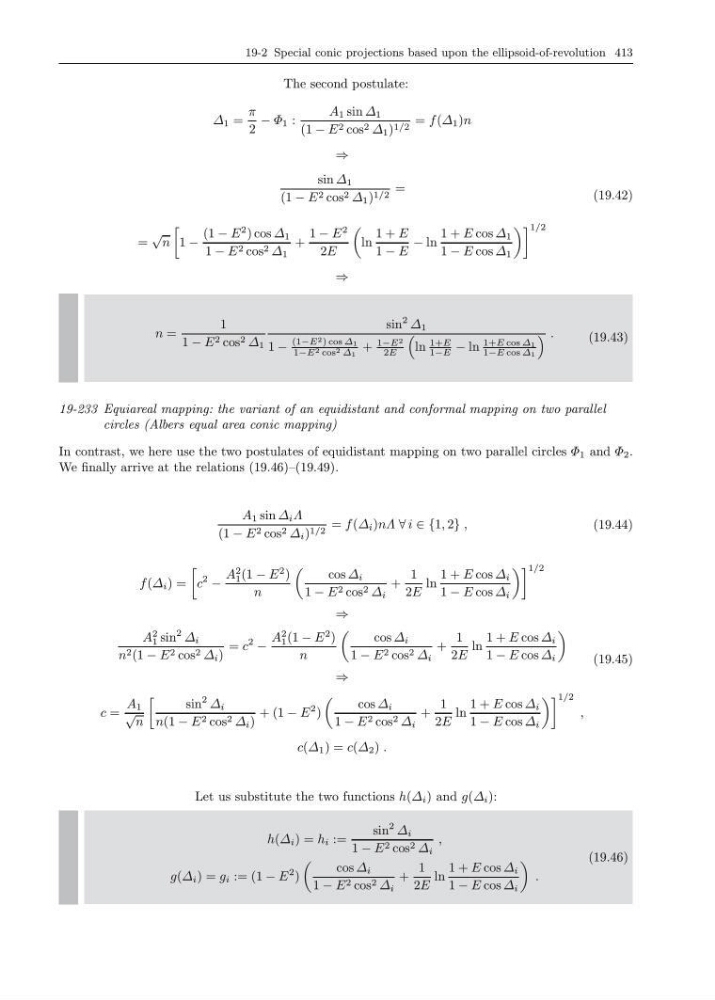
The second postulate:
∆ 1 =
π
2
− Φ 1 :
A 1 sin ∆ 1
(1 − E 2 cos 2 ∆ 1 ) 1/2 = f (∆ 1 )n
⇒
sin ∆ 1
(1 − E 2 cos 2 ∆ 1 ) 1/2 =
=
√
n
1 −
(1 − E
2 ) cos ∆ 1
1 − E 2 cos 2 ∆ 1
+
1 − E
2
2E
ln
1 + E
1 − E
− ln
1 + E cos ∆ 1
1 − E cos ∆ 1
1/2
⇒
(19.42)
n =
1
1 − E 2 cos 2 ∆ 1
sin
2 ∆ 1
1 −
(1−E 2 ) cos ∆ 1
1−E 2 cos 2 ∆ 1
+
1−E 2
2E
ln
1+E
1−E − ln
1+E cos ∆ 1
1−E cos ∆ 1
.
(19.43)
19-233 Equiareal mapping: the variant of an equidistant and conformal mapping on two parallel
circles (Albers equal area conic mapping)
In contrast, we here use the two postulates of equidistant mapping on two parallel circles Φ 1 and Φ 2 .
We finally arrive at the relations (19.46)–(19.49).
A 1 sin ∆ i Λ
(1 − E 2 cos 2 ∆ i ) 1/2 = f (∆ i )nΛ ∀ i ∈ {1, 2} ,
(19.44)
f (∆ i ) =
c
2
−
A
2
1 (1 − E
2 )
n
cos ∆ i
1 − E 2 cos 2 ∆ i
+
1
2E
ln
1 + E cos ∆ i
1 − E cos ∆ i
1/2
⇒
A
2
1 sin
2 ∆ i
n 2 (1 − E 2 cos 2 ∆ i )
= c
2
−
A
2
1 (1 − E
2 )
n
cos ∆ i
1 − E 2 cos 2 ∆ i
+
1
2E
ln
1 + E cos ∆ i
1 − E cos ∆ i
⇒
c =
A 1
√
n
sin
2 ∆ i
n(1 − E 2 cos 2 ∆ i )
+ (1 − E
2 )
cos ∆ i
1 − E 2 cos 2 ∆ i
+
1
2E
ln
1 + E cos ∆ i
1 − E cos ∆ i
1/2
,
c(∆ 1 ) = c(∆ 2 ) .
(19.45)
Let us substitute the two functions h(∆ i ) and g(∆ i ):
h(∆ i ) = h i :=
sin
2 ∆ i
1 − E 2 cos 2 ∆ i
,
g(∆ i ) = g i := (1 − E
2 )
cos ∆ i
1 − E 2 cos 2 ∆ i
+
1
2E
ln
1 + E cos ∆ i
1 − E cos ∆ i
.
(19.46)
The second postulate:
∆ 1 =
π
2
− Φ 1 :
A 1 sin ∆ 1
(1 − E 2 cos 2 ∆ 1 ) 1/2 = f (∆ 1 )n
⇒
sin ∆ 1
(1 − E 2 cos 2 ∆ 1 ) 1/2 =
=
√
n
1 −
(1 − E
2 ) cos ∆ 1
1 − E 2 cos 2 ∆ 1
+
1 − E
2
2E
ln
1 + E
1 − E
− ln
1 + E cos ∆ 1
1 − E cos ∆ 1
1/2
⇒
(19.42)
n =
1
1 − E 2 cos 2 ∆ 1
sin
2 ∆ 1
1 −
(1−E 2 ) cos ∆ 1
1−E 2 cos 2 ∆ 1
+
1−E 2
2E
ln
1+E
1−E − ln
1+E cos ∆ 1
1−E cos ∆ 1
.
(19.43)
19-233 Equiareal mapping: the variant of an equidistant and conformal mapping on two parallel
circles (Albers equal area conic mapping)
In contrast, we here use the two postulates of equidistant mapping on two parallel circles Φ 1 and Φ 2 .
We finally arrive at the relations (19.46)–(19.49).
A 1 sin ∆ i Λ
(1 − E 2 cos 2 ∆ i ) 1/2 = f (∆ i )nΛ ∀ i ∈ {1, 2} ,
(19.44)
f (∆ i ) =
c
2
−
A
2
1 (1 − E
2 )
n
cos ∆ i
1 − E 2 cos 2 ∆ i
+
1
2E
ln
1 + E cos ∆ i
1 − E cos ∆ i
1/2
⇒
A
2
1 sin
2 ∆ i
n 2 (1 − E 2 cos 2 ∆ i )
= c
2
−
A
2
1 (1 − E
2 )
n
cos ∆ i
1 − E 2 cos 2 ∆ i
+
1
2E
ln
1 + E cos ∆ i
1 − E cos ∆ i
⇒
c =
A 1
√
n
sin
2 ∆ i
n(1 − E 2 cos 2 ∆ i )
+ (1 − E
2 )
cos ∆ i
1 − E 2 cos 2 ∆ i
+
1
2E
ln
1 + E cos ∆ i
1 − E cos ∆ i
1/2
,
c(∆ 1 ) = c(∆ 2 ) .
(19.45)
Let us substitute the two functions h(∆ i ) and g(∆ i ):
h(∆ i ) = h i :=
sin
2 ∆ i
1 − E 2 cos 2 ∆ i
,
g(∆ i ) = g i := (1 − E
2 )
cos ∆ i
1 − E 2 cos 2 ∆ i
+
1
2E
ln
1 + E cos ∆ i
1 − E cos ∆ i
.
(19.46)