

412 19 “Ellipsoid-of-revolution to cone”: polar aspect
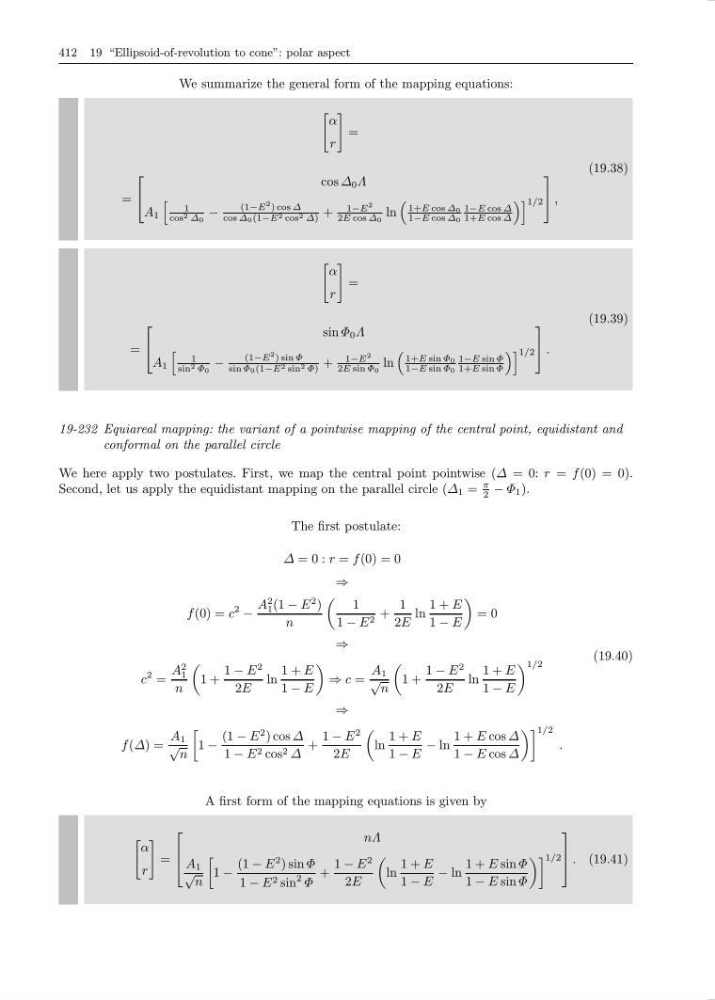
We summarize the general form of the mapping equations:
α
r
=
=
⎡
⎣
cos ∆ 0 Λ
A 1
1
cos 2 ∆ 0
−
(1−E
2 ) cos ∆
cos ∆ 0 (1−E 2 cos 2 ∆) +
1−E
2
2E cos ∆ 0
ln
1+E cos ∆ 0
1−E cos ∆ 0
1−E cos ∆
1+E cos ∆
1/2
⎤
⎦ ,
(19.38)
α
r
=
=
⎡
⎣
sin Φ 0 Λ
A 1
1
sin 2 Φ 0
−
(1−E
2 ) sin Φ
sin Φ 0 (1−E 2 sin 2 Φ)
+
1−E
2
2E sin Φ 0
ln
1+E sin Φ 0
1−E sin Φ 0
1−E sin Φ
1+E sin Φ
1/2
⎤
⎦ .
(19.39)
19-232 Equiareal mapping: the variant of a pointwise mapping of the central point, equidistant and
conformal on the parallel circle
We here apply two postulates. First, we map the central point pointwise (∆ = 0: r = f (0) = 0).
Second, let us apply the equidistant mapping on the parallel circle (∆ 1 =
π
2 − Φ 1 ).
The first postulate:
∆ = 0 : r = f (0) = 0
⇒
f (0) = c
2
−
A
2
1 (1 − E
2 )
n
1
1 − E 2 +
1
2E
ln
1 + E
1 − E
= 0
⇒
c
2 =
A
2
1
n
1 +
1 − E
2
2E
ln
1 + E
1 − E
⇒ c =
A 1
√
n
1 +
1 − E
2
2E
ln
1 + E
1 − E
1/2
⇒
f (∆) =
A 1
√
n
1 −
(1 − E
2 ) cos ∆
1 − E 2 cos 2 ∆
+
1 − E
2
2E
ln
1 + E
1 − E
− ln
1 + E cos ∆
1 − E cos ∆
1/2
.
(19.40)
A first form of the mapping equations is given by
α
r
=
⎡
⎢
⎣
nΛ
A 1
√ n
1 −
(1 − E
2 ) sin Φ
1 − E 2 sin
2 Φ
+
1 − E
2
2E
ln
1 + E
1 − E
− ln
1 + E sin Φ
1 − E sin Φ
1/2
⎤
⎥
⎦ . (19.41)
We summarize the general form of the mapping equations:
α
r
=
=
⎡
⎣
cos ∆ 0 Λ
A 1
1
cos 2 ∆ 0
−
(1−E
2 ) cos ∆
cos ∆ 0 (1−E 2 cos 2 ∆) +
1−E
2
2E cos ∆ 0
ln
1+E cos ∆ 0
1−E cos ∆ 0
1−E cos ∆
1+E cos ∆
1/2
⎤
⎦ ,
(19.38)
α
r
=
=
⎡
⎣
sin Φ 0 Λ
A 1
1
sin 2 Φ 0
−
(1−E
2 ) sin Φ
sin Φ 0 (1−E 2 sin 2 Φ)
+
1−E
2
2E sin Φ 0
ln
1+E sin Φ 0
1−E sin Φ 0
1−E sin Φ
1+E sin Φ
1/2
⎤
⎦ .
(19.39)
19-232 Equiareal mapping: the variant of a pointwise mapping of the central point, equidistant and
conformal on the parallel circle
We here apply two postulates. First, we map the central point pointwise (∆ = 0: r = f (0) = 0).
Second, let us apply the equidistant mapping on the parallel circle (∆ 1 =
π
2 − Φ 1 ).
The first postulate:
∆ = 0 : r = f (0) = 0
⇒
f (0) = c
2
−
A
2
1 (1 − E
2 )
n
1
1 − E 2 +
1
2E
ln
1 + E
1 − E
= 0
⇒
c
2 =
A
2
1
n
1 +
1 − E
2
2E
ln
1 + E
1 − E
⇒ c =
A 1
√
n
1 +
1 − E
2
2E
ln
1 + E
1 − E
1/2
⇒
f (∆) =
A 1
√
n
1 −
(1 − E
2 ) cos ∆
1 − E 2 cos 2 ∆
+
1 − E
2
2E
ln
1 + E
1 − E
− ln
1 + E cos ∆
1 − E cos ∆
1/2
.
(19.40)
A first form of the mapping equations is given by
α
r
=
⎡
⎢
⎣
nΛ
A 1
√ n
1 −
(1 − E
2 ) sin Φ
1 − E 2 sin
2 Φ
+
1 − E
2
2E
ln
1 + E
1 − E
− ln
1 + E sin Φ
1 − E sin Φ
1/2
⎤
⎥
⎦ . (19.41)