

19-2 Special conic projections based upon the ellipsoid-of-revolution 409
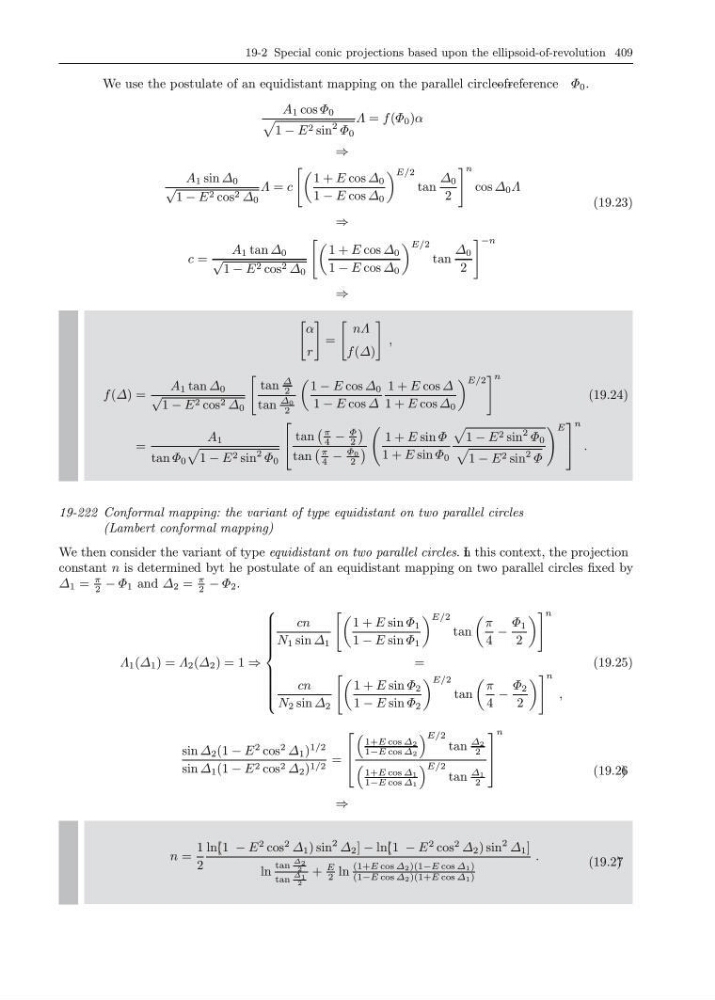
We use the postulate of an equidistant mapping on the parallel circle- of- reference Φ 0 .
A 1 cos Φ 0
1 − E 2 sin
2 Φ 0
Λ = f (Φ 0 )α
⇒
A 1 sin ∆ 0
√
1 − E 2 cos 2 ∆ 0
Λ = c
1 + E cos ∆ 0
1 − E cos ∆ 0
E/2
tan
∆ 0
2
n
cos ∆ 0 Λ
⇒
c =
A 1 tan ∆ 0
√
1 − E 2 cos 2 ∆ 0
1 + E cos ∆ 0
1 − E cos ∆ 0
E/2
tan
∆ 0
2
−n
⇒
(19.23)
α
r
=
nΛ
f (∆)
,
f (∆) =
A 1 tan ∆ 0
√
1 − E 2 cos 2 ∆ 0
tan
∆
2
tan
∆ 0
2
1 − E cos ∆ 0
1 − E cos ∆
1 + E cos ∆
1 + E cos ∆ 0
E/2
n
=
A 1
tan Φ 0
1 − E 2 sin
2 Φ 0
⎡
⎣
tan
π
4 −
Φ
2
tan
π
4 −
Φ 0
2
1 + E sin Φ
1 + E sin Φ 0
1 − E 2 sin
2 Φ 0
1 − E 2 sin
2 Φ
E
⎤
⎦
n
.
(19.24)
19-222 Conformal mapping: the variant of type equidistant on two parallel circles
(Lambert conformal mapping)
We then consider the variant of type equidistant on two parallel circles. I
n this context, the projection
constant n is determined byt he postulate of an equidistant mapping on two parallel circles fixed by
∆ 1 =
π
2 − Φ 1 and ∆ 2 =
π
2 − Φ 2 .
Λ 1 (∆ 1 ) = Λ 2 (∆ 2 ) = 1 ⇒
⎧
⎪ ⎪ ⎪ ⎪ ⎪ ⎪ ⎪ ⎨
⎪ ⎪ ⎪ ⎪ ⎪ ⎪ ⎪ ⎩
cn
N 1 sin ∆ 1
1 + E sin Φ 1
1 − E sin Φ 1
E/2
tan
π
4
−
Φ 1
2
n
=
cn
N 2 sin ∆ 2
1 + E sin Φ 2
1 − E sin Φ 2
E/2
tan
π
4
−
Φ 2
2
n
,
(19.25)
sin ∆ 2 (1 − E
2 cos
2 ∆ 1 )
1/2
sin ∆ 1 (1 − E 2 cos 2 ∆ 2 ) 1/2 =
⎡
⎢
⎣
1+E cos ∆ 2
1−E cos ∆ 2
E/2
tan
∆ 2
2
1+E cos ∆ 1
1−E cos ∆ 1
E/2
tan
∆ 1
2
⎤
⎥
⎦
n
⇒
(19.26 )
n =
1
2
ln[ (1 − E
2 cos
2 ∆ 1 ) sin
2 ∆ 2 ] − ln[ (1 − E
2 cos
2 ∆ 2 ) sin
2 ∆ 1 ]
ln
tan
∆ 2
2
tan
∆ 1
2
+
E
2 ln
(1+E cos ∆ 2 )(1−E cos ∆ 1 )
(1−E cos ∆ 2 )(1+E cos ∆ 1 )
.
(19.27 )
We use the postulate of an equidistant mapping on the parallel circle- of- reference Φ 0 .
A 1 cos Φ 0
1 − E 2 sin
2 Φ 0
Λ = f (Φ 0 )α
⇒
A 1 sin ∆ 0
√
1 − E 2 cos 2 ∆ 0
Λ = c
1 + E cos ∆ 0
1 − E cos ∆ 0
E/2
tan
∆ 0
2
n
cos ∆ 0 Λ
⇒
c =
A 1 tan ∆ 0
√
1 − E 2 cos 2 ∆ 0
1 + E cos ∆ 0
1 − E cos ∆ 0
E/2
tan
∆ 0
2
−n
⇒
(19.23)
α
r
=
nΛ
f (∆)
,
f (∆) =
A 1 tan ∆ 0
√
1 − E 2 cos 2 ∆ 0
tan
∆
2
tan
∆ 0
2
1 − E cos ∆ 0
1 − E cos ∆
1 + E cos ∆
1 + E cos ∆ 0
E/2
n
=
A 1
tan Φ 0
1 − E 2 sin
2 Φ 0
⎡
⎣
tan
π
4 −
Φ
2
tan
π
4 −
Φ 0
2
1 + E sin Φ
1 + E sin Φ 0
1 − E 2 sin
2 Φ 0
1 − E 2 sin
2 Φ
E
⎤
⎦
n
.
(19.24)
19-222 Conformal mapping: the variant of type equidistant on two parallel circles
(Lambert conformal mapping)
We then consider the variant of type equidistant on two parallel circles. I
n this context, the projection
constant n is determined byt he postulate of an equidistant mapping on two parallel circles fixed by
∆ 1 =
π
2 − Φ 1 and ∆ 2 =
π
2 − Φ 2 .
Λ 1 (∆ 1 ) = Λ 2 (∆ 2 ) = 1 ⇒
⎧
⎪ ⎪ ⎪ ⎪ ⎪ ⎪ ⎪ ⎨
⎪ ⎪ ⎪ ⎪ ⎪ ⎪ ⎪ ⎩
cn
N 1 sin ∆ 1
1 + E sin Φ 1
1 − E sin Φ 1
E/2
tan
π
4
−
Φ 1
2
n
=
cn
N 2 sin ∆ 2
1 + E sin Φ 2
1 − E sin Φ 2
E/2
tan
π
4
−
Φ 2
2
n
,
(19.25)
sin ∆ 2 (1 − E
2 cos
2 ∆ 1 )
1/2
sin ∆ 1 (1 − E 2 cos 2 ∆ 2 ) 1/2 =
⎡
⎢
⎣
1+E cos ∆ 2
1−E cos ∆ 2
E/2
tan
∆ 2
2
1+E cos ∆ 1
1−E cos ∆ 1
E/2
tan
∆ 1
2
⎤
⎥
⎦
n
⇒
(19.26 )
n =
1
2
ln[ (1 − E
2 cos
2 ∆ 1 ) sin
2 ∆ 2 ] − ln[ (1 − E
2 cos
2 ∆ 2 ) sin
2 ∆ 1 ]
ln
tan
∆ 2
2
tan
∆ 1
2
+
E
2 ln
(1+E cos ∆ 2 )(1−E cos ∆ 1 )
(1−E cos ∆ 2 )(1+E cos ∆ 1 )
.
(19.27 )