

410 19 “Ellipsoid-of-revolution to cone”: polar aspect
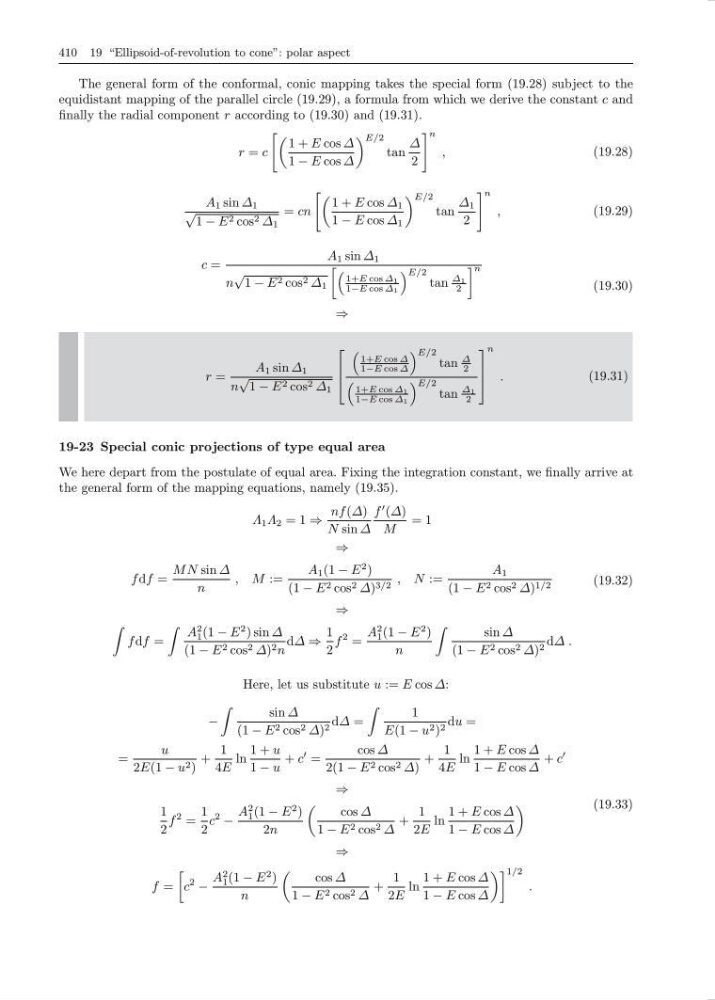
The general form of the conformal, conic mapping takes the special form (19.28) subject to the
equidistant mapping of the parallel circle (19.29), a formula from which we derive the constant c and
finally the radial component r according to (19.30) and (19.31).
r = c
1 + E cos ∆
1 − E cos ∆
E/2
tan
∆
2
n
,
(19.28)
A 1 sin ∆ 1
√
1 − E 2 cos 2 ∆ 1
= cn
1 + E cos ∆ 1
1 − E cos ∆ 1
E/2
tan
∆ 1
2
n
,
(19.29)
c =
A 1 sin ∆ 1
n
√
1 − E 2 cos 2 ∆ 1
1+E cos ∆ 1
1−E cos ∆ 1
E/2
tan
∆ 1
2
n
⇒
(19.30)
r =
A 1 sin ∆ 1
n
√
1 − E 2 cos 2 ∆ 1
⎡
⎢
⎣
1+E cos ∆
1−E cos ∆
E/2
tan
∆
2
1+E cos ∆ 1
1−E cos ∆ 1
E/2
tan
∆ 1
2
⎤
⎥
⎦
n
.
(19.31)
19-23 Special conic projections of type equal area
We here depart from the postulate of equal area. Fixing the integration constant, we finally arrive at
the general form of the mapping equations, namely (19.35).
Λ 1 Λ 2 = 1 ⇒
nf (∆)
N sin ∆
f
(∆)
M
= 1
⇒
f df =
MN sin ∆
n
, M :=
A 1 (1 − E
2 )
(1 − E 2 cos 2 ∆) 3/2 , N :=
A 1
(1 − E 2 cos 2 ∆) 1/2
⇒
f df =
A
2
1 (1 − E
2 ) sin ∆
(1 − E 2 cos 2 ∆) 2 n
d∆ ⇒
1
2
f
2 =
A
2
1 (1 − E
2 )
n
sin ∆
(1 − E 2 cos 2 ∆) 2 d∆ .
(19.32)
Here, let us substitute u := E cos ∆:
−
sin ∆
(1 − E 2 cos 2 ∆) 2 d∆ =
1
E(1 − u 2 ) 2 du =
=
u
2E(1 − u 2 )
+
1
4E
ln
1 + u
1 − u
+ c
=
cos ∆
2(1 − E 2 cos 2 ∆)
+
1
4E
ln
1 + E cos ∆
1 − E cos ∆
+ c
⇒
1
2
f
2 =
1
2
c
2
−
A
2
1 (1 − E
2 )
2n
cos ∆
1 − E 2 cos 2 ∆
+
1
2E
ln
1 + E cos ∆
1 − E cos ∆
⇒
f =
c
2
−
A
2
1 (1 − E
2 )
n
cos ∆
1 − E 2 cos 2 ∆
+
1
2E
ln
1 + E cos ∆
1 − E cos ∆
1/2
.
(19.33)
The general form of the conformal, conic mapping takes the special form (19.28) subject to the
equidistant mapping of the parallel circle (19.29), a formula from which we derive the constant c and
finally the radial component r according to (19.30) and (19.31).
r = c
1 + E cos ∆
1 − E cos ∆
E/2
tan
∆
2
n
,
(19.28)
A 1 sin ∆ 1
√
1 − E 2 cos 2 ∆ 1
= cn
1 + E cos ∆ 1
1 − E cos ∆ 1
E/2
tan
∆ 1
2
n
,
(19.29)
c =
A 1 sin ∆ 1
n
√
1 − E 2 cos 2 ∆ 1
1+E cos ∆ 1
1−E cos ∆ 1
E/2
tan
∆ 1
2
n
⇒
(19.30)
r =
A 1 sin ∆ 1
n
√
1 − E 2 cos 2 ∆ 1
⎡
⎢
⎣
1+E cos ∆
1−E cos ∆
E/2
tan
∆
2
1+E cos ∆ 1
1−E cos ∆ 1
E/2
tan
∆ 1
2
⎤
⎥
⎦
n
.
(19.31)
19-23 Special conic projections of type equal area
We here depart from the postulate of equal area. Fixing the integration constant, we finally arrive at
the general form of the mapping equations, namely (19.35).
Λ 1 Λ 2 = 1 ⇒
nf (∆)
N sin ∆
f
(∆)
M
= 1
⇒
f df =
MN sin ∆
n
, M :=
A 1 (1 − E
2 )
(1 − E 2 cos 2 ∆) 3/2 , N :=
A 1
(1 − E 2 cos 2 ∆) 1/2
⇒
f df =
A
2
1 (1 − E
2 ) sin ∆
(1 − E 2 cos 2 ∆) 2 n
d∆ ⇒
1
2
f
2 =
A
2
1 (1 − E
2 )
n
sin ∆
(1 − E 2 cos 2 ∆) 2 d∆ .
(19.32)
Here, let us substitute u := E cos ∆:
−
sin ∆
(1 − E 2 cos 2 ∆) 2 d∆ =
1
E(1 − u 2 ) 2 du =
=
u
2E(1 − u 2 )
+
1
4E
ln
1 + u
1 − u
+ c
=
cos ∆
2(1 − E 2 cos 2 ∆)
+
1
4E
ln
1 + E cos ∆
1 − E cos ∆
+ c
⇒
1
2
f
2 =
1
2
c
2
−
A
2
1 (1 − E
2 )
2n
cos ∆
1 − E 2 cos 2 ∆
+
1
2E
ln
1 + E cos ∆
1 − E cos ∆
⇒
f =
c
2
−
A
2
1 (1 − E
2 )
n
cos ∆
1 − E 2 cos 2 ∆
+
1
2E
ln
1 + E cos ∆
1 − E cos ∆
1/2
.
(19.33)