

408 19 “Ellipsoid-of-revolution to cone”: polar aspect
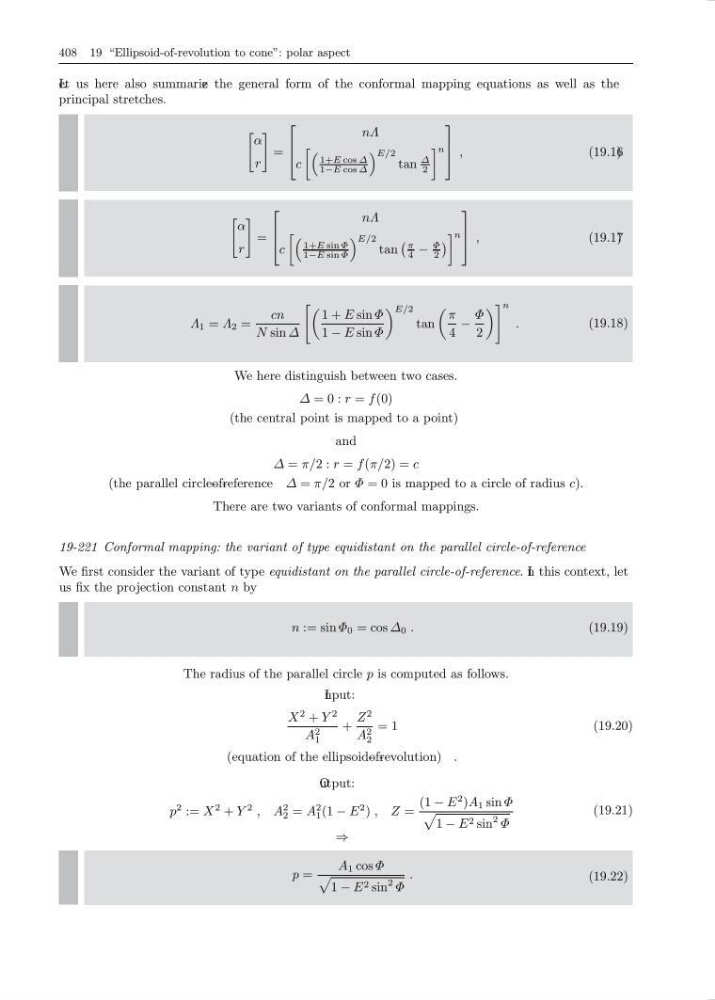
L et us here also summariz e the general form of the conformal mapping equations as well as the
principal stretches.
α
r
=
⎡
⎢
⎣
nΛ
c
1+E cos ∆
1−E cos ∆
E/2
tan
∆
2
n
⎤
⎥
⎦ ,
(19.16 )
α
r
=
⎡
⎢
⎣
nΛ
c
1+E sin Φ
1−E sin Φ
E/2
tan
π
4 −
Φ
2
n
⎤
⎥
⎦ ,
(19.17 )
Λ 1 = Λ 2 =
cn
N sin ∆
1 + E sin Φ
1 − E sin Φ
E/2
tan
π
4
−
Φ
2
n
.
(19.18)
We here distinguish between two cases.
∆ = 0 : r = f (0)
(the central point is mapped to a point)
and
∆ = π/2 : r = f (π/2) = c
(the parallel circle- of- reference ∆ = π/2 or Φ = 0 is mapped to a circle of radius c).
There are two variants of conformal mappings.
19-221 Conformal mapping: the variant of type equidistant on the parallel circle-of-reference
We first consider the variant of type equidistant on the parallel circle-of-reference. I
n this context, let
us fix the projection constant n by
n := sin Φ 0 = cos ∆ 0 .
(19.19)
The radius of the parallel circle p is computed as follows.
I nput:
X
2 + Y
2
A 2
1
+
Z
2
A 2
2
= 1
(equation of the ellipsoid- of- revolution) .
(19.20)
O utput:
p
2 := X
2 + Y
2 , A
2
2 = A
2
1 (1 − E
2 ) , Z =
(1 − E
2 )A 1 sin Φ
1 − E 2 sin
2 Φ
⇒
(19.21)
p =
A 1 cos Φ
1 − E 2 sin
2 Φ
.
(19.22)
L et us here also summariz e the general form of the conformal mapping equations as well as the
principal stretches.
α
r
=
⎡
⎢
⎣
nΛ
c
1+E cos ∆
1−E cos ∆
E/2
tan
∆
2
n
⎤
⎥
⎦ ,
(19.16 )
α
r
=
⎡
⎢
⎣
nΛ
c
1+E sin Φ
1−E sin Φ
E/2
tan
π
4 −
Φ
2
n
⎤
⎥
⎦ ,
(19.17 )
Λ 1 = Λ 2 =
cn
N sin ∆
1 + E sin Φ
1 − E sin Φ
E/2
tan
π
4
−
Φ
2
n
.
(19.18)
We here distinguish between two cases.
∆ = 0 : r = f (0)
(the central point is mapped to a point)
and
∆ = π/2 : r = f (π/2) = c
(the parallel circle- of- reference ∆ = π/2 or Φ = 0 is mapped to a circle of radius c).
There are two variants of conformal mappings.
19-221 Conformal mapping: the variant of type equidistant on the parallel circle-of-reference
We first consider the variant of type equidistant on the parallel circle-of-reference. I
n this context, let
us fix the projection constant n by
n := sin Φ 0 = cos ∆ 0 .
(19.19)
The radius of the parallel circle p is computed as follows.
I nput:
X
2 + Y
2
A 2
1
+
Z
2
A 2
2
= 1
(equation of the ellipsoid- of- revolution) .
(19.20)
O utput:
p
2 := X
2 + Y
2 , A
2
2 = A
2
1 (1 − E
2 ) , Z =
(1 − E
2 )A 1 sin Φ
1 − E 2 sin
2 Φ
⇒
(19.21)
p =
A 1 cos Φ
1 − E 2 sin
2 Φ
.
(19.22)