

15-3 Constraints to the Korn–Lichtenstein equations (Gauss–Krueger/UTM mappings) 327
x(l, b) =
= x 10 l + x 11 lb + x 30 l
3 + x 12 lb
2 + x 31 l
3 b + x 13 lb
3 + x 50 l
5 + x 32 l
3 b
2 +
+x 14 lb
4 + O(6) ,
y(l, b) =
= y 01 b + y 20 l
2 + y 02 b
2 + y 21 l
2 b + y 03 b
3 + y 40 l
4 + y 22 l
2 b
2 + y 04 b
4 + y 41 l
4 b + y 23 l
2 b
3 +
+y 05 b
5 + O(6) .
(15.87)
Box 15.4 and Box 15.5 are a collection of the coefficients x 10 , . . . , y 05 .
End of Theorem.
m, n ↔ x mn
n
m
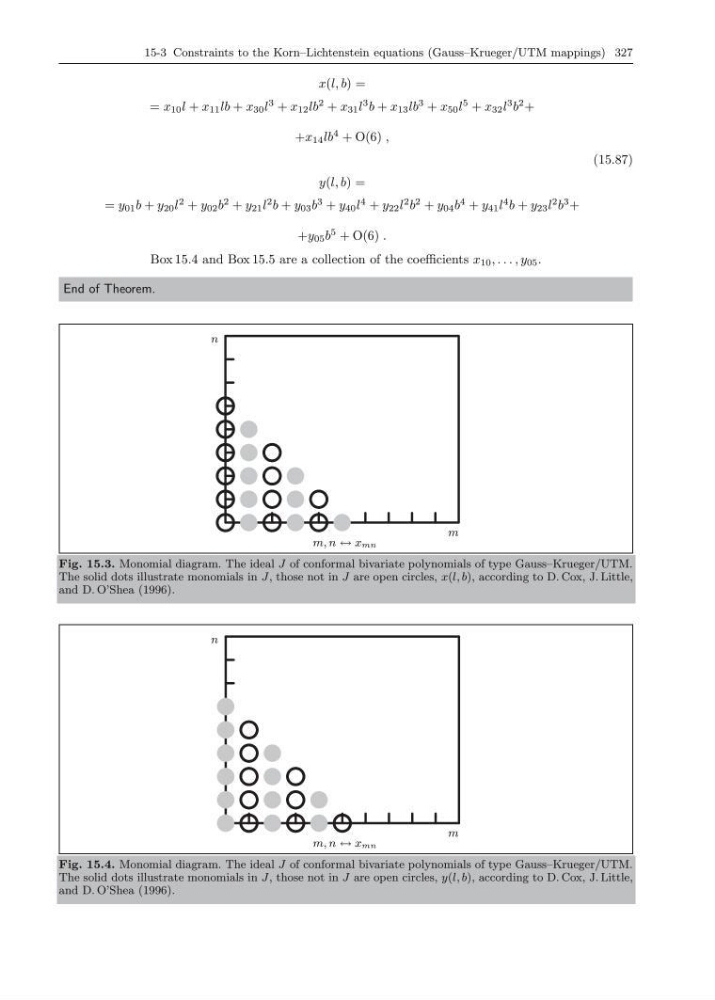
Fig. 15.3. Monomial diagram. The ideal J of conformal bivariate polynomials of type Gauss–Krueger/UTM.
The solid dots illustrate monomials in J, those not in J are open circles, x(l, b), according to D. Cox, J. Little,
and D. O’Shea (1996).
m, n ↔ x mn
n
m
Fig. 15.4. Monomial diagram. The ideal J of conformal bivariate polynomials of type Gauss–Krueger/UTM.
The solid dots illustrate monomials in J, those not in J are open circles, y(l, b), according to D. Cox, J. Little,
and D. O’Shea (1996).
x(l, b) =
= x 10 l + x 11 lb + x 30 l
3 + x 12 lb
2 + x 31 l
3 b + x 13 lb
3 + x 50 l
5 + x 32 l
3 b
2 +
+x 14 lb
4 + O(6) ,
y(l, b) =
= y 01 b + y 20 l
2 + y 02 b
2 + y 21 l
2 b + y 03 b
3 + y 40 l
4 + y 22 l
2 b
2 + y 04 b
4 + y 41 l
4 b + y 23 l
2 b
3 +
+y 05 b
5 + O(6) .
(15.87)
Box 15.4 and Box 15.5 are a collection of the coefficients x 10 , . . . , y 05 .
End of Theorem.
m, n ↔ x mn
n
m
Fig. 15.3. Monomial diagram. The ideal J of conformal bivariate polynomials of type Gauss–Krueger/UTM.
The solid dots illustrate monomials in J, those not in J are open circles, x(l, b), according to D. Cox, J. Little,
and D. O’Shea (1996).
m, n ↔ x mn
n
m
Fig. 15.4. Monomial diagram. The ideal J of conformal bivariate polynomials of type Gauss–Krueger/UTM.
The solid dots illustrate monomials in J, those not in J are open circles, y(l, b), according to D. Cox, J. Little,
and D. O’Shea (1996).