

258 9 “Ellipsoid-of-revolution to sphere and from sphere to plane”
9-12 The metric tensor of the ellipsoid-of-revolution, the first differential form
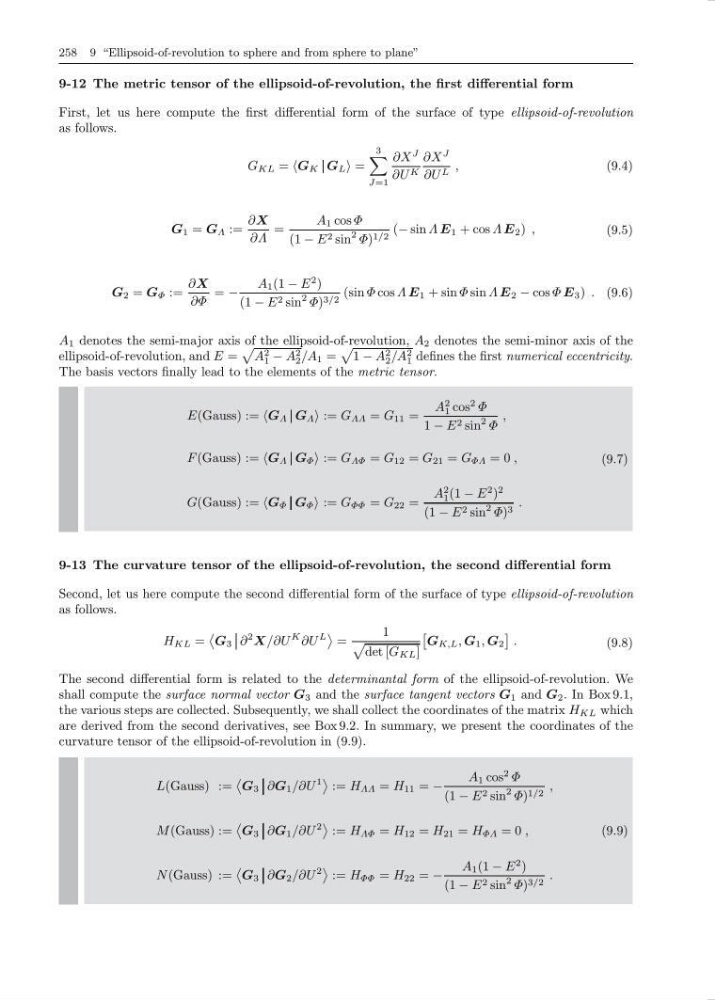
First, let us here compute the first differential form of the surface of type ellipsoid-of-revolution
as follows.
G KL = G K G L =
3
J=1
∂X
J
∂U K
∂X
J
∂U L ,
(9.4)
G 1 = G Λ :=
∂X
∂Λ
=
A 1 cos Φ
(1 − E 2 sin
2 Φ) 1/2 (− sin Λ E 1 + cos Λ E 2 ) ,
(9.5)
G 2 = G Φ :=
∂X
∂Φ
= −
A 1 (1 − E
2 )
(1 − E 2 sin
2 Φ) 3/2 (sin Φ cos Λ E 1 + sin Φ sin Λ E 2 − cos Φ E 3 ) . (9.6)
A 1 denotes the semi-major axis of the ellipsoid-of-revolution, A 2 denotes the semi-minor axis of the
ellipsoid-of-revolution, and E =
A 2
1 − A 2
2 /A 1 =
1 − A 2
2 /A 2
1 defines the first numerical eccentricity.
The basis vectors finally lead to the elements of the metric tensor.
E(Gauss) := G Λ G Λ := G ΛΛ = G 11 =
A
2
1 cos
2 Φ
1 − E 2 sin
2 Φ
,
F (Gauss) := G Λ G Φ := G ΛΦ = G 12 = G 21 = G ΦΛ = 0 ,
G(Gauss) := G Φ G Φ := G ΦΦ = G 22 =
A
2
1 (1 − E
2 )
2
(1 − E 2 sin
2 Φ) 3 .
(9.7)
9-13 The curvature tensor of the ellipsoid-of-revolution, the second differential form
Second, let us here compute the second differential form of the surface of type ellipsoid-of-revolution
as follows.
H KL =
G 3 ∂
2 X/∂U
K ∂U
L
=
1
det [G KL ]
G K,L , G 1 , G 2
.
(9.8)
The second differential form is related to the determinantal form of the ellipsoid-of-revolution. We
shall compute the surface normal vector G 3 and the surface tangent vectors G 1 and G 2 . In Box 9.1,
the various steps are collected. Subsequently, we shall collect the coordinates of the matrix H KL which
are derived from the second derivatives, see Box 9.2. In summary, we present the coordinates of the
curvature tensor of the ellipsoid-of-revolution in (9.9).
L(Gauss) :=
G 3 ∂G 1 /∂U
1
:= H ΛΛ = H 11 = −
A 1 cos
2 Φ
(1 − E 2 sin
2 Φ) 1/2 ,
M (Gauss) :=
G 3 ∂G 1 /∂U
2
:= H ΛΦ = H 12 = H 21 = H ΦΛ = 0 ,
N (Gauss) :=
G 3 ∂G 2 /∂U
2
:= H ΦΦ = H 22 = −
A 1 (1 − E
2 )
(1 − E 2 sin
2 Φ) 3/2 .
(9.9)
9-12 The metric tensor of the ellipsoid-of-revolution, the first differential form
First, let us here compute the first differential form of the surface of type ellipsoid-of-revolution
as follows.
G KL = G K G L =
3
J=1
∂X
J
∂U K
∂X
J
∂U L ,
(9.4)
G 1 = G Λ :=
∂X
∂Λ
=
A 1 cos Φ
(1 − E 2 sin
2 Φ) 1/2 (− sin Λ E 1 + cos Λ E 2 ) ,
(9.5)
G 2 = G Φ :=
∂X
∂Φ
= −
A 1 (1 − E
2 )
(1 − E 2 sin
2 Φ) 3/2 (sin Φ cos Λ E 1 + sin Φ sin Λ E 2 − cos Φ E 3 ) . (9.6)
A 1 denotes the semi-major axis of the ellipsoid-of-revolution, A 2 denotes the semi-minor axis of the
ellipsoid-of-revolution, and E =
A 2
1 − A 2
2 /A 1 =
1 − A 2
2 /A 2
1 defines the first numerical eccentricity.
The basis vectors finally lead to the elements of the metric tensor.
E(Gauss) := G Λ G Λ := G ΛΛ = G 11 =
A
2
1 cos
2 Φ
1 − E 2 sin
2 Φ
,
F (Gauss) := G Λ G Φ := G ΛΦ = G 12 = G 21 = G ΦΛ = 0 ,
G(Gauss) := G Φ G Φ := G ΦΦ = G 22 =
A
2
1 (1 − E
2 )
2
(1 − E 2 sin
2 Φ) 3 .
(9.7)
9-13 The curvature tensor of the ellipsoid-of-revolution, the second differential form
Second, let us here compute the second differential form of the surface of type ellipsoid-of-revolution
as follows.
H KL =
G 3 ∂
2 X/∂U
K ∂U
L
=
1
det [G KL ]
G K,L , G 1 , G 2
.
(9.8)
The second differential form is related to the determinantal form of the ellipsoid-of-revolution. We
shall compute the surface normal vector G 3 and the surface tangent vectors G 1 and G 2 . In Box 9.1,
the various steps are collected. Subsequently, we shall collect the coordinates of the matrix H KL which
are derived from the second derivatives, see Box 9.2. In summary, we present the coordinates of the
curvature tensor of the ellipsoid-of-revolution in (9.9).
L(Gauss) :=
G 3 ∂G 1 /∂U
1
:= H ΛΛ = H 11 = −
A 1 cos
2 Φ
(1 − E 2 sin
2 Φ) 1/2 ,
M (Gauss) :=
G 3 ∂G 1 /∂U
2
:= H ΛΦ = H 12 = H 21 = H ΦΛ = 0 ,
N (Gauss) :=
G 3 ∂G 2 /∂U
2
:= H ΦΦ = H 22 = −
A 1 (1 − E
2 )
(1 − E 2 sin
2 Φ) 3/2 .
(9.9)