

9 “Ellipsoid-of-revolution to sphere and from sphere to plane”
Mapping the ellipsoid-of-revolution to sphere and from sphere to plane (the Gauss double projection, the
“authalic” equal area projection): metric tensors, curvature tensors, principal stretches.
A special mapping, which was invented by C. F. Gauss (1822, 1844), is the double projection of the
ellipsoid-of-revolution to the sphere and from the sphere to the plane. These are conformal mappings. A
very efficient compiler version of the Gauss double projection was presented by M. Rosenmund (1903)
(ROM mapping equations) and applied for mapping Switzerland and the Netherlands, for example.
An alternative mapping, called “authalic”, is equal area, first ellipsoid-of-revolution to sphere, and
second sphere to plane.
9-1 General mapping equations “ellipsoid-of-revolution to plane”
Setting up general equations of the mapping “ellipsoid-of-revolution to plane”: mapping equations, metric
tensors, curvature tensors, differential forms.
Postulate.
The spherical longitude λ should be a linear function of the ellipsoidal longitude Λ: parallel circles of
the ellipsoid-of-revolution should be transformed into parallel circles of the sphere.
End of Postulate.
Postulate.
The spherical latitude φ should only be a function of the ellipsoidal latitude Φ: meridians of the
ellipsoid-of-revolution (lines of constant longitude) should be transformed into meridians of the sphere
(ellipses of constant longitude).
End of Postulate.
9-11 The setup of the mapping equations “ellipsoid-of-revolution to plane”
λ = λ 0 + a
Λ − Λ 0
, φ = f (Φ) .
(9.1)
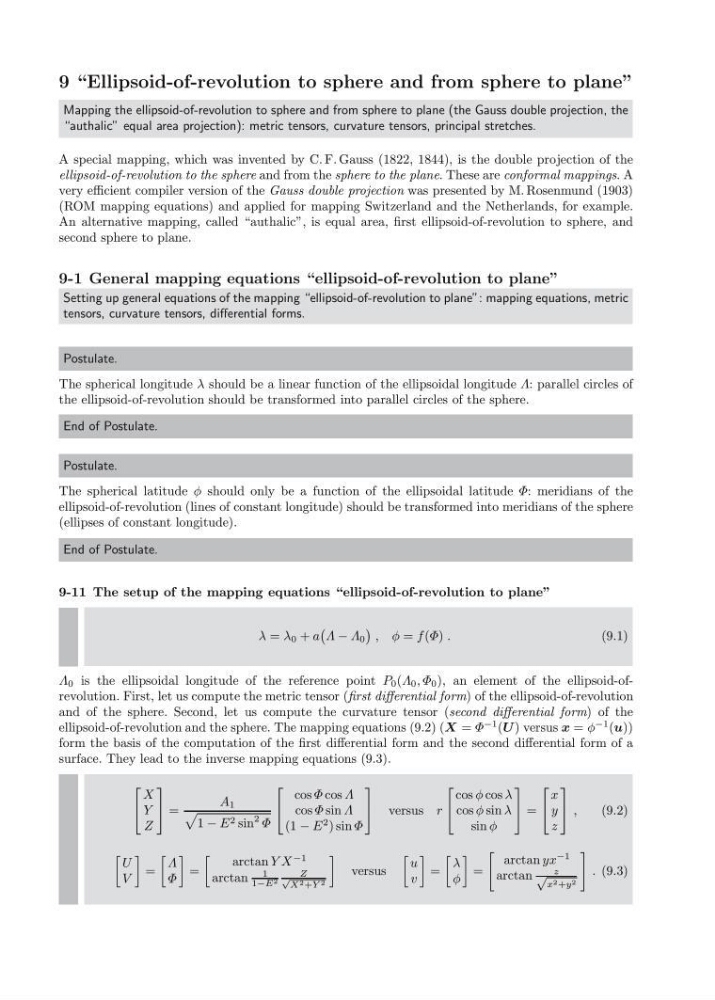
Λ 0 is the ellipsoidal longitude of the reference point P 0 (Λ 0 , Φ 0 ), an element of the ellipsoid-ofrevolution. First, let us compute the metric tensor (first differential form) of the ellipsoid-of-revolution
and of the sphere. Second, let us compute the curvature tensor (second differential form) of the
ellipsoid-of-revolution and the sphere. The mapping equations (9.2) (X = Φ
−1 (U ) versus x = φ
−1 (u))
form the basis of the computation of the first differential form and the second differential form of a
surface. They lead to the inverse mapping equations (9.3).
⎡
⎣
X
Y
Z
⎤
⎦ =
A 1
1 − E 2 sin
2 Φ
⎡
⎣
cos Φ cos Λ
cos Φ sin Λ
(1 − E
2 ) sin Φ
⎤
⎦ versus r
⎡
⎣
cos φ cos λ
cos φ sin λ
sin φ
⎤
⎦ =
⎡
⎣
x
y
z
⎤
⎦ ,
(9.2)
U
V
=
Λ
Φ
=
arctan Y X
−1
arctan
1
1−E 2
Z
√
X 2 +Y 2
versus
u
v
=
λ
φ
=
arctan yx
−1
arctan
z
√
x 2 +y 2
. (9.3)
Mapping the ellipsoid-of-revolution to sphere and from sphere to plane (the Gauss double projection, the
“authalic” equal area projection): metric tensors, curvature tensors, principal stretches.
A special mapping, which was invented by C. F. Gauss (1822, 1844), is the double projection of the
ellipsoid-of-revolution to the sphere and from the sphere to the plane. These are conformal mappings. A
very efficient compiler version of the Gauss double projection was presented by M. Rosenmund (1903)
(ROM mapping equations) and applied for mapping Switzerland and the Netherlands, for example.
An alternative mapping, called “authalic”, is equal area, first ellipsoid-of-revolution to sphere, and
second sphere to plane.
9-1 General mapping equations “ellipsoid-of-revolution to plane”
Setting up general equations of the mapping “ellipsoid-of-revolution to plane”: mapping equations, metric
tensors, curvature tensors, differential forms.
Postulate.
The spherical longitude λ should be a linear function of the ellipsoidal longitude Λ: parallel circles of
the ellipsoid-of-revolution should be transformed into parallel circles of the sphere.
End of Postulate.
Postulate.
The spherical latitude φ should only be a function of the ellipsoidal latitude Φ: meridians of the
ellipsoid-of-revolution (lines of constant longitude) should be transformed into meridians of the sphere
(ellipses of constant longitude).
End of Postulate.
9-11 The setup of the mapping equations “ellipsoid-of-revolution to plane”
λ = λ 0 + a
Λ − Λ 0
, φ = f (Φ) .
(9.1)
Λ 0 is the ellipsoidal longitude of the reference point P 0 (Λ 0 , Φ 0 ), an element of the ellipsoid-ofrevolution. First, let us compute the metric tensor (first differential form) of the ellipsoid-of-revolution
and of the sphere. Second, let us compute the curvature tensor (second differential form) of the
ellipsoid-of-revolution and the sphere. The mapping equations (9.2) (X = Φ
−1 (U ) versus x = φ
−1 (u))
form the basis of the computation of the first differential form and the second differential form of a
surface. They lead to the inverse mapping equations (9.3).
⎡
⎣
X
Y
Z
⎤
⎦ =
A 1
1 − E 2 sin
2 Φ
⎡
⎣
cos Φ cos Λ
cos Φ sin Λ
(1 − E
2 ) sin Φ
⎤
⎦ versus r
⎡
⎣
cos φ cos λ
cos φ sin λ
sin φ
⎤
⎦ =
⎡
⎣
x
y
z
⎤
⎦ ,
(9.2)
U
V
=
Λ
Φ
=
arctan Y X
−1
arctan
1
1−E 2
Z
√
X 2 +Y 2
versus
u
v
=
λ
φ
=
arctan yx
−1
arctan
z
√
x 2 +y 2
. (9.3)