

3-3 The oblique frame of reference of the sphere 133
Ω
I
O
1
1
E1
E3
E 1
E 2
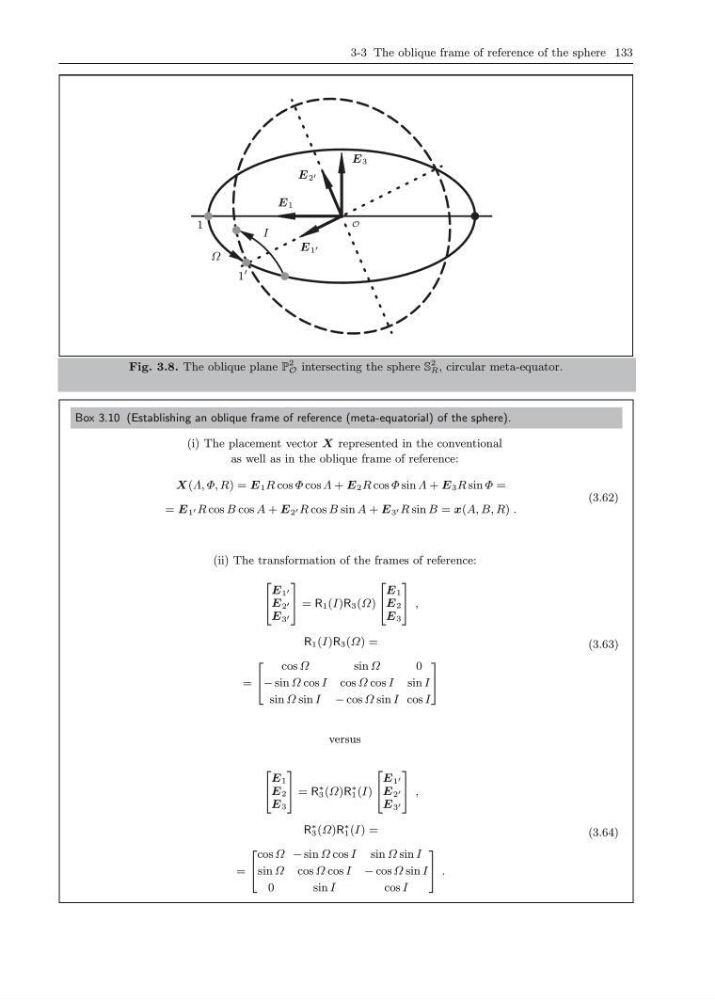
Fig. 3.8. The oblique plane P
2
O intersecting the sphere S
2
R , circular meta-equator.
Box 3.10 (Establishing an oblique frame of reference (meta-equatorial) of the sphere).
(i) The placement vector X represented in the conventional
as well as in the oblique frame of reference:
X(Λ, Φ, R) = E 1 R cos Φ cos Λ + E 2 R cos Φ sin Λ + E 3 R sin Φ =
= E 1 R cos B cos A + E 2 R cos B sin A + E 3 R sin B = x(A, B, R) .
(3.62)
(ii) The transformation of the frames of reference:
2
4
E 1
E 2
E 3
3
5 = R 1 (I)R 3 (Ω)
2
4
E 1
E 2
E 3
3
5 ,
R 1 (I)R 3 (Ω) =
=
2
4
cos Ω
sin Ω
0
− sin Ω cos I cos Ω cos I sin I
sin Ω sin I − cos Ω sin I cos I
3
5
(3.63)
versus
2
4
E 1
E 2
E 3
3
5 = R
∗
3 (Ω)R
∗
1 (I)
2
4
E 1
E 2
E 3
3
5 ,
R
∗
3 (Ω)R
∗
1 (I) =
=
2
4
cos Ω − sin Ω cos I sin Ω sin I
sin Ω cos Ω cos I − cos Ω sin I
0
s i nI
cos I
3
5 .
(3.64)
Ω
I
O
1
1
E1
E3
E 1
E 2
Fig. 3.8. The oblique plane P
2
O intersecting the sphere S
2
R , circular meta-equator.
Box 3.10 (Establishing an oblique frame of reference (meta-equatorial) of the sphere).
(i) The placement vector X represented in the conventional
as well as in the oblique frame of reference:
X(Λ, Φ, R) = E 1 R cos Φ cos Λ + E 2 R cos Φ sin Λ + E 3 R sin Φ =
= E 1 R cos B cos A + E 2 R cos B sin A + E 3 R sin B = x(A, B, R) .
(3.62)
(ii) The transformation of the frames of reference:
2
4
E 1
E 2
E 3
3
5 = R 1 (I)R 3 (Ω)
2
4
E 1
E 2
E 3
3
5 ,
R 1 (I)R 3 (Ω) =
=
2
4
cos Ω
sin Ω
0
− sin Ω cos I cos Ω cos I sin I
sin Ω sin I − cos Ω sin I cos I
3
5
(3.63)
versus
2
4
E 1
E 2
E 3
3
5 = R
∗
3 (Ω)R
∗
1 (I)
2
4
E 1
E 2
E 3
3
5 ,
R
∗
3 (Ω)R
∗
1 (I) =
=
2
4
cos Ω − sin Ω cos I sin Ω sin I
sin Ω cos Ω cos I − cos Ω sin I
0
s i nI
cos I
3
5 .
(3.64)