

132 3 Coordinates
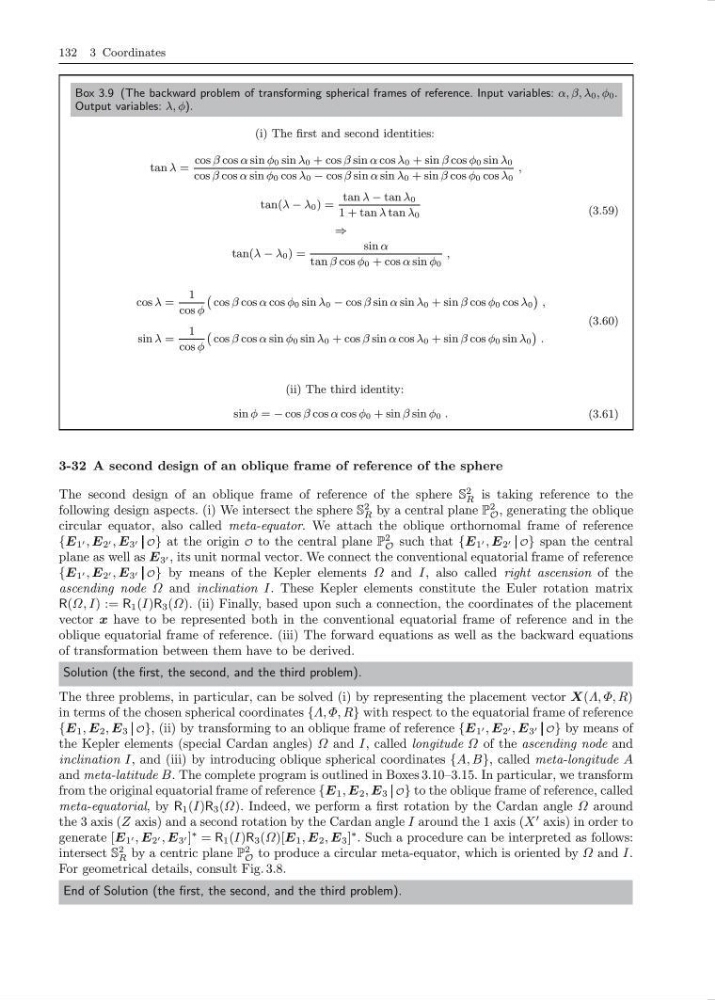
Box 3.9 (The backward problem of transforming spherical frames of reference. Input variables: α, β, λ 0 , φ 0 .
Output variables: λ, φ).
(i) The first and second identities:
tan λ =
cos β cos α sin φ 0 sin λ 0 + cos β sin α cos λ 0 + sin β cos φ 0 sin λ 0
cos β cos α sin φ 0 cos λ 0 − cos β sin α sin λ 0 + sin β cos φ 0 cos λ 0
,
tan(λ − λ 0 ) =
tan λ − tan λ 0
1 + tan λ tan λ 0
⇒
tan(λ − λ 0 ) =
sin α
tan β cos φ 0 + cos α sin φ 0
,
(3.59)
cos λ =
1
cos φ
`
cos β cos α cos φ 0 sin λ 0 − cos β sin α sin λ 0 + sin β cos φ 0 cos λ 0
´
,
sin λ =
1
cos φ
`
cos β cos α sin φ 0 sin λ 0 + cos β sin α cos λ 0 + sin β cos φ 0 sin λ 0
´
.
(3.60)
(ii) The third identity:
sin φ = − cos β cos α cos φ 0 + sin β sin φ 0 .
(3.61)
3-32 A second design of an oblique frame of reference of the sphere
The second design of an oblique frame of reference of the sphere S
2
R is taking reference to the
following design aspects. (i) We intersect the sphere S
2
R by a central plane P
2
O , generating the oblique
circular equator, also called meta-equator. We attach the oblique orthornomal frame of reference
{E 1 , E 2 , E 3 O} at the origin O to the central plane P
2
O such that {E 1 , E 2 O} span the central
plane as well as E 3 , its unit normal vector. We connect the conventional equatorial frame of reference
{E 1 , E 2 , E 3 O} by means of the Kepler elements Ω and I, also called right ascension of the
ascending node Ω and inclination I. These Kepler elements constitute the Euler rotation matrix
R(Ω, I) := R 1 (I)R 3 (Ω). (ii) Finally, based upon such a connection, the coordinates of the placement
vector x have to be represented both in the conventional equatorial frame of reference and in the
oblique equatorial frame of reference. (iii) The forward equations as well as the backward equations
of transformation between them have to be derived.
Solution (the first, the second, and the third problem).
The three problems, in particular, can be solved (i) by representing the placement vector X(Λ, Φ, R)
in terms of the chosen spherical coordinates {Λ, Φ, R} with respect to the equatorial frame of reference
{E 1 , E 2 , E 3 O}, (ii) by transforming to an oblique frame of reference {E 1 , E 2 , E 3 O} by means of
the Kepler elements (special Cardan angles) Ω and I, called longitude Ω of the ascending node and
inclination I, and (iii) by introducing oblique spherical coordinates {A, B}, called meta-longitude A
and meta-latitude B. The complete program is outlined in Boxes 3.10–3.15. In particular, we transform
from the original equatorial frame of reference {E 1 , E 2 , E 3 O} to the oblique frame of reference, called
meta-equatorial, by R 1 (I)R 3 (Ω). Indeed, we perform a first rotation by the Cardan angle Ω around
the 3 axis (Z axis) and a second rotation by the Cardan angle I around the 1 axis (X
axis) in order to
generate [E 1 , E 2 , E 3 ]
∗ = R 1 (I)R 3 (Ω)[E 1 , E 2 , E 3 ]
∗ . Such a procedure can be interpreted as follows:
intersect S
2
R by a centric plane P
2
O to produce a circular meta-equator, which is oriented by Ω and I.
For geometrical details, consult Fig. 3.8.
End of Solution (the first, the second, and the third problem).
Box 3.9 (The backward problem of transforming spherical frames of reference. Input variables: α, β, λ 0 , φ 0 .
Output variables: λ, φ).
(i) The first and second identities:
tan λ =
cos β cos α sin φ 0 sin λ 0 + cos β sin α cos λ 0 + sin β cos φ 0 sin λ 0
cos β cos α sin φ 0 cos λ 0 − cos β sin α sin λ 0 + sin β cos φ 0 cos λ 0
,
tan(λ − λ 0 ) =
tan λ − tan λ 0
1 + tan λ tan λ 0
⇒
tan(λ − λ 0 ) =
sin α
tan β cos φ 0 + cos α sin φ 0
,
(3.59)
cos λ =
1
cos φ
`
cos β cos α cos φ 0 sin λ 0 − cos β sin α sin λ 0 + sin β cos φ 0 cos λ 0
´
,
sin λ =
1
cos φ
`
cos β cos α sin φ 0 sin λ 0 + cos β sin α cos λ 0 + sin β cos φ 0 sin λ 0
´
.
(3.60)
(ii) The third identity:
sin φ = − cos β cos α cos φ 0 + sin β sin φ 0 .
(3.61)
3-32 A second design of an oblique frame of reference of the sphere
The second design of an oblique frame of reference of the sphere S
2
R is taking reference to the
following design aspects. (i) We intersect the sphere S
2
R by a central plane P
2
O , generating the oblique
circular equator, also called meta-equator. We attach the oblique orthornomal frame of reference
{E 1 , E 2 , E 3 O} at the origin O to the central plane P
2
O such that {E 1 , E 2 O} span the central
plane as well as E 3 , its unit normal vector. We connect the conventional equatorial frame of reference
{E 1 , E 2 , E 3 O} by means of the Kepler elements Ω and I, also called right ascension of the
ascending node Ω and inclination I. These Kepler elements constitute the Euler rotation matrix
R(Ω, I) := R 1 (I)R 3 (Ω). (ii) Finally, based upon such a connection, the coordinates of the placement
vector x have to be represented both in the conventional equatorial frame of reference and in the
oblique equatorial frame of reference. (iii) The forward equations as well as the backward equations
of transformation between them have to be derived.
Solution (the first, the second, and the third problem).
The three problems, in particular, can be solved (i) by representing the placement vector X(Λ, Φ, R)
in terms of the chosen spherical coordinates {Λ, Φ, R} with respect to the equatorial frame of reference
{E 1 , E 2 , E 3 O}, (ii) by transforming to an oblique frame of reference {E 1 , E 2 , E 3 O} by means of
the Kepler elements (special Cardan angles) Ω and I, called longitude Ω of the ascending node and
inclination I, and (iii) by introducing oblique spherical coordinates {A, B}, called meta-longitude A
and meta-latitude B. The complete program is outlined in Boxes 3.10–3.15. In particular, we transform
from the original equatorial frame of reference {E 1 , E 2 , E 3 O} to the oblique frame of reference, called
meta-equatorial, by R 1 (I)R 3 (Ω). Indeed, we perform a first rotation by the Cardan angle Ω around
the 3 axis (Z axis) and a second rotation by the Cardan angle I around the 1 axis (X
axis) in order to
generate [E 1 , E 2 , E 3 ]
∗ = R 1 (I)R 3 (Ω)[E 1 , E 2 , E 3 ]
∗ . Such a procedure can be interpreted as follows:
intersect S
2
R by a centric plane P
2
O to produce a circular meta-equator, which is oriented by Ω and I.
For geometrical details, consult Fig. 3.8.
End of Solution (the first, the second, and the third problem).