

124 3 Coordinates
Question.
Question 2: “Let a transformation group act on the coordinate representation of a sphere.
Or we may say, we make a coordinate transformation. What are the transformation groups
(the coordinate transformations) which leave the first differential invariant ds
2 of a sphere
equivariant or form-invariant?” Answer 2: “The transformation group, which leaves the
first differential invariant ds
2 (also called “arc length”) equivariant is the three-dimensional
rotation group R(α, β, γ), a subsequent rotation around the 1 axis, the 2 axis, and the 3
axis of the ambient space {R
3 , δ ij }. The three axes establish the three Killing vectors of
symmetry.”
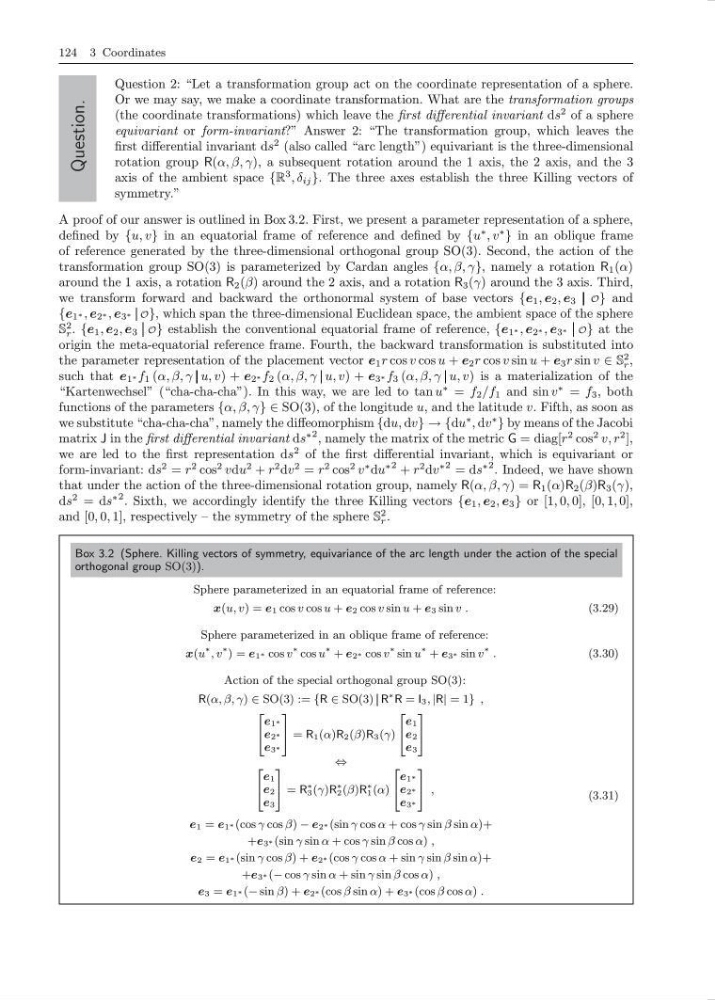
A proof of our answer is outlined in Box 3.2. First, we present a parameter representation of a sphere,
defined by {u, v} in an equatorial frame of reference and defined by {u
∗ , v
∗
} in an oblique frame
of reference generated by the three-dimensional orthogonal group SO(3). Second, the action of the
transformation group SO(3) is parameterized by Cardan angles {α, β, γ}, namely a rotation R 1 (α)
around the 1 axis, a rotation R 2 (β) around the 2 axis, and a rotation R 3 (γ) around the 3 axis. Third,
we transform forward and backward the orthonormal system of base vectors {e 1 , e 2 , e 3 O} and
{e 1 ∗ , e 2 ∗ , e 3 ∗ O}, which span the three-dimensional Euclidean space, the ambient space of the sphere
S
2
r . {e 1 , e 2 , e 3 O} establish the conventional equatorial frame of reference, {e 1 ∗ , e 2 ∗ , e 3 ∗ O} at the
origin the meta-equatorial reference frame. Fourth, the backward transformation is substituted into
the parameter representation of the placement vector e 1 r cos v cos u + e 2 r cos v sin u + e 3 r sin v ∈ S
2
r ,
such that e 1 ∗ f 1 (α, β, γ u, v) + e 2 ∗ f 2 (α, β, γ u, v) + e 3 ∗ f 3 (α, β, γ u, v) is a materialization of the
“Kartenwechsel” (“cha-cha-cha”). In this way, we are led to tan u
∗ = f 2 /f 1 and sin v
∗ = f 3 , both
functions of the parameters {α, β, γ} ∈ SO(3), of the longitude u, and the latitude v. Fifth, as soon as
we substitute “cha-cha-cha”, namely the diffeomorphism {du, dv} → {du
∗ , dv
∗
} by means of the Jacobi
matrix J in the first differential invariant ds
∗2 , namely the matrix of the metric G = diag[r
2 cos
2 v, r
2 ],
we are led to the first representation ds
2 of the first differential invariant, which is equivariant or
form-invariant: ds
2 = r
2 cos
2 vdu
2 + r
2 dv
2 = r
2 cos
2 v
∗ du
∗2 + r
2 dv
∗2 = ds
∗2 . Indeed, we have shown
that under the action of the three-dimensional rotation group, namely R(α, β, γ) = R 1 (α)R 2 (β)R 3 (γ),
ds
2 = ds
∗2 . Sixth, we accordingly identify the three Killing vectors {e 1 , e 2 , e 3 } or [1, 0, 0], [0, 1, 0],
and [0, 0, 1], respectively – the symmetry of the sphere S
2
r .
Box 3.2 (Sphere. Killing vectors of symmetry, equivariance of the arc length under the action of the special
orthogonal group SO(3)).
Sphere parameterized in an equatorial frame of reference:
x(u, v) = e 1 cos v cos u + e 2 cos v sin u + e 3 sin v .
(3.29)
Sphere parameterized in an oblique frame of reference:
x(u
∗ , v
∗ ) = e 1 ∗ cos v
∗ cos u
∗ + e 2 ∗ cos v
∗ sin u
∗ + e 3 ∗ sin v
∗ .
(3.30)
Action of the special orthogonal group SO(3):
R(α, β, γ) ∈ SO(3) := {R ∈ SO(3) R
∗ R = I 3 , |R| = 1} ,
2
4
e 1 ∗
e 2 ∗
e 3 ∗
3
5 = R 1 (α)R 2 (β)R 3 (γ)
2
4
e 1
e 2
e 3
3
5
⇔
2
4
e 1
e 2
e 3
3
5 = R
∗
3 (γ)R
∗
2 (β)R
∗
1 (α)
2
4
e 1 ∗
e 2 ∗
e 3 ∗
3
5 ,
e 1 = e 1 ∗ (cos γ cos β) − e 2 ∗ (sin γ cos α + cos γ sin β sin α)+
+e 3 ∗ (sin γ sin α + cos γ sin β cos α) ,
e 2 = e 1 ∗ (sin γ cos β) + e 2 ∗ (cos γ cos α + sin γ sin β sin α)+
+e 3 ∗ (− cos γ sin α + sin γ sin β cos α) ,
e 3 = e 1 ∗ (− sin β) + e 2 ∗ (cos β sin α) + e 3 ∗ (cos β cos α) .
(3.31)
Question.
Question 2: “Let a transformation group act on the coordinate representation of a sphere.
Or we may say, we make a coordinate transformation. What are the transformation groups
(the coordinate transformations) which leave the first differential invariant ds
2 of a sphere
equivariant or form-invariant?” Answer 2: “The transformation group, which leaves the
first differential invariant ds
2 (also called “arc length”) equivariant is the three-dimensional
rotation group R(α, β, γ), a subsequent rotation around the 1 axis, the 2 axis, and the 3
axis of the ambient space {R
3 , δ ij }. The three axes establish the three Killing vectors of
symmetry.”
A proof of our answer is outlined in Box 3.2. First, we present a parameter representation of a sphere,
defined by {u, v} in an equatorial frame of reference and defined by {u
∗ , v
∗
} in an oblique frame
of reference generated by the three-dimensional orthogonal group SO(3). Second, the action of the
transformation group SO(3) is parameterized by Cardan angles {α, β, γ}, namely a rotation R 1 (α)
around the 1 axis, a rotation R 2 (β) around the 2 axis, and a rotation R 3 (γ) around the 3 axis. Third,
we transform forward and backward the orthonormal system of base vectors {e 1 , e 2 , e 3 O} and
{e 1 ∗ , e 2 ∗ , e 3 ∗ O}, which span the three-dimensional Euclidean space, the ambient space of the sphere
S
2
r . {e 1 , e 2 , e 3 O} establish the conventional equatorial frame of reference, {e 1 ∗ , e 2 ∗ , e 3 ∗ O} at the
origin the meta-equatorial reference frame. Fourth, the backward transformation is substituted into
the parameter representation of the placement vector e 1 r cos v cos u + e 2 r cos v sin u + e 3 r sin v ∈ S
2
r ,
such that e 1 ∗ f 1 (α, β, γ u, v) + e 2 ∗ f 2 (α, β, γ u, v) + e 3 ∗ f 3 (α, β, γ u, v) is a materialization of the
“Kartenwechsel” (“cha-cha-cha”). In this way, we are led to tan u
∗ = f 2 /f 1 and sin v
∗ = f 3 , both
functions of the parameters {α, β, γ} ∈ SO(3), of the longitude u, and the latitude v. Fifth, as soon as
we substitute “cha-cha-cha”, namely the diffeomorphism {du, dv} → {du
∗ , dv
∗
} by means of the Jacobi
matrix J in the first differential invariant ds
∗2 , namely the matrix of the metric G = diag[r
2 cos
2 v, r
2 ],
we are led to the first representation ds
2 of the first differential invariant, which is equivariant or
form-invariant: ds
2 = r
2 cos
2 vdu
2 + r
2 dv
2 = r
2 cos
2 v
∗ du
∗2 + r
2 dv
∗2 = ds
∗2 . Indeed, we have shown
that under the action of the three-dimensional rotation group, namely R(α, β, γ) = R 1 (α)R 2 (β)R 3 (γ),
ds
2 = ds
∗2 . Sixth, we accordingly identify the three Killing vectors {e 1 , e 2 , e 3 } or [1, 0, 0], [0, 1, 0],
and [0, 0, 1], respectively – the symmetry of the sphere S
2
r .
Box 3.2 (Sphere. Killing vectors of symmetry, equivariance of the arc length under the action of the special
orthogonal group SO(3)).
Sphere parameterized in an equatorial frame of reference:
x(u, v) = e 1 cos v cos u + e 2 cos v sin u + e 3 sin v .
(3.29)
Sphere parameterized in an oblique frame of reference:
x(u
∗ , v
∗ ) = e 1 ∗ cos v
∗ cos u
∗ + e 2 ∗ cos v
∗ sin u
∗ + e 3 ∗ sin v
∗ .
(3.30)
Action of the special orthogonal group SO(3):
R(α, β, γ) ∈ SO(3) := {R ∈ SO(3) R
∗ R = I 3 , |R| = 1} ,
2
4
e 1 ∗
e 2 ∗
e 3 ∗
3
5 = R 1 (α)R 2 (β)R 3 (γ)
2
4
e 1
e 2
e 3
3
5
⇔
2
4
e 1
e 2
e 3
3
5 = R
∗
3 (γ)R
∗
2 (β)R
∗
1 (α)
2
4
e 1 ∗
e 2 ∗
e 3 ∗
3
5 ,
e 1 = e 1 ∗ (cos γ cos β) − e 2 ∗ (sin γ cos α + cos γ sin β sin α)+
+e 3 ∗ (sin γ sin α + cos γ sin β cos α) ,
e 2 = e 1 ∗ (sin γ cos β) + e 2 ∗ (cos γ cos α + sin γ sin β sin α)+
+e 3 ∗ (− cos γ sin α + sin γ sin β cos α) ,
e 3 = e 1 ∗ (− sin β) + e 2 ∗ (cos β sin α) + e 3 ∗ (cos β cos α) .
(3.31)