

3-2 Killing vectors of symmetry 125
Continuation of Box.
Coordinate transformations:
x(u, v) = x(u
∗ , v
∗ )
⇔
e 1 ∗ f 1 (α, β, γ u, v) + e 2 ∗ f 2 (α, β, γ u, v) + e 3 ∗ f 3 (α, β, γ u, v) =
= e 1 ∗ cos v
∗ cos u
∗ + e 2 ∗ cos v
∗ sin u
∗ + e 3 ∗ sin v
∗ ,
(3.32)
cos v
∗ cos u
∗ = f 1 (α, β, γ u, v) =
= cos γ cos β cos v cos u + sin γ cos β cos v sin u − sin β sin v ,
cos v
∗ sin u
∗ = f 2 (α, β, γ u, v) =
= −(sin γ cos α + cos γ sin β sin α) cos v cos u+
+(cos γ cos α + sin γ sin β sin α) cos v sin u + cos β sin α sin v ,
sin v
∗ = f 3 (α, β, γ u, v) =
= (sin γ sin α + cos γ sin β cos α) cos v cos u−
−(cos γ sin α + sin γ sin β cos α) cos v sin u + cos β cos α sin v ,
(3.33)
tan u
∗ = f 2 /f 1 , sin v
∗ = f 3 .
(3.34)
Arc length (first differential invariant):
ds
2 = [du, dv]
»
r
2 cos v 0
0
r
2
– »
du
dv
–
(“diffeomorphism”) ,
»
du
∗
dv
∗
–
= J
»
du
dv
–
, J :=
»
D u u
∗ D v u
∗
D u v
∗ D v v
∗
–
,
d tan u
∗ = (1 + tan
2 u
∗ )du
∗ ⇒ du
∗ = cos
2 u
∗ d tan u
∗ ,
d sin v
∗ = cos v
∗ dv
∗ ⇒ dv
∗ =
1
p
1 − sin
2 v ∗
d sin v
∗ ,
ds
2 = r
2 cos
2 vdu
2 + r
2 dv
2 = r
2 cos
2 v
∗ du
∗2 + r
2 dv
∗2 = ds
∗2 .
(3.35)
Killing vector of symmetry (rotation axis):
1 axis of symmetry: e 1 ∼
2
4
1
0
0
3
5 , 2 axis of symmetry: e 2 ∼
2
4
0
1
0
3
5 , 3 axis of symmetry: e 3 ∼
2
4
0
0
1
3
5 . (3.36)
Historical aside.
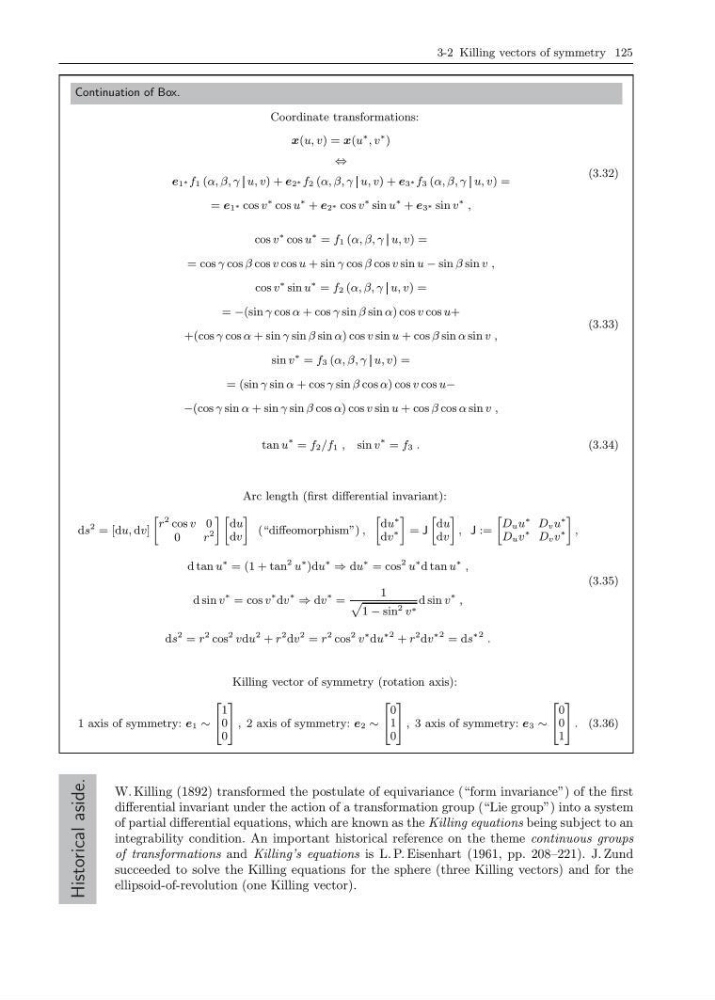
W. Killing (1892) transformed the postulate of equivariance (“form invariance”) of the first
differential invariant under the action of a transformation group (“Lie group”) into a system
of partial differential equations, which are known as the Killing equations being subject to an
integrability condition. An important historical reference on the theme continuous groups
of transformations and Killing’s equations is L. P. Eisenhart (1961, pp. 208–221). J. Zund
succeeded to solve the Killing equations for the sphere (three Killing vectors) and for the
ellipsoid-of-revolution (one Killing vector).
Continuation of Box.
Coordinate transformations:
x(u, v) = x(u
∗ , v
∗ )
⇔
e 1 ∗ f 1 (α, β, γ u, v) + e 2 ∗ f 2 (α, β, γ u, v) + e 3 ∗ f 3 (α, β, γ u, v) =
= e 1 ∗ cos v
∗ cos u
∗ + e 2 ∗ cos v
∗ sin u
∗ + e 3 ∗ sin v
∗ ,
(3.32)
cos v
∗ cos u
∗ = f 1 (α, β, γ u, v) =
= cos γ cos β cos v cos u + sin γ cos β cos v sin u − sin β sin v ,
cos v
∗ sin u
∗ = f 2 (α, β, γ u, v) =
= −(sin γ cos α + cos γ sin β sin α) cos v cos u+
+(cos γ cos α + sin γ sin β sin α) cos v sin u + cos β sin α sin v ,
sin v
∗ = f 3 (α, β, γ u, v) =
= (sin γ sin α + cos γ sin β cos α) cos v cos u−
−(cos γ sin α + sin γ sin β cos α) cos v sin u + cos β cos α sin v ,
(3.33)
tan u
∗ = f 2 /f 1 , sin v
∗ = f 3 .
(3.34)
Arc length (first differential invariant):
ds
2 = [du, dv]
»
r
2 cos v 0
0
r
2
– »
du
dv
–
(“diffeomorphism”) ,
»
du
∗
dv
∗
–
= J
»
du
dv
–
, J :=
»
D u u
∗ D v u
∗
D u v
∗ D v v
∗
–
,
d tan u
∗ = (1 + tan
2 u
∗ )du
∗ ⇒ du
∗ = cos
2 u
∗ d tan u
∗ ,
d sin v
∗ = cos v
∗ dv
∗ ⇒ dv
∗ =
1
p
1 − sin
2 v ∗
d sin v
∗ ,
ds
2 = r
2 cos
2 vdu
2 + r
2 dv
2 = r
2 cos
2 v
∗ du
∗2 + r
2 dv
∗2 = ds
∗2 .
(3.35)
Killing vector of symmetry (rotation axis):
1 axis of symmetry: e 1 ∼
2
4
1
0
0
3
5 , 2 axis of symmetry: e 2 ∼
2
4
0
1
0
3
5 , 3 axis of symmetry: e 3 ∼
2
4
0
0
1
3
5 . (3.36)
Historical aside.
W. Killing (1892) transformed the postulate of equivariance (“form invariance”) of the first
differential invariant under the action of a transformation group (“Lie group”) into a system
of partial differential equations, which are known as the Killing equations being subject to an
integrability condition. An important historical reference on the theme continuous groups
of transformations and Killing’s equations is L. P. Eisenhart (1961, pp. 208–221). J. Zund
succeeded to solve the Killing equations for the sphere (three Killing vectors) and for the
ellipsoid-of-revolution (one Killing vector).