

100 2 From Riemann manifolds to Euclidean manifolds
Left eigencolumns:
F 11
F 21
=
1
G 11 (e 22 − K 1 G 22 ) 2 − 2G 12 (e 12 − K 1 G 12 )(e 22 − K 1 G 22 ) + G 22 (e 12 − K 1 G 12 ) 2
×
×
e 22 − K 1 G 22
−(e 12 − K 1 G 12 )
,
F 12
F 22
=
1
G 22 (e 11 − K 2 G 11 ) 2 − 2G 12 (e 11 − K 2 G 11 )(e 12 − K 2 G 12 ) + G 11 (e 12 − K 2 G 12 ) 2
×
×
−(e 12 − K 2 G 12 )
e 11 − K 2 G 11
.
(2.14)
Right eigenvalues
(the right general eigenvalue problem reduces to the right special eigenvalue problem):
|E r − κ i I r | = 0 ,
κ 1,2 = κ ± =
1
2
tr [E r ] ±
(tr [E r ])
2 − 4det [E r ]
=
=
1
2
E 11 + E 22 ±
(E 11 − E 22 ) 2 + (2E 12 ) 2
.
(2.15)
Right eigencolumns:
F r =
f 11 f 12
f 21 f 22
⎧
⎪ ⎪ ⎪ ⎪ ⎨
⎪ ⎪ ⎪ ⎪ ⎩
f 11
f 21
=
1
(E 22 − κ 1 ) 2 + E 2
12
E 22 − κ 1
−E 12
,
f 12
f 22
=
1
(E 11 − κ 2 ) 2 + E 2
12
−E 12
E 11 − κ 2
.
(2.16)
Since the right Frobenius matrix F r is an orthonormal matrix, it can be represented by
F r =
cos φ sin φ
− sin φ cos φ
∀ φ ∈ [0, 2π] ,
tan φ =
E 12
E 11 − κ −
, tan 2φ =
2E 12
E 11 − E 22
.
(2.17)
End of Lemma.
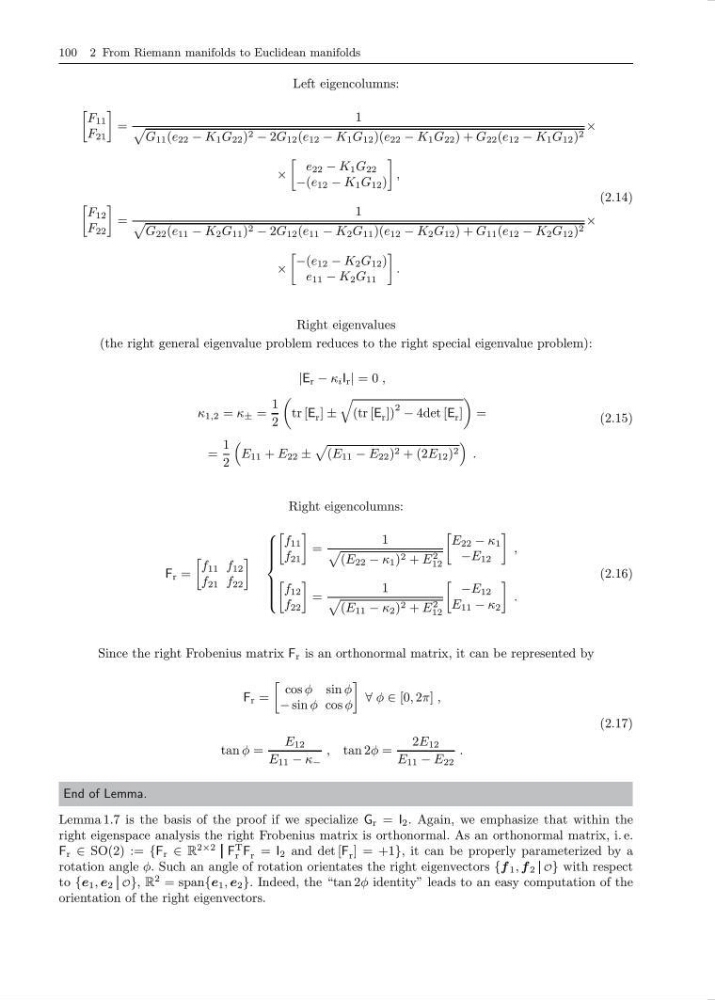
Lemma 1.7 is the basis of the proof if we specialize G r = I 2 . Again, we emphasize that within the
right eigenspace analysis the right Frobenius matrix is orthonormal. As an orthonormal matrix, i. e.
F r ∈ SO(2) := {F r ∈ R
2×2 F
T
r F r = I 2 and det [F r ] = +1}, it can be properly parameterized by a
rotation angle φ. Such an angle of rotation orientates the right eigenvectors {f 1 , f 2 O} with respect
to {e 1 , e 2 O}, R
2 = span{e 1 , e 2 }. Indeed, the “tan 2φ identity” leads to an easy computation of the
orientation of the right eigenvectors.
Left eigencolumns:
F 11
F 21
=
1
G 11 (e 22 − K 1 G 22 ) 2 − 2G 12 (e 12 − K 1 G 12 )(e 22 − K 1 G 22 ) + G 22 (e 12 − K 1 G 12 ) 2
×
×
e 22 − K 1 G 22
−(e 12 − K 1 G 12 )
,
F 12
F 22
=
1
G 22 (e 11 − K 2 G 11 ) 2 − 2G 12 (e 11 − K 2 G 11 )(e 12 − K 2 G 12 ) + G 11 (e 12 − K 2 G 12 ) 2
×
×
−(e 12 − K 2 G 12 )
e 11 − K 2 G 11
.
(2.14)
Right eigenvalues
(the right general eigenvalue problem reduces to the right special eigenvalue problem):
|E r − κ i I r | = 0 ,
κ 1,2 = κ ± =
1
2
tr [E r ] ±
(tr [E r ])
2 − 4det [E r ]
=
=
1
2
E 11 + E 22 ±
(E 11 − E 22 ) 2 + (2E 12 ) 2
.
(2.15)
Right eigencolumns:
F r =
f 11 f 12
f 21 f 22
⎧
⎪ ⎪ ⎪ ⎪ ⎨
⎪ ⎪ ⎪ ⎪ ⎩
f 11
f 21
=
1
(E 22 − κ 1 ) 2 + E 2
12
E 22 − κ 1
−E 12
,
f 12
f 22
=
1
(E 11 − κ 2 ) 2 + E 2
12
−E 12
E 11 − κ 2
.
(2.16)
Since the right Frobenius matrix F r is an orthonormal matrix, it can be represented by
F r =
cos φ sin φ
− sin φ cos φ
∀ φ ∈ [0, 2π] ,
tan φ =
E 12
E 11 − κ −
, tan 2φ =
2E 12
E 11 − E 22
.
(2.17)
End of Lemma.
Lemma 1.7 is the basis of the proof if we specialize G r = I 2 . Again, we emphasize that within the
right eigenspace analysis the right Frobenius matrix is orthonormal. As an orthonormal matrix, i. e.
F r ∈ SO(2) := {F r ∈ R
2×2 F
T
r F r = I 2 and det [F r ] = +1}, it can be properly parameterized by a
rotation angle φ. Such an angle of rotation orientates the right eigenvectors {f 1 , f 2 O} with respect
to {e 1 , e 2 O}, R
2 = span{e 1 , e 2 }. Indeed, the “tan 2φ identity” leads to an easy computation of the
orientation of the right eigenvectors.