

2-3 The equivalence theorem for conformal mappings 101
2-3 The equivalence theorem for conformal mappings
The equivalence theorem for conformal mappings from the left two-dimensional Riemann manifold to
the right two-dimensional Euclidean manifold (conformeomorphism), Korn–Lichtenstein equations and
Cauchy–Riemann equations (d’Alembert–Euler equations).
The previous equivalence theorem for a conformeomorphism is specialized for the case of the twodimensional right Euclidean manifold {M
2
r , g µν } = {R
2 , δ µν } =: E
2 . In many applications, the choice
of {R
2 , δ µν } is the planar manifold, for instance, the tangent space T U 0 M
2
l of the left two-dimensional
Riemann manifold fixed to the point U 0 = {U
1
0 , U
2
0 }, being covered by Cartesian or polar coordinates.
For an illustration of such a setup of a “planar manifold”, go back to our previous examples.
2-31 Conformeomorphism
First, let us confront you with Lemma 2.3. The proof based upon Theorem 1.11 is straightforward.
Examples are given in the following chapters.
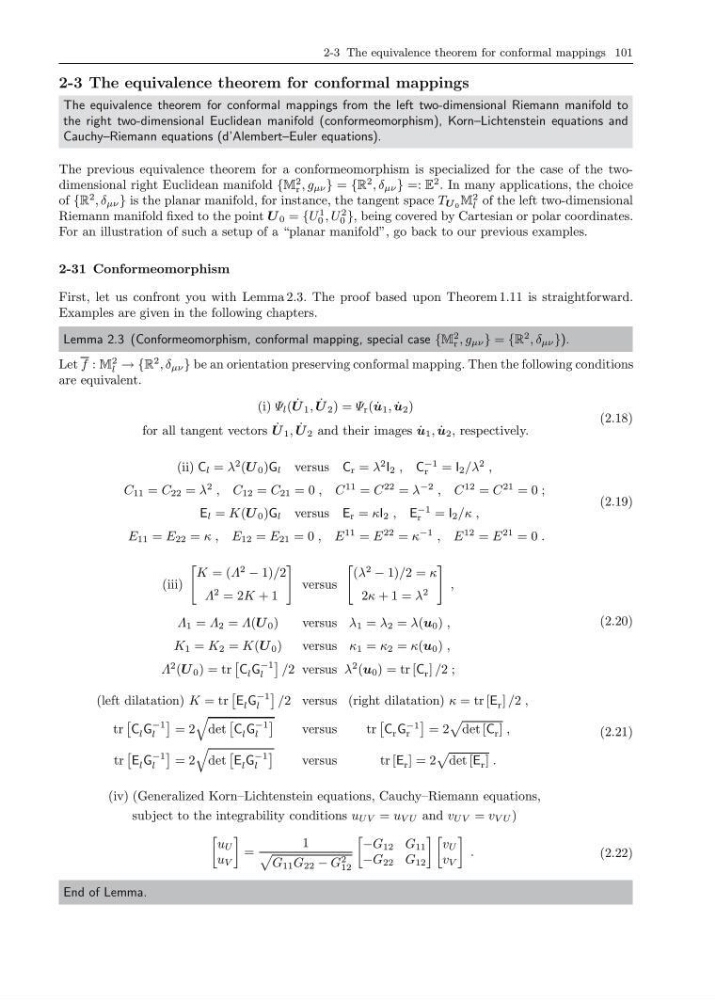
Lemma 2.3 (Conformeomorphism, conformal mapping, special case {M
2
r , g µν } = {R
2 , δ µν }).
Let f : M
2
l → {R
2 , δ µν } be an orientation preserving conformal mapping. Then the following conditions
are equivalent.
(i) Ψ l ( ˙
U 1 , ˙
U 2 ) = Ψ r ( ˙
u 1 , ˙
u 2 )
for all tangent vectors ˙
U 1 , ˙
U 2 and their images ˙
u 1 , ˙
u 2 , respectively.
(2.18)
(ii) C l = λ
2 (U 0 )G l versus C r = λ
2 I 2 , C
−1
r = I 2 /λ
2 ,
C 11 = C 22 = λ
2 , C 12 = C 21 = 0 , C
11 = C
22 = λ
−2 , C
12 = C
21 = 0 ;
E l = K(U 0 )G l versus E r = κI 2 , E
−1
r = I 2 /κ ,
E 11 = E 22 = κ , E 12 = E 21 = 0 , E
11 = E
22 = κ
−1 , E
12 = E
21 = 0 .
(2.19)
(iii)
K = (Λ
2
− 1)/2
Λ
2 = 2K + 1
versus
(λ
2
− 1)/2 = κ
2κ + 1 = λ
2
,
Λ 1 = Λ 2 = Λ(U 0 )
versus λ 1 = λ 2 = λ(u 0 ) ,
K 1 = K 2 = K(U 0 )
versus κ 1 = κ 2 = κ(u 0 ) ,
Λ
2 (U 0 ) = tr
C l G
−1
l
/2 versus λ
2 (u 0 ) = tr [C r ] /2 ;
(2.20)
(left dilatation) K = tr
E l G
−1
l
/2 versus (right dilatation) κ = tr [E r ] /2 ,
tr
C l G
−1
l
= 2
det
C l G
−1
l
versus
tr
C r G
−1
r
= 2
det [C r ] ,
tr
E l G
−1
l
= 2
det
E l G
−1
l
versus
tr [E r ] = 2
det [E r ] .
(2.21)
(iv) (Generalized Korn–Lichtenstein equations, Cauchy–Riemann equations,
subject to the integrability conditions u UV = u V U and v UV = v V U )
u U
u V
=
1
G 11 G 22 − G 2
12
−G 12 G 11
−G 22 G 12
v U
v V
.
(2.22)
End of Lemma.
2-3 The equivalence theorem for conformal mappings
The equivalence theorem for conformal mappings from the left two-dimensional Riemann manifold to
the right two-dimensional Euclidean manifold (conformeomorphism), Korn–Lichtenstein equations and
Cauchy–Riemann equations (d’Alembert–Euler equations).
The previous equivalence theorem for a conformeomorphism is specialized for the case of the twodimensional right Euclidean manifold {M
2
r , g µν } = {R
2 , δ µν } =: E
2 . In many applications, the choice
of {R
2 , δ µν } is the planar manifold, for instance, the tangent space T U 0 M
2
l of the left two-dimensional
Riemann manifold fixed to the point U 0 = {U
1
0 , U
2
0 }, being covered by Cartesian or polar coordinates.
For an illustration of such a setup of a “planar manifold”, go back to our previous examples.
2-31 Conformeomorphism
First, let us confront you with Lemma 2.3. The proof based upon Theorem 1.11 is straightforward.
Examples are given in the following chapters.
Lemma 2.3 (Conformeomorphism, conformal mapping, special case {M
2
r , g µν } = {R
2 , δ µν }).
Let f : M
2
l → {R
2 , δ µν } be an orientation preserving conformal mapping. Then the following conditions
are equivalent.
(i) Ψ l ( ˙
U 1 , ˙
U 2 ) = Ψ r ( ˙
u 1 , ˙
u 2 )
for all tangent vectors ˙
U 1 , ˙
U 2 and their images ˙
u 1 , ˙
u 2 , respectively.
(2.18)
(ii) C l = λ
2 (U 0 )G l versus C r = λ
2 I 2 , C
−1
r = I 2 /λ
2 ,
C 11 = C 22 = λ
2 , C 12 = C 21 = 0 , C
11 = C
22 = λ
−2 , C
12 = C
21 = 0 ;
E l = K(U 0 )G l versus E r = κI 2 , E
−1
r = I 2 /κ ,
E 11 = E 22 = κ , E 12 = E 21 = 0 , E
11 = E
22 = κ
−1 , E
12 = E
21 = 0 .
(2.19)
(iii)
K = (Λ
2
− 1)/2
Λ
2 = 2K + 1
versus
(λ
2
− 1)/2 = κ
2κ + 1 = λ
2
,
Λ 1 = Λ 2 = Λ(U 0 )
versus λ 1 = λ 2 = λ(u 0 ) ,
K 1 = K 2 = K(U 0 )
versus κ 1 = κ 2 = κ(u 0 ) ,
Λ
2 (U 0 ) = tr
C l G
−1
l
/2 versus λ
2 (u 0 ) = tr [C r ] /2 ;
(2.20)
(left dilatation) K = tr
E l G
−1
l
/2 versus (right dilatation) κ = tr [E r ] /2 ,
tr
C l G
−1
l
= 2
det
C l G
−1
l
versus
tr
C r G
−1
r
= 2
det [C r ] ,
tr
E l G
−1
l
= 2
det
E l G
−1
l
versus
tr [E r ] = 2
det [E r ] .
(2.21)
(iv) (Generalized Korn–Lichtenstein equations, Cauchy–Riemann equations,
subject to the integrability conditions u UV = u V U and v UV = v V U )
u U
u V
=
1
G 11 G 22 − G 2
12
−G 12 G 11
−G 22 G 12
v U
v V
.
(2.22)
End of Lemma.