

84
1 From Riemann manifolds to Riemann manifolds
1
2
I 1 =
1
2
Λ
2
1 + Λ
2
2
=
1
2 tr
C l G
−1
l
,
1
2
i 1 =
1
2
λ
2
1 + λ
2
2
=
1
2 tr
C r G
−1
r
(1.306)
represent the average Cauchy–Green deformation, distortion energy density of the first kind, also called
Cauchy–Green dilatation. In contrast,
ln
√
I 2 =
1
2
ln Λ
2
1 + ln Λ
2
2
= ln
det
C l G
−1
l
,
ln
√
i 2 =
1
2
ln λ
2
1 + ln λ
2
2
= ln
det
C r G
−1
r
(1.307)
are the geometric mean of Cauchy–Green deformation or distortion energy density of the second
kind. Note that similar Hilbert invariants can be formulated and interpreted for the Euler–Lagrange
deformation tensor.
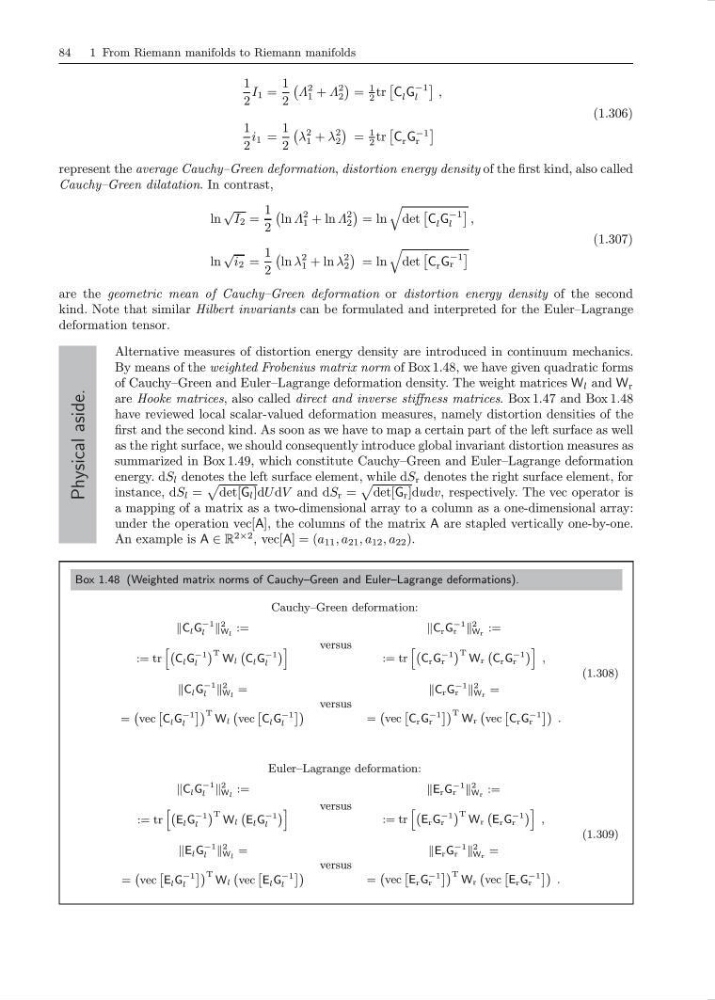
Physical aside.
Alternative measures of distortion energy density are introduced in continuum mechanics.
By means of the weighted Frobenius matrix norm of Box 1.48, we have given quadratic forms
of Cauchy–Green and Euler–Lagrange deformation density. The weight matrices W l and W r
are Hooke matrices, also called direct and inverse stiffness matrices. Box 1.47 and Box 1.48
have reviewed local scalar-valued deformation measures, namely distortion densities of the
first and the second kind. As soon as we have to map a certain part of the left surface as well
as the right surface, we should consequently introduce global invariant distortion measures as
summarized in Box 1.49, which constitute Cauchy–Green and Euler–Lagrange deformation
energy. dS l denotes the left surface element, while dS r denotes the right surface element, for
instance, dS l =
det[G l ]dU dV and dS r =
det[G r ]dudv, respectively. The vec operator is
a mapping of a matrix as a two-dimensional array to a column as a one-dimensional array:
under the operation vec[A], the columns of the matrix A are stapled vertically one-by-one.
An example is A ∈ R
2×2 , vec[A] = (a 11 , a 21 , a 12 , a 22 ).
Box 1.48 (Weighted matrix norms of Cauchy–Green and Euler–Lagrange deformations).
Cauchy–Green deformation:
C l G
−1
l
2
W l
:=
:= tr
h `
C l G
−1
l
´ T W l
`
C l G
−1
l
´ i
versus
C r G
−1
r
2
W r :=
:= tr
h `
C r G
−1
r
´ T W r
`
C r G
−1
r
´ i
,
C l G
−1
l
2
W l
=
=
`
vec
ˆ
C l G
−1
l
˜´ T W l
`
vec
ˆ
C l G
−1
l
˜´ versus
C r G
−1
r
2
W r =
=
`
vec
ˆ
C r G
−1
r
˜´ T W r
`
vec
ˆ
C r G
−1
r
˜´
.
(1.308)
Euler–Lagrange deformation:
C l G
−1
l
2
W l
:=
:= tr
h `
E l G
−1
l
´ T W l
`
E l G
−1
l
´ i
versus
E r G
−1
r
2
W r :=
:= tr
h `
E r G
−1
r
´ T W r
`
E r G
−1
r
´ i
,
E l G
−1
l
2
W l
=
=
`
vec
ˆ
E l G
−1
l
˜´ T W l
`
vec
ˆ
E l G
−1
l
˜´ versus
E r G
−1
r
2
W r =
=
`
vec
ˆ
E r G
−1
r
˜´ T W r
`
vec
ˆ
E r G
−1
r
˜´
.
(1.309)
1 From Riemann manifolds to Riemann manifolds
1
2
I 1 =
1
2
Λ
2
1 + Λ
2
2
=
1
2 tr
C l G
−1
l
,
1
2
i 1 =
1
2
λ
2
1 + λ
2
2
=
1
2 tr
C r G
−1
r
(1.306)
represent the average Cauchy–Green deformation, distortion energy density of the first kind, also called
Cauchy–Green dilatation. In contrast,
ln
√
I 2 =
1
2
ln Λ
2
1 + ln Λ
2
2
= ln
det
C l G
−1
l
,
ln
√
i 2 =
1
2
ln λ
2
1 + ln λ
2
2
= ln
det
C r G
−1
r
(1.307)
are the geometric mean of Cauchy–Green deformation or distortion energy density of the second
kind. Note that similar Hilbert invariants can be formulated and interpreted for the Euler–Lagrange
deformation tensor.
Physical aside.
Alternative measures of distortion energy density are introduced in continuum mechanics.
By means of the weighted Frobenius matrix norm of Box 1.48, we have given quadratic forms
of Cauchy–Green and Euler–Lagrange deformation density. The weight matrices W l and W r
are Hooke matrices, also called direct and inverse stiffness matrices. Box 1.47 and Box 1.48
have reviewed local scalar-valued deformation measures, namely distortion densities of the
first and the second kind. As soon as we have to map a certain part of the left surface as well
as the right surface, we should consequently introduce global invariant distortion measures as
summarized in Box 1.49, which constitute Cauchy–Green and Euler–Lagrange deformation
energy. dS l denotes the left surface element, while dS r denotes the right surface element, for
instance, dS l =
det[G l ]dU dV and dS r =
det[G r ]dudv, respectively. The vec operator is
a mapping of a matrix as a two-dimensional array to a column as a one-dimensional array:
under the operation vec[A], the columns of the matrix A are stapled vertically one-by-one.
An example is A ∈ R
2×2 , vec[A] = (a 11 , a 21 , a 12 , a 22 ).
Box 1.48 (Weighted matrix norms of Cauchy–Green and Euler–Lagrange deformations).
Cauchy–Green deformation:
C l G
−1
l
2
W l
:=
:= tr
h `
C l G
−1
l
´ T W l
`
C l G
−1
l
´ i
versus
C r G
−1
r
2
W r :=
:= tr
h `
C r G
−1
r
´ T W r
`
C r G
−1
r
´ i
,
C l G
−1
l
2
W l
=
=
`
vec
ˆ
C l G
−1
l
˜´ T W l
`
vec
ˆ
C l G
−1
l
˜´ versus
C r G
−1
r
2
W r =
=
`
vec
ˆ
C r G
−1
r
˜´ T W r
`
vec
ˆ
C r G
−1
r
˜´
.
(1.308)
Euler–Lagrange deformation:
C l G
−1
l
2
W l
:=
:= tr
h `
E l G
−1
l
´ T W l
`
E l G
−1
l
´ i
versus
E r G
−1
r
2
W r :=
:= tr
h `
E r G
−1
r
´ T W r
`
E r G
−1
r
´ i
,
E l G
−1
l
2
W l
=
=
`
vec
ˆ
E l G
−1
l
˜´ T W l
`
vec
ˆ
E l G
−1
l
˜´ versus
E r G
−1
r
2
W r =
=
`
vec
ˆ
E r G
−1
r
˜´ T W r
`
vec
ˆ
E r G
−1
r
˜´
.
(1.309)