

1-14 Review: the canonical criteria 85
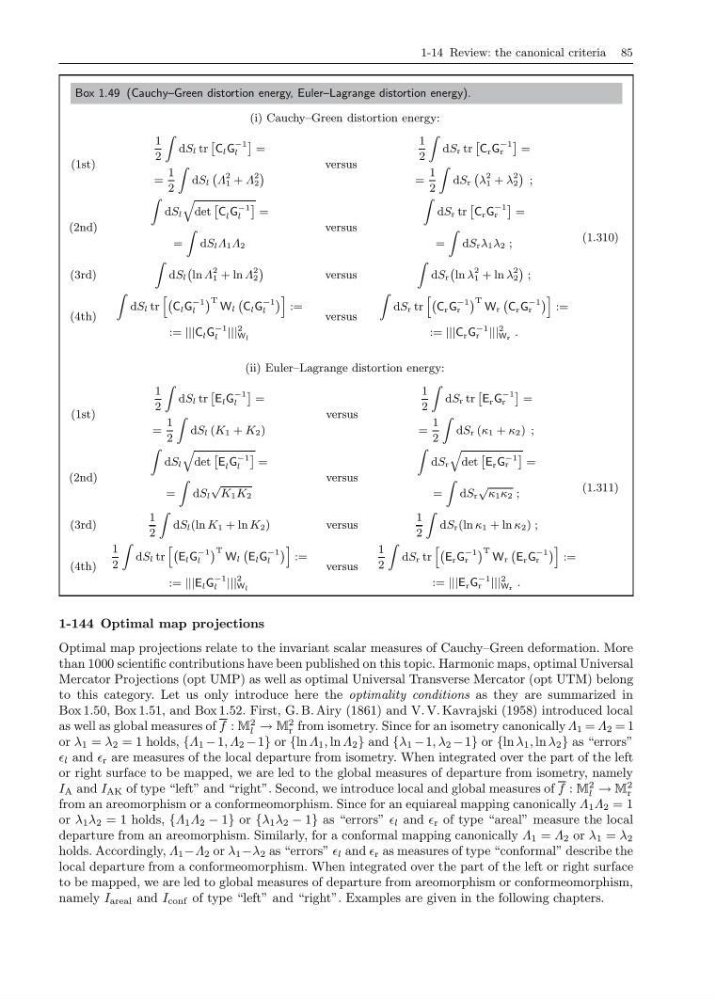
Box 1.49 (Cauchy–Green distortion energy, Euler–Lagrange distortion energy).
(i) Cauchy–Green distortion energy:
(1st)
1
2
Z
dS l tr
ˆ
C l G
−1
l
˜
=
=
1
2
Z
dS l
`
Λ
2
1 + Λ
2
2
´
versus
1
2
Z
dS r tr
ˆ
C r G
−1
r
˜
=
=
1
2
Z
dS r
`
λ
2
1 + λ
2
2
´
;
(2nd)
Z
dS l
q
det
ˆ
C l G
−1
l
˜
=
=
Z
dS l Λ 1 Λ 2
versus
Z
dS r tr
ˆ
C r G
−1
r
˜
=
=
Z
dS r λ 1 λ 2 ;
(3rd)
Z
dS l
`
ln Λ
2
1 + ln Λ
2
2
´
versus
Z
dS r
`
ln λ
2
1 + ln λ
2
2
´
;
(4th)
Z
dS l tr
h `
C l G
−1
l
´ T W l
`
C l G
−1
l
´ i
:=
:= |||C l G
−1
l |||
2
W l
versus
Z
dS r tr
h `
C r G
−1
r
´ T W r
`
C r G
−1
r
´ i
:=
:= |||C r G
−1
r |||
2
W r .
(1.310)
(ii) Euler–Lagrange distortion energy:
(1st)
1
2
Z
dS l tr
ˆ
E l G
−1
l
˜
=
=
1
2
Z
dS l (K 1 + K 2 )
versus
1
2
Z
dS r tr
ˆ
E r G
−1
r
˜
=
=
1
2
Z
dS r (κ 1 + κ 2 ) ;
(2nd)
Z
dS l
q
det
ˆ
E l G
−1
l
˜
=
=
Z
dS l
√
K 1 K 2
versus
Z
dS r
q
det
ˆ
E r G
−1
r
˜
=
=
Z
dS r
√
κ 1 κ 2 ;
(3rd)
1
2
Z
dS l (ln K 1 + ln K 2 )
v e r s u s
1
2
Z
dS r (ln κ 1 + ln κ 2 ) ;
(4th)
1
2
Z
dS l tr
h `
E l G
−1
l
´ T W l
`
E l G
−1
l
´ i
:=
:= |||E l G
−1
l |||
2
W l
versus
1
2
Z
dS r tr
h `
E r G
−1
r
´ T W r
`
E r G
−1
r
´ i
:=
:= |||E r G
−1
r |||
2
W r .
(1.311)
1-144 Optimal map projections
Optimal map projections relate to the invariant scalar measures of Cauchy–Green deformation. More
than 1000 scientific contributions have been published on this topic. Harmonic maps, optimal Universal
Mercator Projections (opt UMP) as well as optimal Universal Transverse Mercator (opt UTM) belong
to this category. Let us only introduce here the optimality conditions as they are summarized in
Box 1.50, Box 1.51, and Box 1.52. First, G. B. Airy (1861) and V. V. Kavrajski (1958) introduced local
as well as global measures of f : M
2
l → M
2
r from isometry. Since for an isometry canonically Λ 1 = Λ 2 = 1
or λ 1 = λ 2 = 1 holds, {Λ 1 − 1, Λ 2 − 1} or {ln Λ 1 , ln Λ 2 } and {λ 1 − 1, λ 2 − 1} or {ln λ 1 , ln λ 2 } as “errors”
l and r are measures of the local departure from isometry. When integrated over the part of the left
or right surface to be mapped, we are led to the global measures of departure from isometry, namely
I A and I AK of type “left” and “right”. Second, we introduce local and global measures of f : M
2
l → M
2
r
from an areomorphism or a conformeomorphism. Since for an equiareal mapping canonically Λ 1 Λ 2 = 1
or λ 1 λ 2 = 1 holds, {Λ 1 Λ 2 − 1} or {λ 1 λ 2 − 1} as “errors” l and r of type “areal” measure the local
departure from an areomorphism. Similarly, for a conformal mapping canonically Λ 1 = Λ 2 or λ 1 = λ 2
holds. Accordingly, Λ 1 −Λ 2 or λ 1 −λ 2 as “errors” l and r as measures of type “conformal” describe the
local departure from a conformeomorphism. When integrated over the part of the left or right surface
to be mapped, we are led to global measures of departure from areomorphism or conformeomorphism,
namely I areal and I conf of type “left” and “right”. Examples are given in the following chapters.
Box 1.49 (Cauchy–Green distortion energy, Euler–Lagrange distortion energy).
(i) Cauchy–Green distortion energy:
(1st)
1
2
Z
dS l tr
ˆ
C l G
−1
l
˜
=
=
1
2
Z
dS l
`
Λ
2
1 + Λ
2
2
´
versus
1
2
Z
dS r tr
ˆ
C r G
−1
r
˜
=
=
1
2
Z
dS r
`
λ
2
1 + λ
2
2
´
;
(2nd)
Z
dS l
q
det
ˆ
C l G
−1
l
˜
=
=
Z
dS l Λ 1 Λ 2
versus
Z
dS r tr
ˆ
C r G
−1
r
˜
=
=
Z
dS r λ 1 λ 2 ;
(3rd)
Z
dS l
`
ln Λ
2
1 + ln Λ
2
2
´
versus
Z
dS r
`
ln λ
2
1 + ln λ
2
2
´
;
(4th)
Z
dS l tr
h `
C l G
−1
l
´ T W l
`
C l G
−1
l
´ i
:=
:= |||C l G
−1
l |||
2
W l
versus
Z
dS r tr
h `
C r G
−1
r
´ T W r
`
C r G
−1
r
´ i
:=
:= |||C r G
−1
r |||
2
W r .
(1.310)
(ii) Euler–Lagrange distortion energy:
(1st)
1
2
Z
dS l tr
ˆ
E l G
−1
l
˜
=
=
1
2
Z
dS l (K 1 + K 2 )
versus
1
2
Z
dS r tr
ˆ
E r G
−1
r
˜
=
=
1
2
Z
dS r (κ 1 + κ 2 ) ;
(2nd)
Z
dS l
q
det
ˆ
E l G
−1
l
˜
=
=
Z
dS l
√
K 1 K 2
versus
Z
dS r
q
det
ˆ
E r G
−1
r
˜
=
=
Z
dS r
√
κ 1 κ 2 ;
(3rd)
1
2
Z
dS l (ln K 1 + ln K 2 )
v e r s u s
1
2
Z
dS r (ln κ 1 + ln κ 2 ) ;
(4th)
1
2
Z
dS l tr
h `
E l G
−1
l
´ T W l
`
E l G
−1
l
´ i
:=
:= |||E l G
−1
l |||
2
W l
versus
1
2
Z
dS r tr
h `
E r G
−1
r
´ T W r
`
E r G
−1
r
´ i
:=
:= |||E r G
−1
r |||
2
W r .
(1.311)
1-144 Optimal map projections
Optimal map projections relate to the invariant scalar measures of Cauchy–Green deformation. More
than 1000 scientific contributions have been published on this topic. Harmonic maps, optimal Universal
Mercator Projections (opt UMP) as well as optimal Universal Transverse Mercator (opt UTM) belong
to this category. Let us only introduce here the optimality conditions as they are summarized in
Box 1.50, Box 1.51, and Box 1.52. First, G. B. Airy (1861) and V. V. Kavrajski (1958) introduced local
as well as global measures of f : M
2
l → M
2
r from isometry. Since for an isometry canonically Λ 1 = Λ 2 = 1
or λ 1 = λ 2 = 1 holds, {Λ 1 − 1, Λ 2 − 1} or {ln Λ 1 , ln Λ 2 } and {λ 1 − 1, λ 2 − 1} or {ln λ 1 , ln λ 2 } as “errors”
l and r are measures of the local departure from isometry. When integrated over the part of the left
or right surface to be mapped, we are led to the global measures of departure from isometry, namely
I A and I AK of type “left” and “right”. Second, we introduce local and global measures of f : M
2
l → M
2
r
from an areomorphism or a conformeomorphism. Since for an equiareal mapping canonically Λ 1 Λ 2 = 1
or λ 1 λ 2 = 1 holds, {Λ 1 Λ 2 − 1} or {λ 1 λ 2 − 1} as “errors” l and r of type “areal” measure the local
departure from an areomorphism. Similarly, for a conformal mapping canonically Λ 1 = Λ 2 or λ 1 = λ 2
holds. Accordingly, Λ 1 −Λ 2 or λ 1 −λ 2 as “errors” l and r as measures of type “conformal” describe the
local departure from a conformeomorphism. When integrated over the part of the left or right surface
to be mapped, we are led to global measures of departure from areomorphism or conformeomorphism,
namely I areal and I conf of type “left” and “right”. Examples are given in the following chapters.