

1-14 Review: the canonical criteria 83
The proof is straightforward. We refer to Example 1.11, where we solved the third problem: the
ellipsoidal equator had been equidistantly mapped to the spherical equator, namely rλ = A 1 Λ, such
that Λ 1 (Φ = 0) = 1 or λ 1 (φ = 0) = 1.
1-143 Canonical criteria
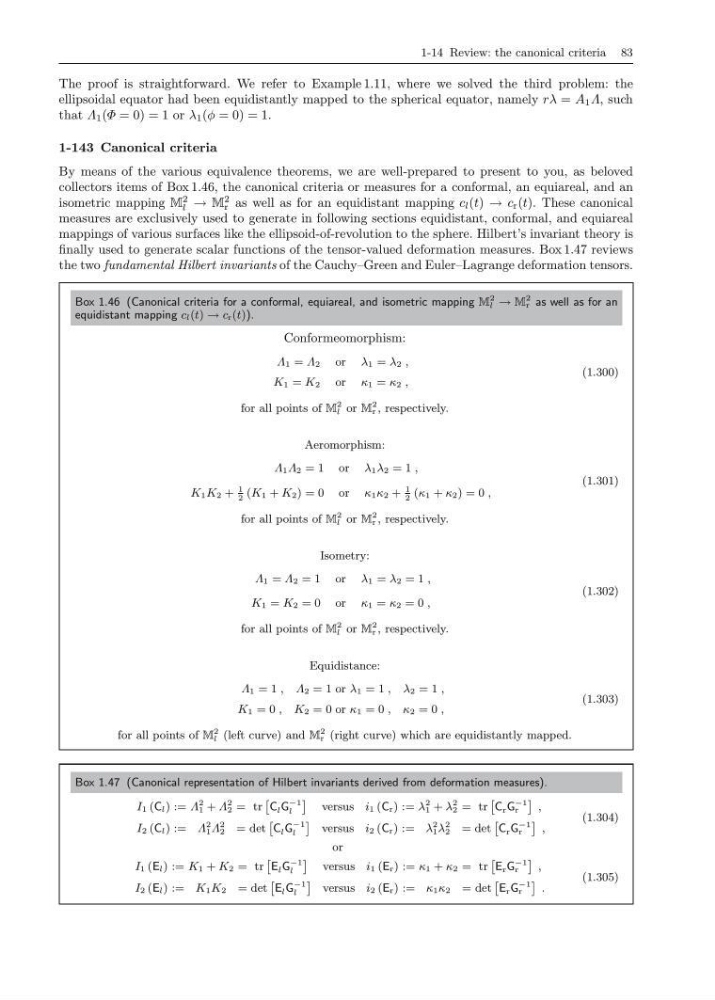
By means of the various equivalence theorems, we are well-prepared to present to you, as beloved
collectors items of Box 1.46, the canonical criteria or measures for a conformal, an equiareal, and an
isometric mapping M
2
l → M
2
r as well as for an equidistant mapping c l (t) → c r (t). These canonical
measures are exclusively used to generate in following sections equidistant, conformal, and equiareal
mappings of various surfaces like the ellipsoid-of-revolution to the sphere. Hilbert’s invariant theory is
finally used to generate scalar functions of the tensor-valued deformation measures. Box 1.47 reviews
the two fundamental Hilbert invariants of the Cauchy–Green and Euler–Lagrange deformation tensors.
Box 1.46 (Canonical criteria for a conformal, equiareal, and isometric mapping M
2
l → M
2
r as well as for an
equidistant mapping c l (t) → c r (t)).
Conformeomorphism:
Λ 1 = Λ 2 or λ 1 = λ 2 ,
K 1 = K 2 or κ 1 = κ 2 ,
(1.300)
for all points of M
2
l or M
2
r , respectively.
Aeromorphism:
Λ 1 Λ 2 = 1 or λ 1 λ 2 = 1 ,
K 1 K 2 +
1
2
(K 1 + K 2 ) = 0 or κ 1 κ 2 +
1
2
(κ 1 + κ 2 ) = 0 ,
(1.301)
for all points of M
2
l or M
2
r , respectively.
Isometry:
Λ 1 = Λ 2 = 1 or λ 1 = λ 2 = 1 ,
K 1 = K 2 = 0 or κ 1 = κ 2 = 0 ,
(1.302)
for all points of M
2
l or M
2
r , respectively.
Equidistance:
Λ 1 = 1 , Λ 2 = 1 or λ 1 = 1 , λ 2 = 1 ,
K 1 = 0 , K 2 = 0 or κ 1 = 0 , κ 2 = 0 ,
(1.303)
for all points of M
2
l (left curve) and M
2
r (right curve) which are equidistantly mapped.
Box 1.47 (Canonical representation of Hilbert invariants derived from deformation measures).
I 1 (C l ) := Λ
2
1 + Λ
2
2 = tr
ˆ
C l G
−1
l
˜
versus i 1 (C r ) := λ
2
1 + λ
2
2 = tr
ˆ
C r G
−1
r
˜
,
I 2 (C l ) := Λ
2
1 Λ
2
2
= det
ˆ
C l G
−1
l
˜
versus i 2 (C r ) := λ
2
1 λ
2
2
= det
ˆ
C r G
−1
r
˜
,
(1.304)
or
I 1 (E l ) := K 1 + K 2 = tr
ˆ
E l G
−1
l
˜
versus i 1 (E r ) := κ 1 + κ 2 = tr
ˆ
E r G
−1
r
˜
,
I 2 (E l ) := K 1 K 2 = det
ˆ
E l G
−1
l
˜
versus i 2 (E r ) := κ 1 κ 2 = det
ˆ
E r G
−1
r
˜
.
(1.305)
The proof is straightforward. We refer to Example 1.11, where we solved the third problem: the
ellipsoidal equator had been equidistantly mapped to the spherical equator, namely rλ = A 1 Λ, such
that Λ 1 (Φ = 0) = 1 or λ 1 (φ = 0) = 1.
1-143 Canonical criteria
By means of the various equivalence theorems, we are well-prepared to present to you, as beloved
collectors items of Box 1.46, the canonical criteria or measures for a conformal, an equiareal, and an
isometric mapping M
2
l → M
2
r as well as for an equidistant mapping c l (t) → c r (t). These canonical
measures are exclusively used to generate in following sections equidistant, conformal, and equiareal
mappings of various surfaces like the ellipsoid-of-revolution to the sphere. Hilbert’s invariant theory is
finally used to generate scalar functions of the tensor-valued deformation measures. Box 1.47 reviews
the two fundamental Hilbert invariants of the Cauchy–Green and Euler–Lagrange deformation tensors.
Box 1.46 (Canonical criteria for a conformal, equiareal, and isometric mapping M
2
l → M
2
r as well as for an
equidistant mapping c l (t) → c r (t)).
Conformeomorphism:
Λ 1 = Λ 2 or λ 1 = λ 2 ,
K 1 = K 2 or κ 1 = κ 2 ,
(1.300)
for all points of M
2
l or M
2
r , respectively.
Aeromorphism:
Λ 1 Λ 2 = 1 or λ 1 λ 2 = 1 ,
K 1 K 2 +
1
2
(K 1 + K 2 ) = 0 or κ 1 κ 2 +
1
2
(κ 1 + κ 2 ) = 0 ,
(1.301)
for all points of M
2
l or M
2
r , respectively.
Isometry:
Λ 1 = Λ 2 = 1 or λ 1 = λ 2 = 1 ,
K 1 = K 2 = 0 or κ 1 = κ 2 = 0 ,
(1.302)
for all points of M
2
l or M
2
r , respectively.
Equidistance:
Λ 1 = 1 , Λ 2 = 1 or λ 1 = 1 , λ 2 = 1 ,
K 1 = 0 , K 2 = 0 or κ 1 = 0 , κ 2 = 0 ,
(1.303)
for all points of M
2
l (left curve) and M
2
r (right curve) which are equidistantly mapped.
Box 1.47 (Canonical representation of Hilbert invariants derived from deformation measures).
I 1 (C l ) := Λ
2
1 + Λ
2
2 = tr
ˆ
C l G
−1
l
˜
versus i 1 (C r ) := λ
2
1 + λ
2
2 = tr
ˆ
C r G
−1
r
˜
,
I 2 (C l ) := Λ
2
1 Λ
2
2
= det
ˆ
C l G
−1
l
˜
versus i 2 (C r ) := λ
2
1 λ
2
2
= det
ˆ
C r G
−1
r
˜
,
(1.304)
or
I 1 (E l ) := K 1 + K 2 = tr
ˆ
E l G
−1
l
˜
versus i 1 (E r ) := κ 1 + κ 2 = tr
ˆ
E r G
−1
r
˜
,
I 2 (E l ) := K 1 K 2 = det
ˆ
E l G
−1
l
˜
versus i 2 (E r ) := κ 1 κ 2 = det
ˆ
E r G
−1
r
˜
.
(1.305)