

84
4. Finite Difference Methods
4.2 The Method of Characteristics
4.2.1 Basic Idea of the Method of Characteristics
As stated in the previous section, the numerical dispersion increases with
velocity. When the advection term dominates the advection-dispersion equation, the effect of numerical dispersion will become notable. In this case, the
nature of the advection-dispersion equation is dose to the pure-advection
one. Without the dispersion term, the latter is a hyperbolic equation of the
first order. This fact leads us to use the method of characteristics for hyperbolic equations to solve the advection-dispersion equation. The concept of
this method is simple, and the method is capable of handling various complex conditions. Therefore, many researchers adopted it in water quality
simulation in the early period (e.g., Garder et al. (1964), Pinder and Cooper
(1970), and Konikow and Bredehoeft (1974)). Konikow and Bredehoeft (1978)
gave a systematic exposition, wh ich indudes its principle, details ofusage and
a general pro gram written in FORTRAN.
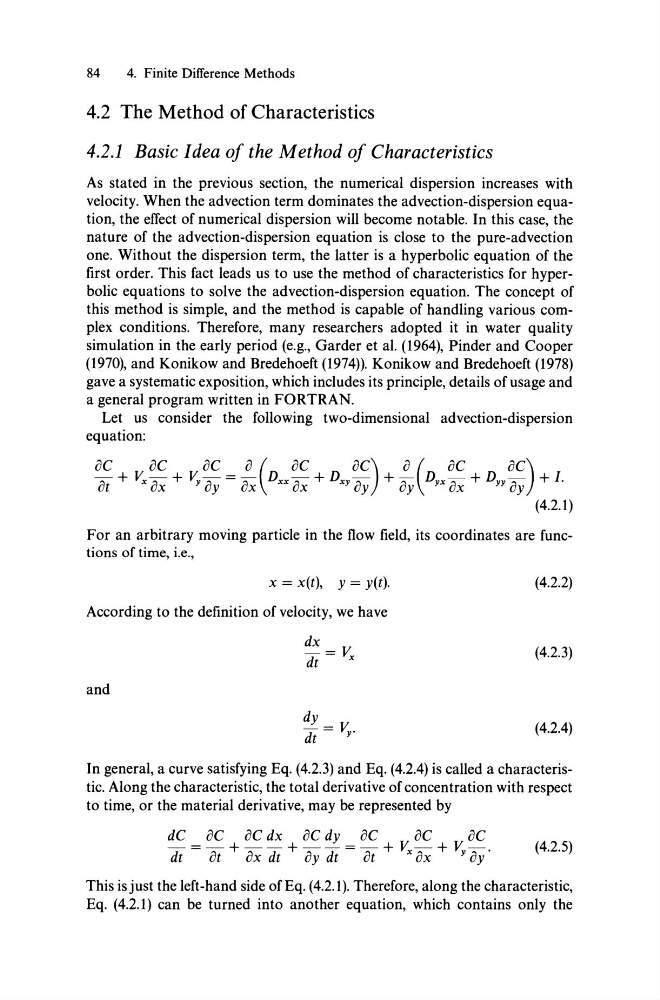
Let us consider the following two-dimensional advection-dispersion
equation:
For an arbitrary moving partide in the flow field, its coordinates are functions of time, i.e.,
x = x(t), y = y(t).
(4.2.2)
According to the definition of velocity, we have
(4.2.3)
and
dy
dt =~.
(4.2.4)
In general, a curve satisfying Eq. (4.2.3) and Eq. (4.2.4) is called a characteristic. Along the characteristic, the total derivative of concentration with respect
to time, or the material derivative, may be represented by
dC OC OC dx oC dy OC
oC
oC
dt = Tt + ox dt + oy dt = Tt + V x ox + ~ oy .
(4.2.5)
This isjust the left-hand side ofEq. (4.2.1). Therefore, along the characteristic,
Eq. (4.2.1) can be turned into another equation, which contains only the
4. Finite Difference Methods
4.2 The Method of Characteristics
4.2.1 Basic Idea of the Method of Characteristics
As stated in the previous section, the numerical dispersion increases with
velocity. When the advection term dominates the advection-dispersion equation, the effect of numerical dispersion will become notable. In this case, the
nature of the advection-dispersion equation is dose to the pure-advection
one. Without the dispersion term, the latter is a hyperbolic equation of the
first order. This fact leads us to use the method of characteristics for hyperbolic equations to solve the advection-dispersion equation. The concept of
this method is simple, and the method is capable of handling various complex conditions. Therefore, many researchers adopted it in water quality
simulation in the early period (e.g., Garder et al. (1964), Pinder and Cooper
(1970), and Konikow and Bredehoeft (1974)). Konikow and Bredehoeft (1978)
gave a systematic exposition, wh ich indudes its principle, details ofusage and
a general pro gram written in FORTRAN.
Let us consider the following two-dimensional advection-dispersion
equation:
For an arbitrary moving partide in the flow field, its coordinates are functions of time, i.e.,
x = x(t), y = y(t).
(4.2.2)
According to the definition of velocity, we have
(4.2.3)
and
dy
dt =~.
(4.2.4)
In general, a curve satisfying Eq. (4.2.3) and Eq. (4.2.4) is called a characteristic. Along the characteristic, the total derivative of concentration with respect
to time, or the material derivative, may be represented by
dC OC OC dx oC dy OC
oC
oC
dt = Tt + ox dt + oy dt = Tt + V x ox + ~ oy .
(4.2.5)
This isjust the left-hand side ofEq. (4.2.1). Therefore, along the characteristic,
Eq. (4.2.1) can be turned into another equation, which contains only the