

4.1. Finite DifTerence Methods
83
4.1.4 Finite Difference Solutions for Two- and
Three-Dimensional Dispersion Problems
To ex te nd the FDM from its one-dimensional form to two- and threedimensional forms is straightforward. Finite difference approximations can
be used to diseretize eaeh term in two- and three-dimensional adveetiondispersion equations. However, we should note that the hydrodynamie dispersion eoeffieient is always a tensor even for isotropie porous media. Thus
the diseretization of dispersion terms may involve more neighboring nodes
than that in the solution of groundwater flow problems. For a two-dimensional problem, we have four dispersion terms:
(a, ß = 1,2).
(4.1.35)
When Eqs. (4.1.7) and (4.1.8) are used to diseretize these terms, nine nodal
eoneentrations: Ci-1,i-l' Ci-1,i' Ci-1,i+l' Ci,i-l' Ci,i' Ci,i+l' Ci+l,i-l' C i+1,i
and Ci+l,i+l will be involved in the finite differenee equation ofnode (i,j). For
a three-dimensional problem, the number of dispersion terms is nine, and 27
nodal values of eoneentration will be involved in the finite differenee equation of anode.
The numerieal dispersion problem assoeiated with two- and three-dimensional finite element methods ean also be analyzed. Let us consider the
following two-dimensional adveetion-dispersion equation:
(4.1.36)
where Vx and Yy are eomponents of the flow veloeity in the x and y direetions,
respeetively; Dxx ' Dxy and D yy are eomponents of the dispersion eoefficient
tensor. If the baekward differenee is used for the first order partial derivatives
in the equation, the resulting numerieal dispersion will be
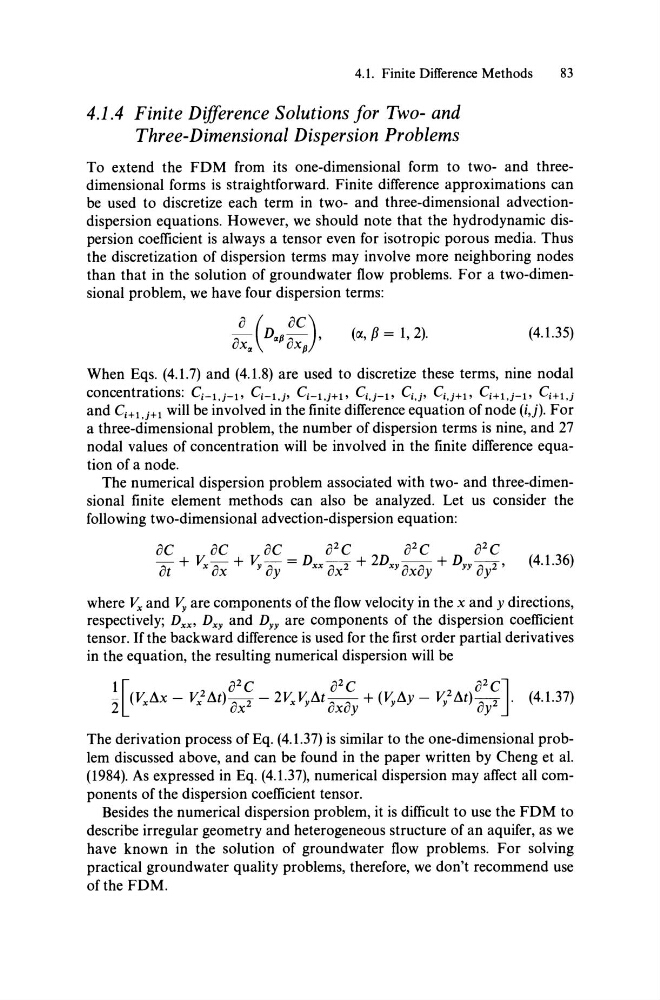
The derivation process of Eq. (4.1.37) is similar to the one-dimensional problem diseussed above, and ean be found in the paper written by Cheng et al.
(1984). As expressed in Eq. (4.1.37), numerieal dispersion may affeet all eomponents of the dispersion eoeffieient tensor.
Besides the numerieal dispersion problem, it is diffieult to use the FDM to
deseribe irregular geometry and heterogeneous strueture of an aquifer, as we
have known in the solution of groundwater flow problems. For solving
praetieal groundwater quality problems, therefore, we don't reeommend use
ofthe FDM.
83
4.1.4 Finite Difference Solutions for Two- and
Three-Dimensional Dispersion Problems
To ex te nd the FDM from its one-dimensional form to two- and threedimensional forms is straightforward. Finite difference approximations can
be used to diseretize eaeh term in two- and three-dimensional adveetiondispersion equations. However, we should note that the hydrodynamie dispersion eoeffieient is always a tensor even for isotropie porous media. Thus
the diseretization of dispersion terms may involve more neighboring nodes
than that in the solution of groundwater flow problems. For a two-dimensional problem, we have four dispersion terms:
(a, ß = 1,2).
(4.1.35)
When Eqs. (4.1.7) and (4.1.8) are used to diseretize these terms, nine nodal
eoneentrations: Ci-1,i-l' Ci-1,i' Ci-1,i+l' Ci,i-l' Ci,i' Ci,i+l' Ci+l,i-l' C i+1,i
and Ci+l,i+l will be involved in the finite differenee equation ofnode (i,j). For
a three-dimensional problem, the number of dispersion terms is nine, and 27
nodal values of eoneentration will be involved in the finite differenee equation of anode.
The numerieal dispersion problem assoeiated with two- and three-dimensional finite element methods ean also be analyzed. Let us consider the
following two-dimensional adveetion-dispersion equation:
(4.1.36)
where Vx and Yy are eomponents of the flow veloeity in the x and y direetions,
respeetively; Dxx ' Dxy and D yy are eomponents of the dispersion eoefficient
tensor. If the baekward differenee is used for the first order partial derivatives
in the equation, the resulting numerieal dispersion will be
The derivation process of Eq. (4.1.37) is similar to the one-dimensional problem diseussed above, and ean be found in the paper written by Cheng et al.
(1984). As expressed in Eq. (4.1.37), numerieal dispersion may affeet all eomponents of the dispersion eoeffieient tensor.
Besides the numerieal dispersion problem, it is diffieult to use the FDM to
deseribe irregular geometry and heterogeneous strueture of an aquifer, as we
have known in the solution of groundwater flow problems. For solving
praetieal groundwater quality problems, therefore, we don't reeommend use
ofthe FDM.