

68
3. Analytie Solutions of Hydrodynamie Dispersion Equations
where
r"'/'O[ (r-ro)xJ [
Y(O(
)3 / 2J. [ß(
0()3 / 2JdX
14 = J"'/' 1 + 40( exp -tx - x ro - x sm x x - r x'
1
00
[1 (r - ro)xJ ( ). [ß(X - 0(/r)3 / 2 - y(x - 0(/ro)3 / 2J dx
15 =
+ 4
exp - tx sm
- .
"'/'0
0(
X
X
Moench and Ogata (1981) calculated the inverse Laplace transform by
a numerical method to avoid calculation of these complex expressions. With
this algorithm, the computational effort is reduced and the results obtained
are accurate enough. A simpler analytic solution including the Airy function
was given by Hsieh (1986). Chen (1987) changed the boundary condition
of the constant concentration into the Cauchy boundary condition at the
injecting weIl, and obtained the corresponding analytic solution.
In researching radial dispersion, Rasmuson (1981) considered the twodimensional dispersion problem on the plane (r, z). An analytic solution for
the case that there is a disc-shaped pollution source (C(r, 0, t) = Co, 0 ::;
r ::; a) on the plane z = 0 was obtained. This solution includes the effect of
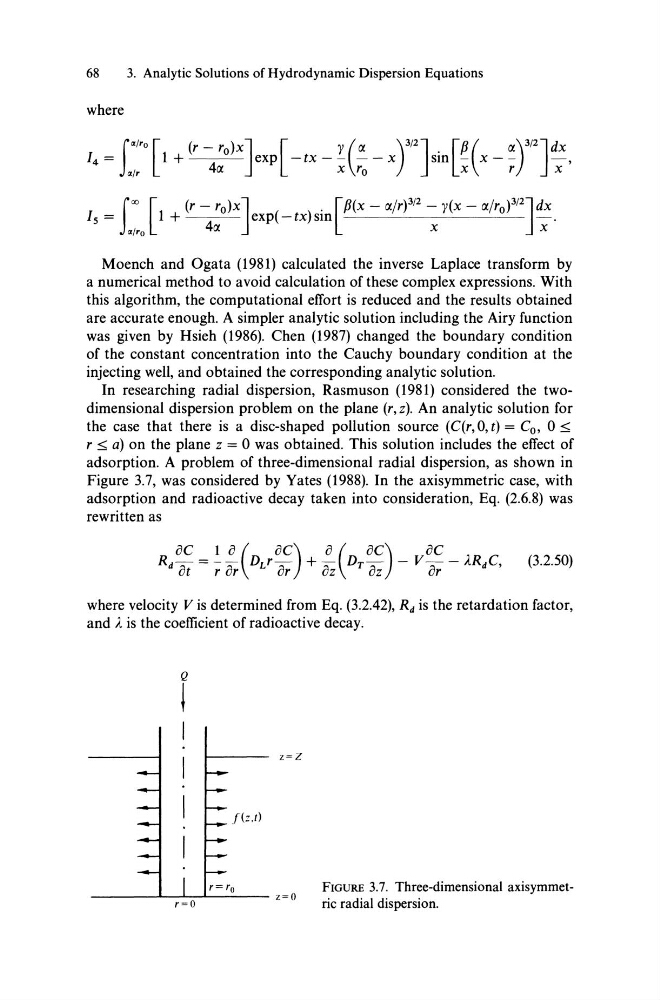
adsorption. A problem of three-dimensional radial dispersion, as shown in
Figure 3.7, was considered by Yates (1988). In the axisymmetric case, with
adsorption and radioactive decay taken into consideration, Eq. (2.6.8) was
rewritten as
(3.2.50)
where velocity V is determined from Eq. (3.2.42), R d is the retardation factor,
and Ä. is the coefficient of radioactive decay.
z=Z
!(z.t)
,= '0
------~L-,~=~o-L--~---z=o
FIGURE 3.7. Three-dimensional axisymmetrie radial dispersion.
3. Analytie Solutions of Hydrodynamie Dispersion Equations
where
r"'/'O[ (r-ro)xJ [
Y(O(
)3 / 2J. [ß(
0()3 / 2JdX
14 = J"'/' 1 + 40( exp -tx - x ro - x sm x x - r x'
1
00
[1 (r - ro)xJ ( ). [ß(X - 0(/r)3 / 2 - y(x - 0(/ro)3 / 2J dx
15 =
+ 4
exp - tx sm
- .
"'/'0
0(
X
X
Moench and Ogata (1981) calculated the inverse Laplace transform by
a numerical method to avoid calculation of these complex expressions. With
this algorithm, the computational effort is reduced and the results obtained
are accurate enough. A simpler analytic solution including the Airy function
was given by Hsieh (1986). Chen (1987) changed the boundary condition
of the constant concentration into the Cauchy boundary condition at the
injecting weIl, and obtained the corresponding analytic solution.
In researching radial dispersion, Rasmuson (1981) considered the twodimensional dispersion problem on the plane (r, z). An analytic solution for
the case that there is a disc-shaped pollution source (C(r, 0, t) = Co, 0 ::;
r ::; a) on the plane z = 0 was obtained. This solution includes the effect of
adsorption. A problem of three-dimensional radial dispersion, as shown in
Figure 3.7, was considered by Yates (1988). In the axisymmetric case, with
adsorption and radioactive decay taken into consideration, Eq. (2.6.8) was
rewritten as
(3.2.50)
where velocity V is determined from Eq. (3.2.42), R d is the retardation factor,
and Ä. is the coefficient of radioactive decay.
z=Z
!(z.t)
,= '0
------~L-,~=~o-L--~---z=o
FIGURE 3.7. Three-dimensional axisymmetrie radial dispersion.