

3.2. Some Canonical Problems Having Analytic Solutions
69
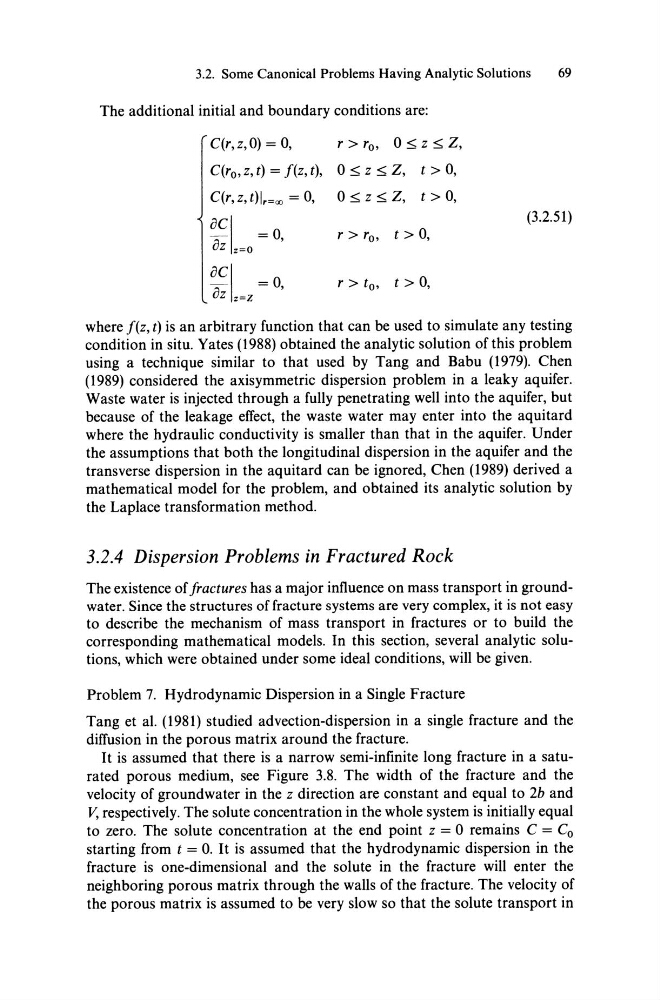
The additional initial and boundary conditions are:
C(r, z, 0) = 0,
C(r o , z, t) = j(z, t),
C(r, z, t)lr=oo = 0,
OCI = °
oz z=o '
OCI = °
oz z=z '
° : : ; z ::; Z, t > 0,
° : : ; z ::; Z, t > 0,
r > r o , t > 0,
r> t o, t > 0,
(3.2.51)
where j(z, t) is an arbitrary function that can be used to simulate any testing
condition in situ. Yates (1988) obtained the analytic solution of this problem
using a technique similar to that used by Tang and Babu (1979). Chen
(1989) considered the axisymmetric dispersion problem in a leaky aquifer.
Waste water is injected through a fully penetrating weIl into the aquifer, but
because of the leakage effect, the waste water may enter into the aquitard
where the hydraulic conductivity is smaller than that in the aquifer. Under
the assumptions that both the longitudinal dispersion in the aquifer and the
trans verse dispersion in the aquitard can be ignored, Chen (1989) derived a
mathematical model for the problem, and obtained its analytic solution by
the Laplace transformation method.
3.2.4 Dispersion Problems in Fractured Rock
The existence of jractures has a major influence on mass transport in groundwater. Since the structures of fracture systems are very complex, it is not easy
to describe the mechanism of mass transport in fractures or to build the
corresponding mathematical models. In this section, several analytic solutions, which were obtained under some ideal conditions, will be given.
Problem 7. Hydrodynamic Dispersion in a Single Fracture
Tang et al. (1981) studied advection-dispersion in a single fracture and the
diffusion in the porous matrix around the fracture.
It is assumed that there is a narrow semi-infinite long fracture in a saturated porous medium, see Figure 3.8. The width of the fracture and the
velocity of groundwater in the z direction are constant and equal to 2b and
V, respectively. The solute concentration in the whole system is initially equal
to zero. The solute concentration at the end point z = ° remains C = Co
starting from t = 0. It is assumed that the hydrodynamic dispersion in the
fracture is one-dimensional and the solute in the fracture will enter the
neighboring porous matrix through the walls of the fracture. The velocity of
the porous matrix is assumed to be very slow so that the solute transport in
69
The additional initial and boundary conditions are:
C(r, z, 0) = 0,
C(r o , z, t) = j(z, t),
C(r, z, t)lr=oo = 0,
OCI = °
oz z=o '
OCI = °
oz z=z '
° : : ; z ::; Z, t > 0,
° : : ; z ::; Z, t > 0,
r > r o , t > 0,
r> t o, t > 0,
(3.2.51)
where j(z, t) is an arbitrary function that can be used to simulate any testing
condition in situ. Yates (1988) obtained the analytic solution of this problem
using a technique similar to that used by Tang and Babu (1979). Chen
(1989) considered the axisymmetric dispersion problem in a leaky aquifer.
Waste water is injected through a fully penetrating weIl into the aquifer, but
because of the leakage effect, the waste water may enter into the aquitard
where the hydraulic conductivity is smaller than that in the aquifer. Under
the assumptions that both the longitudinal dispersion in the aquifer and the
trans verse dispersion in the aquitard can be ignored, Chen (1989) derived a
mathematical model for the problem, and obtained its analytic solution by
the Laplace transformation method.
3.2.4 Dispersion Problems in Fractured Rock
The existence of jractures has a major influence on mass transport in groundwater. Since the structures of fracture systems are very complex, it is not easy
to describe the mechanism of mass transport in fractures or to build the
corresponding mathematical models. In this section, several analytic solutions, which were obtained under some ideal conditions, will be given.
Problem 7. Hydrodynamic Dispersion in a Single Fracture
Tang et al. (1981) studied advection-dispersion in a single fracture and the
diffusion in the porous matrix around the fracture.
It is assumed that there is a narrow semi-infinite long fracture in a saturated porous medium, see Figure 3.8. The width of the fracture and the
velocity of groundwater in the z direction are constant and equal to 2b and
V, respectively. The solute concentration in the whole system is initially equal
to zero. The solute concentration at the end point z = ° remains C = Co
starting from t = 0. It is assumed that the hydrodynamic dispersion in the
fracture is one-dimensional and the solute in the fracture will enter the
neighboring porous matrix through the walls of the fracture. The velocity of
the porous matrix is assumed to be very slow so that the solute transport in