

3.2. Some Canonical Problems Having Analytic Solutions
67
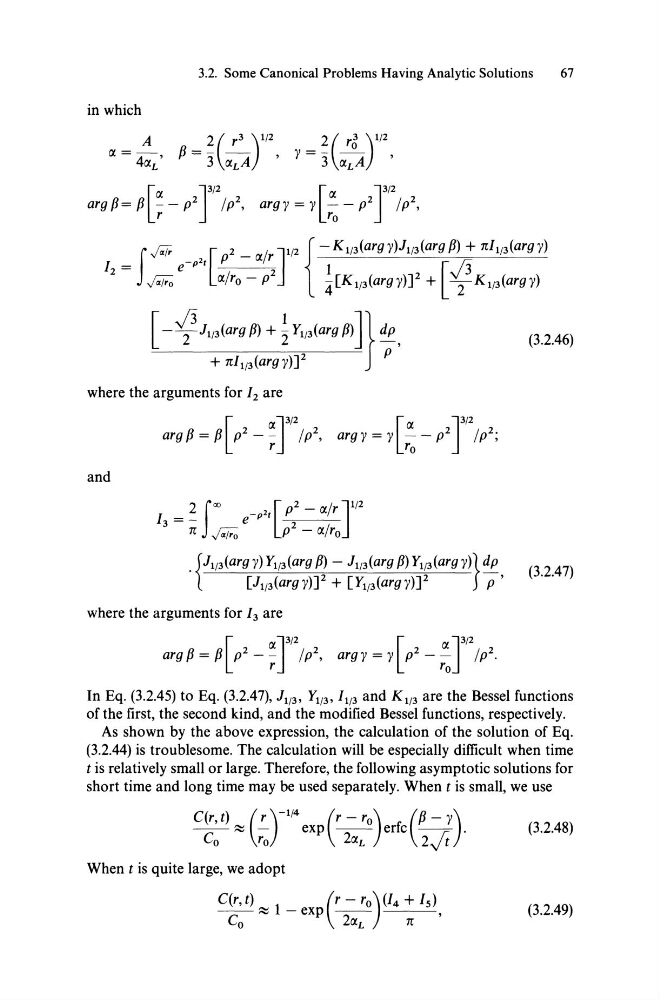
in which
where the arguments for 1 2 are
arg ß = ß[p2 - ~ J/2/ p2 , argy = y[~ - p2 J/2/ p2 ;
and
where the arguments for 1 3 are
arg ß = ß[p2 - ~ J/2/ p2 , argy = y[p2 - ~J/2/p2.
In Eq. (3.2.45) to Eq. (3.2.47), J1/3 , Y1/ 3 , 11/3 and K 1/3 are the Bessel functions
of the first, the second kind, and the modified Bessel functions, respectively.
As shown by the above expression, the calculation of the solution of Eq.
(3.2.44) is troublesome. The calculation will be especially difficult when time
t is relatively small or large. Therefore, the following asymptotie solutions for
short time and long time may be used separately. When t is small, we use
C(r, t) ~ (~)-1/4 exp (r - ro) erfe (ß - y).
Co
ro
2IXL
20
(3.2.48)
When t is quite large, we adopt
C(r, t) ~ 1 _ exp (r - ro)(14 + 1 5 ),
CO
2IXL
1t
(3.2.49)
67
in which
where the arguments for 1 2 are
arg ß = ß[p2 - ~ J/2/ p2 , argy = y[~ - p2 J/2/ p2 ;
and
where the arguments for 1 3 are
arg ß = ß[p2 - ~ J/2/ p2 , argy = y[p2 - ~J/2/p2.
In Eq. (3.2.45) to Eq. (3.2.47), J1/3 , Y1/ 3 , 11/3 and K 1/3 are the Bessel functions
of the first, the second kind, and the modified Bessel functions, respectively.
As shown by the above expression, the calculation of the solution of Eq.
(3.2.44) is troublesome. The calculation will be especially difficult when time
t is relatively small or large. Therefore, the following asymptotie solutions for
short time and long time may be used separately. When t is small, we use
C(r, t) ~ (~)-1/4 exp (r - ro) erfe (ß - y).
Co
ro
2IXL
20
(3.2.48)
When t is quite large, we adopt
C(r, t) ~ 1 _ exp (r - ro)(14 + 1 5 ),
CO
2IXL
1t
(3.2.49)