

66
3. Analytic Solutions of Hydrodynamic Dispersion Equations
and obtained associated analytical solutions. In their model, both horizontal
and vertical flows are taken into account. First-order reaction and retardation effects are also considered.
3.2.3 Radial Dispersion Problems
Problem 6. Radial Dispersion of a Tracer in an Aquifer with No Natural
Groundwater Velocity
It is assumed that there is a fuHy penetrating weH with radius ro in a confined
aquifer, which is horizontal, of constant thickness, infinite extent, homogeneous, and isotropic. Water with tracer concentration Co is continuously
injected at constant rate Q into the weH. A nearly steady two-dimensional
radial flow will be formed very soon around the weH when no natural flow
exists. Meanwhile, the flux passing through any circle centered around the
weH and with an arbitrary radius r is
oh
2nKBr or = - Q,
where K is the hydraulic conductivity, and B is the thickness of the aquifer.
Based on this equation and Darcy's law, the average velocity is
q
K oh
Q
A
V(r)=-= - - - = - - = -
n
n or 2nBnr r '
(3.2.42)
where A = - 2
Q . Substituting Eq. (3.2.42) into Eq. (2.6.12), the mathematical
nBn
model of this problem is obtained as foHows:
OC (XLA 02C A OC
at = -r- or2 - rar'
C(r,O) = 0,
C(r o , t) = Co, t > 0,
C(oo, t) = 0, t> 0.
(3.2.43)
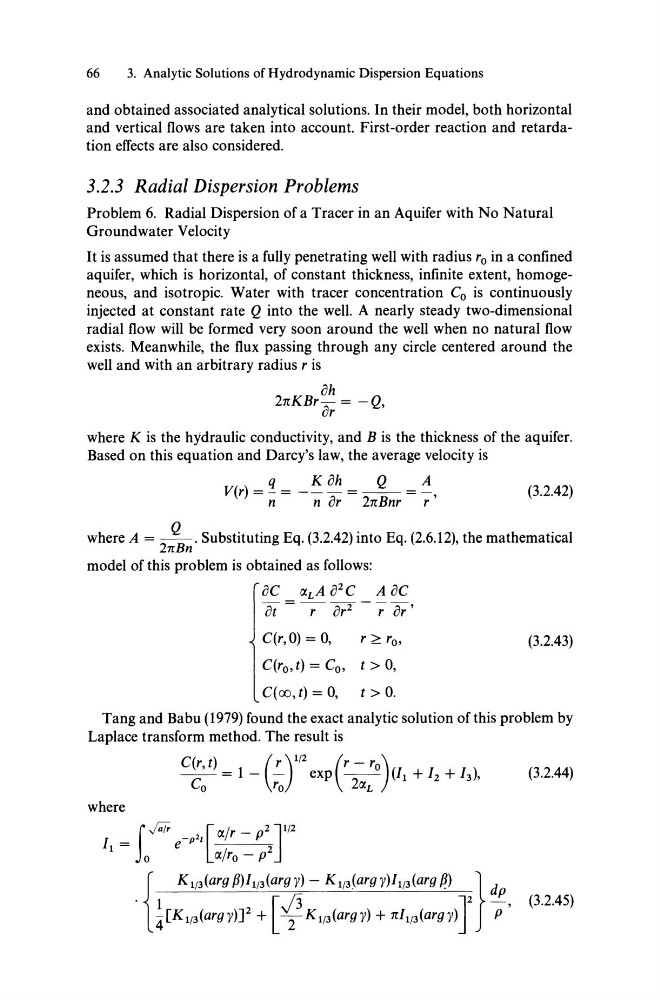
Tang and Babu (1979) found the exact analytic solution ofthis problem by
Laplace transform method. The result is
C(r, t)
(r )1/2 (r - ro)
- - = 1 - -
exp -2- (/1 + 12 + 13 ),
Co
ro
(XL
(3.2.44)
3. Analytic Solutions of Hydrodynamic Dispersion Equations
and obtained associated analytical solutions. In their model, both horizontal
and vertical flows are taken into account. First-order reaction and retardation effects are also considered.
3.2.3 Radial Dispersion Problems
Problem 6. Radial Dispersion of a Tracer in an Aquifer with No Natural
Groundwater Velocity
It is assumed that there is a fuHy penetrating weH with radius ro in a confined
aquifer, which is horizontal, of constant thickness, infinite extent, homogeneous, and isotropic. Water with tracer concentration Co is continuously
injected at constant rate Q into the weH. A nearly steady two-dimensional
radial flow will be formed very soon around the weH when no natural flow
exists. Meanwhile, the flux passing through any circle centered around the
weH and with an arbitrary radius r is
oh
2nKBr or = - Q,
where K is the hydraulic conductivity, and B is the thickness of the aquifer.
Based on this equation and Darcy's law, the average velocity is
q
K oh
Q
A
V(r)=-= - - - = - - = -
n
n or 2nBnr r '
(3.2.42)
where A = - 2
Q . Substituting Eq. (3.2.42) into Eq. (2.6.12), the mathematical
nBn
model of this problem is obtained as foHows:
OC (XLA 02C A OC
at = -r- or2 - rar'
C(r,O) = 0,
C(r o , t) = Co, t > 0,
C(oo, t) = 0, t> 0.
(3.2.43)
Tang and Babu (1979) found the exact analytic solution ofthis problem by
Laplace transform method. The result is
C(r, t)
(r )1/2 (r - ro)
- - = 1 - -
exp -2- (/1 + 12 + 13 ),
Co
ro
(XL
(3.2.44)