

3.2. Some Canonical Problems Having Analytic Solutions
65
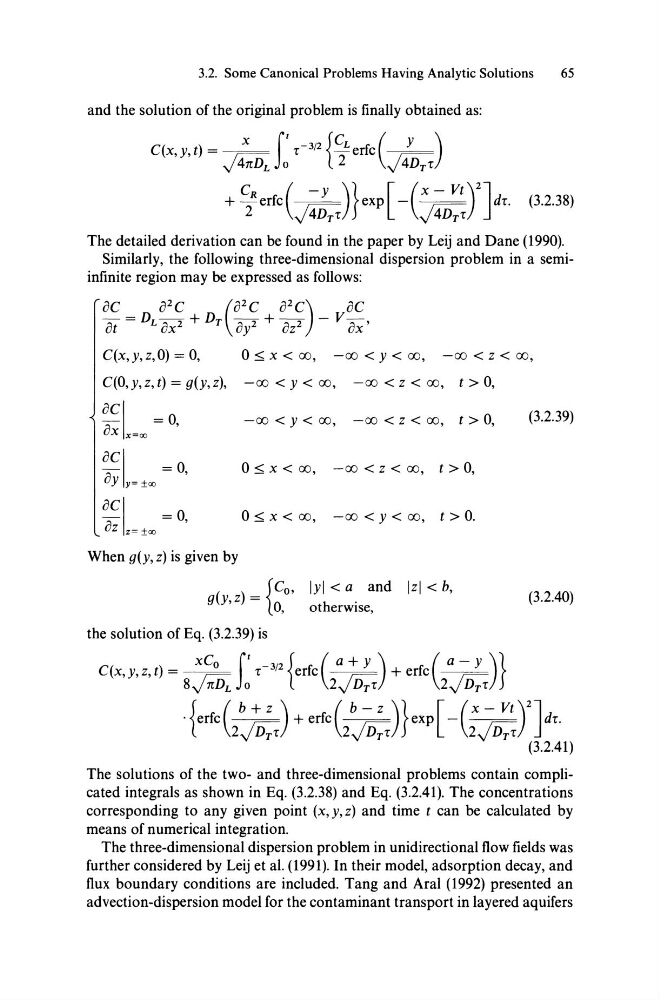
and the solution of the original problem is finally obtained as:
C(x,y,t) = k f' r:- 3 / 2 {~Lerfe(k)
4nD L 0
4D T r:
+ ~R erfe (~) } exp [ - (~r] dr:. (3.2.38)
The detailed derivation ean be found in the paper by Leij and Dane (1990).
Similarly, the following three-dimensional dispersion problem in a semiinfinite region may be expressed as follows:
oC
02C
(02C 02C)
oC
at = DL ox2 + DT oy2 + OZ2 - V ox'
C(x,y,z,O) = 0,
° ~ x < 00, -00 < y < 00, -00 < Z < 00,
C(O,y,z,t) = g(y,z), -00 < y < 00, -00 < Z < 00, t > 0,
OC!
=0
ox x=oo
'
-00 < y < 00, -00 < Z < 00, t > 0,
OC!
=0
oy y= ±oo
'
° ~ x < 00, -00 < Z < 00, t > 0,
OC!
= °
oz z= ±oo
'
° ~ x < 00, -00 < y < 00, t > 0.
When g(y, z) is given by
{
Co,
g(y,z) = 0,
the solution of Eq. (3.2.39) is
lyl < a and Izi < b,
otherwise,
xC o f' { (a + y ) ( a - y )}
C(x, y, Z, t) = fiD;. r:- 3 / 2 erfe .jii;c + erfe .jii;c
8 nDL 0
2 DTr:
2 DTr:
(3.2.39)
(3.2.40)
{
( b + Z )
( b - z )} [(x - Vt)2]
. erfe 2.jii;c + erfe 2.jii;c exp - 2.jii;c dt.
(3.2.41)
The solutions of the two- and three-dimensional problems eontain eomplieated integrals as shown in Eq. (3.2.38) and Eq. (3.2.41). The eoneentrations
eorresponding to any given point (x, y, z) and time t ean be ealculated by
means of numerieal integration.
The three-dimensional dispersion problem in unidireetional flow fields was
further eonsidered by Leij et al. (1991). In their model, adsorption deeay, and
flux boundary eonditions are included. Tang and Aral (1992) presented an
adveetion-dispersion model for the eontaminant transport in layered aquifers
65
and the solution of the original problem is finally obtained as:
C(x,y,t) = k f' r:- 3 / 2 {~Lerfe(k)
4nD L 0
4D T r:
+ ~R erfe (~) } exp [ - (~r] dr:. (3.2.38)
The detailed derivation ean be found in the paper by Leij and Dane (1990).
Similarly, the following three-dimensional dispersion problem in a semiinfinite region may be expressed as follows:
oC
02C
(02C 02C)
oC
at = DL ox2 + DT oy2 + OZ2 - V ox'
C(x,y,z,O) = 0,
° ~ x < 00, -00 < y < 00, -00 < Z < 00,
C(O,y,z,t) = g(y,z), -00 < y < 00, -00 < Z < 00, t > 0,
OC!
=0
ox x=oo
'
-00 < y < 00, -00 < Z < 00, t > 0,
OC!
=0
oy y= ±oo
'
° ~ x < 00, -00 < Z < 00, t > 0,
OC!
= °
oz z= ±oo
'
° ~ x < 00, -00 < y < 00, t > 0.
When g(y, z) is given by
{
Co,
g(y,z) = 0,
the solution of Eq. (3.2.39) is
lyl < a and Izi < b,
otherwise,
xC o f' { (a + y ) ( a - y )}
C(x, y, Z, t) = fiD;. r:- 3 / 2 erfe .jii;c + erfe .jii;c
8 nDL 0
2 DTr:
2 DTr:
(3.2.39)
(3.2.40)
{
( b + Z )
( b - z )} [(x - Vt)2]
. erfe 2.jii;c + erfe 2.jii;c exp - 2.jii;c dt.
(3.2.41)
The solutions of the two- and three-dimensional problems eontain eomplieated integrals as shown in Eq. (3.2.38) and Eq. (3.2.41). The eoneentrations
eorresponding to any given point (x, y, z) and time t ean be ealculated by
means of numerieal integration.
The three-dimensional dispersion problem in unidireetional flow fields was
further eonsidered by Leij et al. (1991). In their model, adsorption deeay, and
flux boundary eonditions are included. Tang and Aral (1992) presented an
adveetion-dispersion model for the eontaminant transport in layered aquifers